
You are reading Virgil’s Aeneid — or perhaps Ovid’s Metamorphoses, or Milton’s Paradise Lost, or Keats’s odes, or Shelley’s Prometheus Unbound — and a name appears that stops you.
Jupiter. Or Juno. Or Mercury. Or Venus. Or Saturn. Or perhaps the Greek equivalent — Zeus, Hera, Hermes, Aphrodite, Kronos — because English literature uses both Roman and Greek names, sometimes interchangeably, sometimes deliberately, always with assumptions about what the reader already knows.
And if you don’t already know — if you weren’t raised on these stories, if your schooling didn’t cover classical mythology, if you come to English Honours from a tradition where these names are not household words — you find yourself at a disadvantage that nobody quite acknowledges.
Because the classical gods are everywhere in English literature. Not just in texts that are explicitly classical — not just in Milton or Virgil or Keats’s Lamia. They are in Shakespeare’s plays, in Victorian poetry, in Romantic odes, in the symbolism and imagery and allusion of texts across every period we have discussed in this series.
Without knowing who Jupiter is, you cannot fully understand why Milton’s Satan is described in certain terms. Without knowing who Venus is, you cannot fully understand the imagery of Shakespeare’s sonnets. Without knowing who Prometheus is, you cannot fully understand Shelley’s greatest poem or Mary Shelley’s Frankenstein or the entire Romantic tradition of the rebel against divine authority.
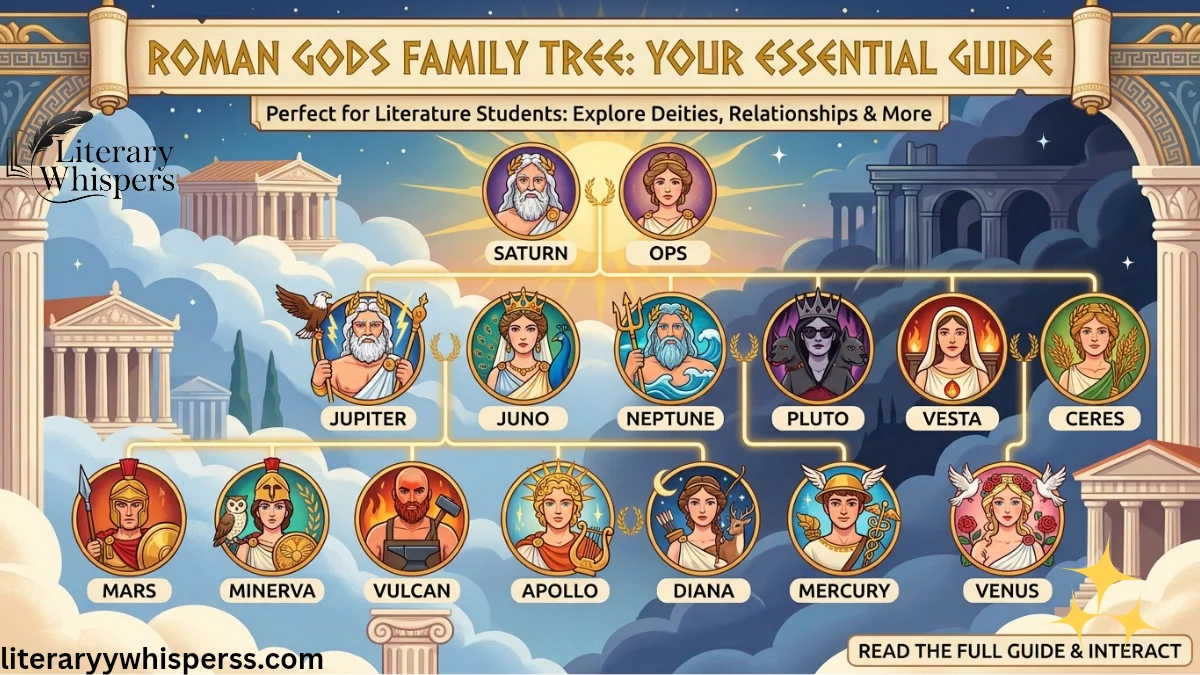
This post (The Complete Family Tree of Roman Gods: An Essential Guide for Literature Students) gives you everything you need.
The complete family tree of the Roman gods — with their Greek equivalents, their domains, their symbols, their stories, and most importantly, their significance for English literature. Organised clearly, explained accessibly, cross-referenced throughout.
This is the classical mythology guide that English literature students actually need.
Make sure you check this out The Complete Family Tree of Greek Gods.
Before We Begin: Roman vs Greek Names
English literature uses both Roman and Greek names for the classical gods, and the choice is never arbitrary.
Roman names are used when the text is engaging with the Roman tradition specifically — with Virgil, with Ovid, with Roman history, with the Roman Empire and its culture. Latin texts use Latin names.
Greek names are used when the text is engaging with the Greek tradition specifically — with Homer, with Hesiod, with Greek tragedy, with the Greek philosophical tradition.
The Romantic poets tend to use Greek names: Keats writes about Hyperion, Prometheus, Apollo — Greek figures. This is deliberate: the Romantics identified with Greece rather than Rome, with democratic Athens rather than imperial Rome, with the original rather than the copy.
Milton uses both: Paradise Lost has Latin texture (Satan as a classical hero) but draws on the full classical tradition.
Rule of thumb: When you encounter a classical name in English literature, check both the Roman and Greek versions. The choice often tells you something about the text’s relationship to the classical tradition.
Here is the essential correspondence table:
| Roman Name | Greek Name | Domain |
|---|---|---|
| Jupiter (Jove) | Zeus | King of gods, sky, thunder, justice |
| Juno | Hera | Queen of gods, marriage, women |
| Neptune | Poseidon | Sea, earthquakes, horses |
| Pluto (Dis) | Hades | Underworld, death, wealth |
| Apollo | Apollo | Sun, light, music, poetry, prophecy, healing |
| Diana | Artemis | Moon, hunting, chastity, wilderness |
| Mars | Ares | War, violence, courage |
| Venus | Aphrodite | Love, beauty, desire, fertility |
| Mercury | Hermes | Messenger of gods, travel, commerce, thieves |
| Minerva | Athena | Wisdom, craft, war strategy |
| Vulcan | Hephaestus | Fire, forge, metalwork, craftsmen |
| Ceres | Demeter | Harvest, grain, agriculture |
| Bacchus (Dionysus) | Dionysus | Wine, ecstasy, theatre, fertility |
| Janus | — | Beginnings, doorways, time (Roman only) |
| Saturn | Kronos | Time, harvest, agriculture (father of Jupiter) |
| Cupid | Eros | Love, desire |
| Proserpina | Persephone | Underworld, spring, death, rebirth |
| Aurora | Eos | Dawn |
| Luna | Selene | Moon (distinct from Diana in some traditions) |
| Sol | Helios | Sun (distinct from Apollo in some traditions) |
Deep Insight:
Apollo is the one major deity who uses the same name in both Greek and Roman tradition — he is simply Apollo in both. This reflects his importance to both cultures and the way the Romans adopted the Greek Apollo wholesale rather than translating him. In literature, Apollo’s name always carries the full weight of both traditions simultaneously.
Part One: The Primordial Beginnings — Before the Gods
The Chaos Before Creation
Roman mythology, drawing heavily on Hesiod’s Greek Theogony, begins before the gods — before even the universe had form.
Chaos — not the modern sense of disorder, but the primordial void, the original state of formless existence from which everything emerged. In Ovid’s Metamorphoses — the single most important source of classical mythology for English literature — the world begins as:
“A rough, unordered mass of things, nothing at all / Save lifeless bulk and warring seeds of ill-matched elements”
From Chaos emerged the first generation of cosmic forces — not gods with personalities but elemental realities:
Gaia / Terra — the Earth itself, the foundation of all existence Tartarus — the deepest abyss, below even the Underworld Eros / Amor / Cupid — primordial love as a cosmic force (distinct from the later Cupid, son of Venus) Nyx / Nox — Night Erebus — Darkness
These are not characters in the way that Jupiter or Venus are characters. They are the conditions of existence — the framework within which the gods and their stories operate.
For literature students: Understanding Chaos as creative void rather than disorder is important for reading Milton’s Paradise Lost and any text that uses creation mythology. When Keats writes of “unheard melodies,” when Shelley writes of the “unborn” — they are drawing on this tradition of the creative void that precedes form.
The Titans — The First Generation of Gods
From Gaia (Earth) and Uranus (Sky) were born the Titans — a first generation of divine beings who ruled before Jupiter and the Olympian gods.
The twelve original Titans:
Saturn (Kronos) — the most important Titan for literature. He castrated his father Uranus, ruled the universe, and swallowed his own children (fearing one would overthrow him) until Jupiter forced him to disgorge them. He rules the Golden Age — the mythological period of perfect human happiness before the current era. He gives his name to Saturday and is associated with time, harvest, and the irreversible passage of things. Goya’s Saturn Devouring His Son is the most famous image of him.
Rhea (Ops) — Saturn’s wife and sister. She hid Jupiter from Saturn by wrapping a stone in swaddling and presenting it to be swallowed. She protected her children.
Oceanus — the Titan who is the great river encircling the world. In many ancient texts, all rivers derive from Oceanus.
Tethys — Oceanus’s wife, mother of the river gods and sea nymphs.
Hyperion — Titan of light; father of the Sun (Sol/Helios), the Moon (Luna/Selene), and the Dawn (Aurora/Eos). Keats’s unfinished poem Hyperion depicts him as the dethroned king of light, overcome by Apollo. This succession — Hyperion overthrown by Apollo — represents the transition from Titan to Olympian rule.
Themis — Titan of divine law, justice, and order. Mother of the Fates (Moirae) and the Seasons (Horae).
Mnemosyne — Titan of memory. Mother, by Jupiter, of the nine Muses. Memory as the mother of the arts — this is one of the most important mythological genealogies for understanding why classical culture placed memory at the centre of creative achievement.
Prometheus — the most important Titan for English literature. He stole fire from the gods and gave it to humanity, for which he was punished by Jupiter: chained to a rock, his liver eaten daily by an eagle, only to regenerate nightly.
Prometheus is the great symbol of the rebel against divine authority — of the figure who steals divine knowledge for human benefit and suffers the consequences. He appears in Shelley’s Prometheus Unbound (where he is the hero who refuses to capitulate), in Mary Shelley’s Frankenstein (subtitled The Modern Prometheus — Frankenstein gives life but destroys what he creates), in Byron’s poetry, and throughout the Romantic tradition as the archetype of the suffering creative visionary.
Atlas — the Titan condemned to hold up the sky (often depicted as holding the world) as punishment for fighting against Jupiter in the Titanomachy.
Epimetheus — Prometheus’s brother, whose name means “hindsight” (Prometheus means “forethought”). He was given Pandora as a wife by Jupiter, and she opened the box (originally a jar) releasing all evils into the world.
The Cyclopes and the Hundred-Handed Ones — also children of Uranus and Gaia, not Titans but related beings. The Cyclopes forged Jupiter’s thunderbolts.
Part Two: The Olympians — The Twelve Great Gods
After the Titanomachy — the war in which Jupiter and his siblings overthrew the Titans — the Olympian gods established their rule on Mount Olympus. These are the gods most frequently encountered in English literature.
Jupiter (Zeus) — King of the Gods
Domain: Sky, thunder, lightning, justice, law, order, hospitality
Symbols: Thunderbolt, eagle, oak tree, sceptre
Parents: Saturn and Rhea
Siblings: Juno, Neptune, Pluto, Ceres, Vesta
Consort: Juno (Hera) — official wife, though he had countless affairs
Children by Juno: Mars, Vulcan, Hebe Children by others: Apollo, Diana, Mercury, Minerva (from his head), Bacchus, Hercules, Helen of Troy, Perseus, Minos, and many more
The mythology:
Jupiter is the ruler of Olympus — the most powerful of the gods, but not omnipotent. He is subject to fate (the Fates, or Parcae, exist above even Jupiter’s authority). He settles disputes between gods, enforces divine law, and punishes mortals who violate hospitality or oaths.
His personal life is a catalogue of transformations and seductions: he becomes a bull to carry off Europa, a swan to seduce Leda (producing Helen of Troy), a shower of gold to reach Danaë, a cloud to take Io. These transformations are not just stories about divine promiscuity — they explore the relationship between divine power and mortal vulnerability, between the god who can be anything and the human who cannot refuse.
Jupiter in English literature:
In Paradise Lost, Milton draws on Jupiter’s authority and power to suggest the parallel and contrast with the Christian God — Satan’s rebellion parallels the Titans’ war against Jupiter, but Milton’s God has absolute moral authority where Jupiter is morally ambiguous.
In Shakespeare’s plays, characters swear by Jove — “By Jove!” — as the highest available oath.
In the Romantic period, Jupiter becomes associated with tyranny — the divine authority that Prometheus defied and Shelley’s poetry seeks to overthrow.
The “jovial” personality — generous, good-humoured, expansive — derives from Jupiter’s association with the planet Jupiter in astrology, which was believed to produce these qualities.
Juno (Hera) — Queen of the Gods
Domain: Marriage, women, childbirth, family, the heavens
Symbols: Peacock, pomegranate, diadem, sceptre, cow
Parents: Saturn and Rhea
Consort: Jupiter (her brother and husband)
Children: Mars, Vulcan, Hebe, Eileithyia (goddess of childbirth)
The mythology:
Juno is the goddess of marriage and the protector of women — but her own marriage is notoriously unhappy. Jupiter’s constant infidelities are the source of much classical mythology, and Juno’s responses to them — her persecution of Jupiter’s lovers and illegitimate children — give her a reputation for jealousy and vindictiveness that her position as the goddess of marriage makes ironic.
She persecutes Io (transformed into a cow), Hercules (sending the madness that makes him kill his children), and most famously, she is the primary divine antagonist of the entire Aeneid — it is Juno’s anger that drives Aeneas from Troy, causes him to linger in Carthage, and makes his journey to Italy as difficult as possible.
The peacock is her symbol because the peacock’s tail feathers contain the “eyes” of Argus — the hundred-eyed giant she set to guard Io, who was killed by Mercury.
Juno in English literature:
In the Aeneid, Juno is the force of opposition — the divine will working against the hero’s ordained destiny. Understanding her role is essential for understanding the epic’s structure.
In Shakespeare’s The Tempest, Juno appears in the betrothal masque as the goddess of sovereignty and marriage — a blessing figure rather than a threatening one.
In Spenser’s The Faerie Queene, Juno appears as one of the allegorical models for royal female power.
Neptune (Poseidon) — God of the Sea
Domain: Sea, storms, earthquakes, horses
Symbols: Trident, dolphin, horse, bull
Parents: Saturn and Rhea
Consort: Amphitrite (a sea nymph)
Notable children: Triton, Polyphemus (the Cyclops), Theseus (claimed as father)
The mythology:
When the three brothers — Jupiter, Neptune, and Pluto — divided the world after the Titanomachy, Neptune received the sea. He is the god of all water — oceans, rivers, springs — and of the forces that move the earth itself (earthquakes).
His relationship with horses is important: he is sometimes described as the creator of the horse, and he and Minerva competed for the patronage of Athens — he struck the earth with his trident to produce a saltwater spring, she produced an olive tree, and the Athenians chose her gift.
His anger is terrifying: he raised the storm that scattered Odysseus’s fleet, and his grudge against Odysseus (for blinding his son Polyphemus) is one of the driving forces of Homer’s Odyssey.
Neptune in English literature:
In The Tempest, Prospero controls winds and seas through his magic — invoking Neptune’s domain.
In Milton’s Lycidas — the great elegy — Neptune is invoked in the meditation on death at sea.
Milton’s “Comus” mentions Neptune as the lord of waters.
Tennyson’s Ulysses — “to sail beyond the sunset” — invokes the Neptunian world of ocean as the space of final adventure.
Pluto (Hades / Dis) — God of the Underworld
Domain: The Underworld, the dead, wealth (Dis means “rich” — the earth yields both death and mineral wealth)
Symbols: Bident (two-pronged staff), helm of invisibility, Cerberus, cypress, narcissus
Parents: Saturn and Rhea
Consort: Proserpina (Persephone)
The mythology:
Pluto received the Underworld when the three brothers divided the world. Unlike later conceptions of Hell, the classical Underworld (often called Hades, using the god’s name for his realm) is not a place of punishment for ordinary mortals — it is simply the realm of the dead, a shadow world where all souls go.
Its geography: the river Styx (over which the ferryman Charon carries souls), the Elysian Fields (paradise for heroes and the virtuous), Tartarus (punishment for the wicked), and the Asphodel Meadows (where ordinary souls wander).
The most important story: Pluto falls in love with Proserpina (Persephone), daughter of Ceres (the harvest goddess), and abducts her to the Underworld. Ceres’s grief causes the earth to stop producing — winter. Jupiter negotiates: Proserpina will spend part of the year with Pluto and part with Ceres. This is the mythological explanation of the seasons — winter is Ceres’s grief while Proserpina is in the Underworld.
Pluto in English literature:
The Underworld is one of the most persistent settings in literature — from Virgil’s Aeneid Book VI (Aeneas’s descent) to Dante’s Inferno (which draws on the classical Underworld even in a Christian framework) to Milton’s Hell (a transformed version of classical Tartarus) to the many literary descents to the underworld (katabasis) across the tradition.
Proserpina’s story — the cycle of death and rebirth, the seasons as mythological narrative — appears everywhere in Romantic poetry: Keats’s Ode to Autumn, Shelley’s imagery of death and renewal.
You can also explore The Most Misunderstood Characters in English Literature.
Apollo — God of the Sun, Poetry, Music, and Prophecy
Domain: Sun and light, music, poetry, art, prophecy, truth, archery, plague, healing, the oracle at Delphi
Symbols: Lyre, laurel wreath, bow and arrow, raven, dolphin
Parents: Jupiter and Leto (a Titaness)
Twin: Diana (Artemis)
The mythology:
Apollo is the most complex and most multifaceted of the Olympians — a god of light and truth, but also of plague and sudden death; a god of music and poetry, but also a hunter; a god of prophecy who spoke through the Oracle at Delphi, but whose prophecies were often fulfilled in terrible ways.
His lovers: Daphne (who became a laurel tree rather than submit to him), Hyacinthus (accidentally killed by Apollo; hyacinths grew from his blood), Cassandra (to whom he gave the gift of prophecy but cursed her so no one would believe her).
Apollo is the god of the rational, the ordered, the beautiful, the controlled — Friedrich Nietzsche contrasted the “Apollonian” (order, reason, beauty) with the “Dionysian” (chaos, ecstasy, abandon) as the two creative principles of culture.
Apollo in English literature:
This is where Apollo’s importance is immeasurable. He is the patron god of poetry — when poets invoke the Muses, they invoke the forces under Apollo’s authority.
Keats’s Hyperion fragments trace Apollo’s emergence as the new god of poetry and light, overthrowing the Titan Hyperion. Apollo’s assumption of divine power is, for Keats, the story of how genuine poetry (felt, mortal, aware of pain) overcomes mere brilliance (powerful, immortal, feeling nothing).
The laurel wreath given to Apollo by Daphne became the crown of poets and victors — the “laureate” tradition of English literature derives directly from Apollo’s laurel.
Milton invokes Apollo in Lycidas: “O fountain Arethuse, and thou honoured flood / Smooth-sliding Mincius, crowned with vocal reeds.”
Shakespeare’s Sonnet 18 (“Shall I compare thee to a summer’s day?”) engages with Apollonian traditions of beauty and permanence.
Diana (Artemis) — Goddess of the Hunt and Moon
Domain: Hunt, wilderness, moon, chastity, childbirth (paradoxically), protection of young girls, wild animals
Symbols: Bow and arrows, crescent moon, deer, cypress
Parents: Jupiter and Leto
Twin: Apollo
The mythology:
Diana is the virgin goddess — she swore never to marry, and she protects her chastity and that of her nymphs with lethal force. The hunter Actaeon accidentally saw her bathing and she transformed him into a stag, which was then torn apart by his own hounds.
She is the goddess of the moon but distinct in some traditions from Luna (the moon itself as a deity) — Diana is the divine hunter who is associated with the moon’s light and hunting by night.
She is paradoxically also associated with childbirth — she helped her mother Leto give birth to Apollo after her own painless birth, and she protects women in labour. The virgin goddess of childbirth: another example of classical mythology’s comfort with contradiction.
Diana in English literature:
Diana is invoked in countless texts as the symbol of chastity and the virgin ideal. In Shakespeare’s A Midsummer Night’s Dream, Theseus warns Hermia that choosing to remain single means “chanting faint hymns to the cold fruitless moon” — Diana as the goddess of the unsatisfied, chaste, loveless life.
In Spenser’s The Faerie Queene, Belphoebe is modelled on Diana — the huntress figure who represents chastity as a positive ideal.
Keats’s Endymion is based on the myth of Diana falling in love with a sleeping shepherd — the goddess who preserves his beauty eternally by keeping him always asleep.
Mars (Ares) — God of War
Domain: War, battle, courage, military honour
Symbols: Spear, shield, helmet, wolf, woodpecker
Parents: Jupiter and Juno
Lover: Venus (Aphrodite)
Notable children: Romulus and Remus (by a Vestal Virgin — making Mars the divine ancestor of Rome)
The mythology:
Mars is the father of the Roman people — Romulus, founder of Rome, was his son. This makes Mars not merely the god of war but the divine ancestor of Roman civilisation, which gives him a dignity in Roman culture that the Greek Ares (who is simply war’s violence and chaos) does not possess.
His affair with Venus is one of the most famous stories in mythology: Vulcan, Venus’s husband, forged a net so fine it was invisible, draped it over the bed, and caught the lovers there — then summoned all the gods to witness their embarrassment.
Tuesday is named for Mars (via the Norse god Tyr, his Germanic equivalent) — “Mars-day” became “Tuesday” in English.
Mars in English literature:
In Shakespeare’s Henry V and other history plays, Mars is invoked as the god of English military honour: “O for a Muse of fire, that would ascend / The brightest heaven of invention, / A kingdom for a stage, princes to act / And monarchs to behold the swelling scene!”
Milton’s Satan has Martian qualities — the fallen general, the military commander, the hero of war displaced from his proper sphere.
The “martial” — from Mars — describes anything military, a derivation that enters English directly from the god’s name.
Venus (Aphrodite) — Goddess of Love and Beauty
Domain: Love, beauty, desire, fertility, pleasure, victory
Symbols: Dove, sparrow, myrtle, rose, apple, shell, mirror
Parents: Born from the sea foam around the severed genitals of Uranus (in Hesiod’s version) — or Jupiter and the Titaness Dione (in Homer’s version)
Consort (official): Vulcan (Hephaestus), the lame blacksmith
Lover: Mars, Adonis, Anchises (father of Aeneas)
Children: Cupid (Eros), Aeneas (by Anchises — making Venus the divine ancestress of the Roman people through a different lineage from Mars)
The mythology:
Venus is born from the sea — Botticelli’s painting of this birth is one of the most famous images in Western art. She is irresistible — even the other gods fall under her influence — and she uses this power freely and sometimes destructively.
The Judgement of Paris: the Trojan prince Paris was asked to judge which goddess was most beautiful — Venus, Juno, or Minerva. Each offered a bribe; Venus offered Helen, the most beautiful woman in the world. Paris chose Venus, claimed Helen, and began the Trojan War.
Adonis: Venus falls in love with the beautiful mortal Adonis, who is killed by a boar while hunting. Anemones (or roses, in some versions) spring from his blood. The Adonis myth is one of the great classical stories of love, mortality, and the pain of beauty that cannot last.
Venus in English literature:
Shakespeare’s poem Venus and Adonis (1593) — his first published work — retells the Adonis story with Venus as the aggressor and Adonis as the reluctant beloved. It was enormously popular and established Shakespeare’s literary reputation.
In Spenser’s The Faerie Queene, the garden of Venus is one of the great allegorical gardens — a place of beauty and fertility but also of dangerous pleasure.
The word “venereal” (now primarily medical) originally meant “of Venus” — of love, of desire. “Veneration” similarly derives from Venus — to venerate is to love or worship.
Keats’s Ode on a Grecian Urn — “Beauty is truth, truth beauty” — engages with the Apollonian and Venusian traditions of beauty as divine truth.
Mercury (Hermes) — Messenger of the Gods
Domain: Messengers, travel, commerce, thieves, boundaries, luck, language, writing, guide of souls to the Underworld
Symbols: Caduceus (winged staff entwined by serpents), winged sandals, winged helmet, tortoise
Parents: Jupiter and the nymph Maia
The mythology:
Mercury is the most active and most clever of the Olympians — the god who moves between all worlds (Olympus, Earth, and the Underworld), who serves as the messenger between divine and mortal realms, and who is the patron of all activities that involve movement, exchange, and communication.
He invented the lyre — on the day he was born, he stole Apollo’s cattle, invented the lyre from a tortoise shell, and traded it to Apollo in exchange for the caduceus and the golden shepherd’s staff.
As psychopomp — guide of souls — he leads the dead to the Underworld. This makes him unique among the Olympians: he has free passage between life and death, between divine and mortal realms, between all boundaries.
The caduceus — two serpents entwined around a winged staff — is often confused with the Rod of Asclepius (one serpent, used as a medical symbol). The caduceus is Mercury’s staff; its association with medicine is an error but a persistent one.
Wednesday is named for Mercury (via the Norse god Woden/Odin, his Germanic equivalent) — “Mercury-day” became “Wednesday.”
Mercury in English literature:
In Shakespeare, Mercury frequently appears as the image of swiftness and eloquence: “winged Mercury,” “swift as Mercury.”
In Paradise Lost, Raphael’s descent to Eden draws on the tradition of divine messengers like Mercury.
The “mercurial” personality — quick, changeable, clever, unpredictable — derives directly from Mercury’s qualities.
Minerva (Athena) — Goddess of Wisdom and War Strategy
Domain: Wisdom, strategy, craft, reason, weaving, the arts, civilisation, Athens
Symbols: Owl, olive tree, armour, shield (aegis), spear, helmet
Parents: Jupiter alone — she sprang fully armed from his head after he swallowed her pregnant mother Metis
The mythology:
Minerva’s birth is one of the most vivid in classical mythology: Jupiter, warned that any child of Metis would surpass him, swallowed Metis whole. He developed a terrible headache. Vulcan split open his head with an axe, and Minerva emerged fully grown and fully armed, crying her war cry.
She is the goddess of wisdom — but specifically of practical wisdom, of intelligence applied to craft and strategy. She is not the god of abstract philosophy (that belongs more to Apollo) but of skill, of making, of winning wars through superior planning rather than brute force.
The contest with Neptune for Athens: she produced an olive tree; Neptune produced a saltwater spring. Athens chose the olive — symbol of peace, agriculture, and civilisation.
The contest with Arachne: the mortal weaver Arachne challenged Minerva’s skill. Minerva wove a tapestry of the gods in their glory; Arachne wove one showing the gods’ crimes and seductions. Minerva destroyed it — and transformed Arachne into a spider (in Ovid’s telling).
Minerva in English literature:
The owl — Minerva’s symbol — has become the universal symbol of wisdom in Western culture. The “wise owl” of children’s literature, of university emblems, of countless cultural images: all ultimately derive from Minerva’s owl.
Spenser’s The Faerie Queene uses Minerva as a model for intellectual and moral virtue.
The British Empire and the Victorian period frequently invoked Minerva as the goddess of civilised progress — the wisdom that (supposedly) distinguished imperial enterprise from barbarism. This invocation is now read critically as ideological cover for colonial violence.
This is a must-read The Hidden Meanings Behind Famous Literary Symbols.
Vulcan (Hephaestus) — God of Fire and the Forge
Domain: Fire, forge, metalwork, craftsmen, volcanoes
Symbols: Hammer, anvil, tongs, fire
Parents: Jupiter and Juno — or Juno alone (she bore him without Jupiter’s involvement as revenge for his solo production of Minerva)
Consort: Venus
The mythology:
Vulcan is the lame god — he was thrown from Olympus (either by Jupiter in anger or by Juno in disgust at his ugliness at birth) and his lameness resulted from the fall. This makes him the only Olympian with a physical disability, and his exclusion from physical beauty places him in interesting contrast to the other gods.
His forge is located beneath volcanoes — particularly Etna in Sicily. He creates the most extraordinary objects in mythology: Jupiter’s thunderbolts, Achilles’s armour, the net that caught Venus and Mars, Pandora herself (at Jupiter’s command, fashioned as a punishment for humanity).
Despite his ugliness and lameness, Vulcan is married to Venus — the most beautiful goddess. The marriage of Vulcan and Venus is a recurring symbol of the union of craft and beauty, of the making of beautiful things through labour rather than through natural grace.
Vulcan in English literature:
The “volcanic” — fiery, explosive, sudden — derives from Vulcan’s name.
In Paradise Lost, the building of Pandaemonium (Satan’s palace in Hell) is compared to Vulcan’s forge — Mulciber (another name for Vulcan) falling from heaven parallels Satan’s fall.
Shakespeare’s Troilus and Cressida invokes Vulcan’s forge in its imagery of war and craft.
Ceres (Demeter) — Goddess of the Harvest
Domain: Grain, harvest, agriculture, fertility, the cycle of the seasons
Symbols: Wheat sheaf, torch, cornucopia, poppy
Parents: Saturn and Rhea
Children: Proserpina (by Jupiter)
The mythology:
Ceres’s central story is the abduction of her daughter Proserpina by Pluto — and her grief, which causes the earth to stop producing. This is the mythological origin of the seasons and one of the most important myths for understanding literary imagery of death, rebirth, and the natural cycle.
While searching for Proserpina, Ceres neglected the earth — crops failed, animals died, humanity starved. Jupiter eventually negotiated: Proserpina would return to Ceres for part of the year (spring and summer) and return to Pluto for the rest (autumn and winter).
Ceres gives her name to “cereal” — grain crops and the foods made from them.
Ceres in English literature:
In Shakespeare’s The Tempest, Ceres appears in the betrothal masque alongside Juno and Iris, bestowing the blessing of harvest on the young couple.
In Keats’s Ode to Autumn — “Season of mists and mellow fruitfulness” — the entire poem is saturated with imagery from the Ceres and Proserpina myth: the fullness of harvest preceding the withdrawal of Proserpina to the Underworld.
Shelley’s Ode to the West Wind invokes the seasonal cycle: “O Wind, / If Winter comes, can Spring be far behind?” — the Proserpina myth condensed.
Bacchus (Dionysus) — God of Wine and Ecstasy
Domain: Wine, ecstasy, theatre, fertility, madness, religious frenzy, liberation
Symbols: Grapevine, thyrsus (staff topped with a pine cone), ivy, leopard, panther, bull
Parents: Jupiter and the mortal Semele
The mythology:
Bacchus is the most paradoxical of the Olympians — a god of liberation and ecstasy who is also a god of madness and destruction; a god of theatre and art who is also a god of religious frenzy. He is simultaneously joyful and terrifying.
His birth is extraordinary: his mother Semele was destroyed by the sight of Jupiter in his full divine glory (tricked into the request by Juno). Jupiter saved the unborn Bacchus by sewing him into his own thigh until he was ready to be born. Bacchus is thus “twice born” — and this double birth makes him a figure of death and resurrection.
The Bacchae of Euripides — one of the great Greek tragedies — depicts the god returning to Thebes, whose king Pentheus refuses to accept his divinity. Pentheus is torn apart by his own mother in a Dionysian frenzy. The play is one of the most disturbing explorations of the relationship between religious ecstasy and violence in all of literature.
Friedrich Nietzsche’s distinction between the Apollonian (reason, order, beauty) and the Dionysian (ecstasy, chaos, the dissolution of the individual self) is one of the most influential concepts in modern cultural theory.
Bacchus in English literature:
Keats’s Ode to a Nightingale — “O, for a draught of vintage! that hath been / Cool’d a long age in the deep-delved earth” — invokes Bacchus as the deity of wine-as-transcendence.
Milton’s Comus features the character Comus as a son of Bacchus — the embodiment of intoxication and sensual indulgence as a threat to chastity.
The “bacchanal” — a wild celebration — derives from Bacchus’s revels.
Don’t miss this one How to Read a Novel Like Literature Student.
Part Three: The Underworld Family
Pluto and Proserpina’s Court
The Underworld has its own complex geography and population.
Charon — the ferryman who carries souls across the river Styx to the Underworld. He demands payment — a coin placed on the eyes or in the mouth of the dead. This is why ancient funerary practice included coins with the body. Without payment, the soul wanders the shore for a hundred years.
Cerberus — the three-headed dog who guards the entrance to the Underworld, preventing the living from entering and the dead from leaving. The eleventh labour of Hercules was to capture Cerberus. Orpheus charmed him to sleep with music. The Sibyl drugged him with a honey cake.
The Fates (Parcae / Moirae) — three sisters who control human destiny. Clotho spins the thread of life. Lachesis measures it. Atropos (the inflexible one) cuts it. Even Jupiter cannot reverse their decisions. They are among the most important mythological figures for understanding the classical concept of fate (fatum — what has been spoken).
The Furies (Erinyes / Dirae) — three goddesses of vengeance who punish those who violate natural law, particularly crimes against family: Alecto (unceasing anger), Megaera (jealousy), Tisiphone (avenger of murder). They pursue murderers relentlessly. In Aeschylus’s Oresteia, they pursue Orestes for killing his mother Clytemnestra.
The Judges of the Dead — Minos, Rhadamanthus, and Aeacus, who determine where each soul goes after death.
The Rivers of the Underworld:
— Styx (Hatred) — the river of oaths; even the gods swear by the Styx — Acheron (Woe) — the river Charon crosses — Lethe (Forgetfulness) — drinking from it causes the soul to forget its life before rebirth — Phlegethon (Fire) — the river of fire that flows through Tartarus — Cocytus (Lamentation) — the river of wailing
Lethe in literature: The river of forgetfulness appears throughout English poetry as a symbol of oblivion, of the desire to forget, of death as merciful unconsciousness. Keats’s ode opens with the desire to “fade away into the forest dim” — to drink from Lethe.
Part Four: The Lesser Gods and Important Figures
The Muses — Daughters of Jupiter and Mnemosyne
The nine Muses are the goddesses of artistic and intellectual inspiration — daughters of Jupiter and Mnemosyne (Memory). They live on Mount Helicon or Mount Parnassus.
| Muse | Domain |
|---|---|
| Calliope | Epic poetry (most important) |
| Erato | Love poetry |
| Terpsichore | Dance |
| Melpomene | Tragedy |
| Thalia | Comedy |
| Euterpe | Music and lyric poetry |
| Polyhymnia | Sacred hymns |
| Urania | Astronomy |
| Clio | History |
For literature students: When classical and Renaissance poets begin their works with an invocation to the Muse — “Sing in me, Muse” (Homer), “Sing heavenly Muse” (Milton) — they are invoking Calliope, the Muse of epic poetry. The invocation is not merely conventional: it is a claim that the poem that follows is divinely inspired, that the poet is a vessel for something larger than individual genius.
Cupid (Eros) — God of Love and Desire
Domain: Love, desire, attraction
Parents: Venus (and various fathers — Mars, Mercury, or primordial Chaos depending on the tradition)
Symbols: Bow and golden arrows (causing love), lead arrows (causing aversion), blindfold
The mythology:
The familiar image of Cupid as a blindfolded child with a bow and arrow is a later development — in earlier traditions, Eros is a young man of extraordinary beauty. The blindfold represents love’s irrationality — that it strikes without regard for the appropriateness of its targets.
Cupid’s golden arrows cause love; his lead arrows cause repulsion. In A Midsummer Night’s Dream, the love juice that Oberon uses is derived from the flower struck by Cupid’s arrow — “the bolt of Cupid fell… Upon a little western flower, / Before milk-white, now purple with love’s wound.”
The story of Cupid and Psyche (told in Apuleius’s The Golden Ass) is one of the most beautiful in classical mythology: the mortal girl Psyche falls in love with Cupid, whom she is forbidden to see. She breaks the prohibition and he flees; she must perform impossible tasks set by Venus to win him back.
Cupid in English literature:
Cupid’s arrows are invoked constantly in Elizabethan love poetry. Shakespeare’s sonnets and his comedies are full of references to Cupid’s mischief.
In Spenser’s Amoretti sonnet sequence, Cupid is the presiding deity of love’s complicated progress.
Janus — God of Beginnings and Doorways
Domain: Beginnings, endings, doorways, passages, time, transitions
Symbols: Two faces looking in opposite directions (one forward, one back)
Notes: Uniquely Roman — has no Greek equivalent
The mythology:
Janus is the god of doorways, of thresholds, of beginnings and endings. He has two faces — one looking to the past, one to the future — which makes him the appropriate deity of transitions, of moments that are simultaneously endings and beginnings.
January is named for Janus — the beginning of the year, the threshold between the old and the new.
Janus in English literature:
Any text that uses the figure of the double-faced deity, or that explores the threshold between past and future, draws on the Janus tradition — though often without naming it directly. The Victorian poetry of “in memoriam” and elegy is Janus-like: looking back at loss while looking forward to what meaning the loss might yield.
Aurora, Sol, and Luna — The Daily Cycle
Aurora (Eos) — goddess of the dawn. She opens the gates of heaven each morning for the Sun’s chariot. Her tears are the morning dew. Her love for the mortal Tithonus — whom she asked Jupiter to make immortal, forgetting to ask for eternal youth — produced the cicada, who is Tithonus in his immortal, aged, insect form. Tennyson’s poem Tithonus is one of the most beautiful explorations of this myth.
Sol (Helios) — the Sun god, distinct from Apollo in some traditions. He drives the chariot of the sun across the sky each day. His son Phaethon famously lost control of the chariot, threatened to burn the earth, and was killed by Jupiter’s thunderbolt.
Luna (Selene) — the Moon goddess, distinct from Diana in some traditions. She fell in love with the sleeping shepherd Endymion — whom she kept perpetually sleeping and youthful so that she could visit him each night. Keats’s Endymionis the great poem of this myth.
Part Five: The Heroes — Children of Gods and Mortals
The great classical heroes are half-divine — the products of Jupiter’s many affairs with mortal women. They bridge the divine and the mortal, and their stories explore what it means to be partly divine in a mortal world.
Hercules (Heracles)
Parents: Jupiter and Alcmena (a mortal)
The mythology:
Hercules is the greatest of the classical heroes — his twelve labours (imposed by Juno’s persecution) are among the most recognisable stories in Western culture: the Nemean Lion, the Lernaean Hydra, the Augean Stables, the Cerberus.
He is the symbol of physical strength in service of civilisation — the hero who makes the world safer for humanity through the destruction of monsters.
In English literature:
Shakespeare uses “Herculean” to describe extraordinary strength — the comparison to Hercules is one of the highest available compliments for physical heroism.
Spenser’s The Faerie Queene uses Hercules as a model for the hero’s journey through difficult tasks toward moral perfection.
Orpheus
Parents: Apollo (or the Thracian king Oeagrus) and the Muse Calliope
The mythology:
Orpheus is the greatest musician — his lyre playing could charm animals, move trees, still rivers. When his wife Eurydice died, he descended to the Underworld and charmed Pluto with his music. Pluto agreed to release Eurydice on one condition: Orpheus must not look back at her until they reached the upper world. He looked back. She vanished.
In English literature:
Orpheus is the archetype of the artist — whose art is so powerful it can challenge even death, but whose humanity (looking back, unable to trust) ultimately defeats him. Milton invokes Orpheus in Lycidas as the exemplary poet undone by the world’s violence.
The Orphic tradition — the mystery religion that grew from Orpheus’s story — is one of the sources of the idea that the soul can be purified and reborn, which enters Christian thought and influences Dante and Milton.
Aeneas — The Great Roman Hero
Parents: Venus (Aphrodite) and the mortal Anchises
The mythology:
Aeneas is the Trojan hero who escapes the fall of Troy, carrying his father on his back and leading his son by the hand — the perfect image of Roman pietas (familial duty). He eventually reaches Italy and becomes the ancestor of the Roman people.
Virgil’s Aeneid is his story — the founding epic of Roman civilisation, consciously modelled on Homer’s Iliad and Odyssey.
In English literature:
The Aeneid is one of the most important texts in the Western literary tradition. Milton’s Paradise Lost is deeply influenced by it — Satan as the anti-Aeneas, the false epic hero. Dido — the Carthaginian queen who loves Aeneas and is abandoned by him — becomes one of the great figures of tragic love in literature.
Chaucer’s The Legend of Good Women includes Dido. Marlowe’s Dido, Queen of Carthage dramatises the story. Every literary treatment of tragic love, from the medieval period onward, draws on Dido’s paradigmatic abandonment.
How to Use This Guide for Literary Analysis
Understanding Roman and Greek mythology is not merely background knowledge for English literature students. It is a live analytical resource — something you reach for while reading, not something you learn once and put away.
When you encounter a classical name:
First: identify the deity or figure. Use this guide. Know their domain, their symbols, their most important myths.
Second: ask what this name is doing in this specific text. Is the author invoking the deity’s domain? (A reference to Venus in a love poem invokes desire, beauty, the irrationality of love.) Is the author using the deity’s story? (A reference to Prometheus in Romantic poetry invokes the rebel against divine authority.) Is the author using the deity’s name ironically? (A reference to Mars in a poem about the futility of war inverts the god’s conventional association.)
Third: ask what tradition the author is drawing from. The choice of Roman versus Greek name often signals the author’s relationship to the classical tradition.
The most important mythological themes for English literature:
The Promethean rebel: The figure who defies divine authority for human benefit and suffers for it. Central to Romanticism, to Modernism, to any literature of creative rebellion.
The Orphic artist: The artist whose art is so powerful it challenges death — but whose humanity ultimately defeats him. Central to any literary meditation on the function and limits of art.
The Proserpina cycle: Death and rebirth as seasonal rhythm. Central to elegiac poetry, to any literature of grief and renewal.
The Apollonian and Dionysian: The tension between order and ecstasy, between beautiful form and overwhelming feeling. Central to Nietzsche’s cultural theory and to 19th and 20th century literature.
The heroic journey: The quest with divine assistance and divine opposition, the descent to the Underworld, the return. Central to epic literature from Virgil to Milton to the contemporary epic.
A Complete Family Tree: Visual Guide
CHAOS (Primordial void)
│
├── GAIA (Earth) × URANUS (Sky)
│   ├── THE TITANS
│   │   ├── SATURN × RHEA
│   │   │   ├── JUPITER (King of Gods)
│   │   │   ├── JUNO (Queen of Gods)
│   │   │   ├── NEPTUNE (Sea)
│   │   │   ├── PLUTO (Underworld)
│   │   │   ├── CERES (Harvest)
│   │   │   └── VESTA (Hearth)
│   │   ├── HYPERION × THEIA
│   │   │   ├── SOL (Sun)
│   │   │   ├── LUNA (Moon)
│   │   │   └── AURORA (Dawn)
│   │   ├── PROMETHEUS (Fire-giver)
│   │   ├── ATLAS (Sky-bearer)
│   │   └── MNEMOSYNE × JUPITER
│   │       └── THE NINE MUSES
│   └── CYCLOPES, HUNDRED-HANDED ONES
│
JUPITER × JUNO
│   ├── MARS (War)
│   ├── VULCAN (Forge)
│   └── HEBE (Youth)
│
JUPITER × LETO
│   ├── APOLLO (Sun/Poetry)
│   └── DIANA (Hunt/Moon)
│
JUPITER × MAIA
│   └── MERCURY (Messenger)
│
JUPITER × METIS (swallowed)
│   └── MINERVA (Wisdom) — born from Jupiter's head
│
JUPITER × SEMELE
│   └── BACCHUS (Wine)
│
JUPITER × VARIOUS
│   ├── HERCULES (× Alcmena)
│   ├── MINOS (× Europa)
│   └── PROSERPINA (× Ceres)
│
VENUS × ANCHISES
│   └── AENEAS (Hero of Rome)
│
PLUTO × PROSERPINA
│   └── [Rule of the Underworld]
│
VENUS × MARS (or various)
│   └── CUPID (Love/Desire)
A Personal Reflection: The Moment Mythology Unlocked Everything
The moment classical mythology became genuinely useful to me — rather than merely something I was supposed to know — was reading Keats’s Ode to a Nightingale for the third time.
I had read it twice before. I knew it was beautiful. I knew it was about mortality and the desire to transcend it through art and nature.
But on the third reading, I noticed something: “Away! away! for I will fly to thee, / Not charioted by Bacchus and his pards, / But on the viewless wings of Poesy.”
Bacchus. The god of wine and ecstasy — the easy transcendence, the dissolution of consciousness through intoxication. Keats is rejecting it. He wants to transcend mortality through poetry, not wine.
Understanding who Bacchus was — what he represented, what his mode of transcendence was, how the Dionysian tradition defined itself against the Apollonian — suddenly made the whole stanza alive in a way it hadn’t been before.
Keats is choosing Apollo over Bacchus. Poetry over wine. The conscious artist over the ecstatic devotee. The rejection of Bacchus is the poem’s fundamental aesthetic commitment — and you cannot fully read it without knowing who Bacchus is.
That is what classical mythology gives literature students. Not background. Live material. The names carry the mythology with them, and the mythology carries the argument.
Learn the gods. They are waiting in every poem you have ever loved.
Summary: Quick Reference for the Most Common Classical References
| When you see… | Remember… | It usually means… |
|---|---|---|
| Jupiter / Jove | King of gods, thunderbolt | Authority, power, divine justice, the highest |
| Venus / Aphrodite | Goddess of love, born from sea | Desire, beauty, irresistible attraction |
| Mars / Ares | God of war | Military force, courage, violence |
| Apollo | God of sun and poetry | Light, truth, poetic inspiration, reason, beauty |
| Diana / Artemis | Goddess of hunt and moon | Chastity, wildness, the feminine untamed |
| Mercury / Hermes | Messenger god, guide of souls | Speed, eloquence, transition, communication |
| Minerva / Athena | Goddess of wisdom | Rational intelligence, strategy, craft |
| Bacchus / Dionysus | God of wine | Ecstasy, dissolution, the irrational, theatre |
| Prometheus | Titan who stole fire | Rebellion for humanity’s benefit, creative punishment |
| Orpheus | Musician who descended to Hades | Art’s power over death, the artist’s limits |
| Proserpina / Persephone | Queen of Underworld | Seasonal death and rebirth, the cycle |
| The Muses | Daughters of Jupiter | Artistic inspiration, the divine source of creativity |
| The Fates (Parcae) | Spinners of destiny | Unavoidable fate, what is predetermined |
| The Furies | Avengers of moral crime | Guilt, vengeance, the pursuing conscience |
| Cupid / Eros | God of desire | Love’s irrationality, the arrow that cannot be refused |
Before you go, read this How to Study for English Literature Without Memorising Everything.
A Warm Closing from Literary Whispers
The gods of Rome and Greece are not dead.
They live in the language — in the “jovial” and “mercurial” and “venereal” and “martial” and “volcanic” and “lunatic” that we use daily without knowing we are speaking the names of gods.
They live in the literature — in every invocation of the Muse, every Promethean hero, every Orphic descent, every Proserpina spring, every Apollonian beauty and Dionysian ecstasy.
They live in the imagery — in every thunderbolt, every laurel crown, every owl of wisdom, every caduceus, every Cupid’s arrow, every wine-dark sea.
When you learn them — when their names become as familiar as the names of characters in your favourite contemporary novels — the literature you have already read opens in new directions. The texts you will study in English Honours become richer, stranger, more alive.
The gods are in every poem you love. Learn their names.
They have been waiting for you to recognise them.
Which classical god appears most in the texts you are currently studying? Tell me in the comments — I’d love to help you find the connections.
Share this post with every literature student who has ever been lost in a classical reference — this is the guide they needed.
With love and ink, Literary Whispers.
Where literature feels like home.

