
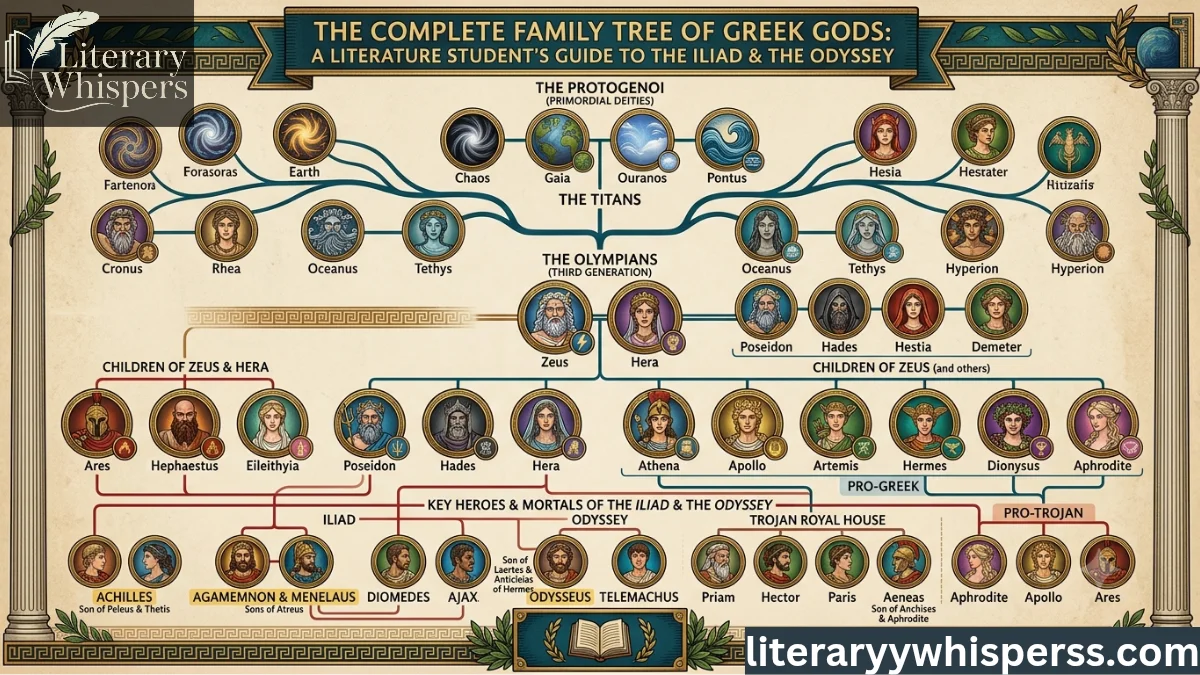
Somewhere around Book 3 of the Iliad, most readers hit the same wall. Aphrodite is fighting for Troy. Hera and Athena — goddesses of marriage and wisdom, not war — are practically leading the Greek army themselves. Poseidon keeps taking suspiciously personal interest in a war between mortals. And nobody in the text stops to explain why.
That’s because Homer‘s original audience already knew. They’d grown up with these gods’ family history the way we grow up knowing who our own relatives are, and which ones don’t speak to each other anymore. For a modern reader — especially one meeting these epics for the first time in a syllabus — that context is missing, and it’s the single biggest reason the Iliad and the Odyssey can feel harder than they need to be.
This guide (The Complete Family Tree of Greek Gods: A Literature Student’s Guide to the Iliad and the Odyssey) fills that gap. We’re going to build the complete Greek gods family tree from the very beginning — from Chaos itself, through the Titans, to the Twelve Olympians and the mortal heroes born from them — and connect every branch directly to what actually happens in Homer. By the end, you won’t just know who’s related to whom. You’ll know why it matters.
Deep Insight: The gods in the Iliad and the Odyssey aren’t neutral forces of nature the way they sometimes become in later literature. They’re family members with old grudges, favourite children, and long memories — and almost every “divine intervention” in Homer is really a relative taking a side.
Why Every Iliad and Odyssey Reader Needs This Family Tree
Homer’s epics run on what scholars often call the “divine machinery” of ancient epic poetry — the gods don’t just watch the human story, they actively shape it. Athena disguises herself to steer Telemachus. Apollo sends a plague to punish an insult to his priest. Hera manipulates her own husband to help the army she favours.
None of this is random. Every alliance, every grudge, every rescue in these poems traces back to a family relationship: whose son was disrespected, whose daughter was passed over, whose old promise is finally being repaid. Once you can see the family tree behind the plot, entire scenes that once felt confusing start to feel almost inevitable.
There’s also a structural reason this matters. Epic poetry, as a form, opens by invoking a Muse — and the Muses themselves are part of this family tree, the daughters of Zeus and the Titaness Mnemosyne. Understanding the gods isn’t separate from understanding the genre you’re reading. It’s the foundation of it.
The Five Generations of Greek Mythology, in Brief
Think of Greek mythology as a family saga told across five generations: first, the raw primordial forces of the universe, like Chaos and Gaia; then the Titans, the first ruling family; then the Twelve Olympians, Zeus’s generation, who overthrew the Titans and still rule when Homer’s epics take place; then a wide layer of minor gods, nymphs, and spirits who populate individual scenes; and finally the demigods and mortal heroes — Achilles, Helen, Heracles — whose stories the epics are actually about.
Let’s walk through each one.
Generation One: The Primordial Gods — Where Everything Began
According to Hesiod’s Theogony — the oldest surviving attempt to organise the Greek gods into a family tree — the universe didn’t begin with a god at all. It began with a gap.
Chaos came first: not chaos in the modern sense of disorder, but a yawning void, the empty space before anything existed. Out of that void came Gaia, the Earth herself, along with Tartarus, the bottomless abyss that would later become a prison for defeated gods, and Eros, the primal force of desire and union.
From Chaos also came Erebus (Darkness) and Nyx (Night). Nyx, on her own, gave birth to a whole cast of figures who matter more to literature students than their obscurity suggests: Thanatos (Death) and Hypnos (Sleep), who appear together in the Iliad carrying a fallen warrior’s body from the battlefield; the Moirai, or Fates, who control the thread of every mortal life; and Eris, goddess of strife — who we’ll meet again very soon, because she’s the one who actually starts the Trojan War.
Gaia, meanwhile, produced Uranus, the Sky, without a partner — and the two of them, Earth and Sky, became the parents of the next generation.
Generation Two: The Titans, and the War That Made Zeus King
Gaia and Uranus had eighteen children together, and this is where the family tree starts producing names you’ll actually recognise later. Twelve of these children were the original Titans: six sons — Oceanus, Coeus, Crius, Hyperion, Iapetus, and the youngest, Cronus — and six daughters, including Rhea, Themis, and Mnemosyne. Alongside them came the three one-eyed Cyclopes and the three hundred-handed Hecatoncheires, both groups feared and eventually imprisoned by their own father.
That imprisonment set the whole story in motion. Gaia, furious on her children’s behalf, convinced her youngest son Cronus to overthrow Uranus — which he did, violently, taking the throne of the universe for himself. But a prophecy warned Cronus that he, too, would be overthrown by one of his own children. So Cronus swallowed each of his newborns whole, one after another.
His wife Rhea couldn’t bear to lose her last child. When Zeus was born, she hid him away on Crete and tricked Cronus into swallowing a stone wrapped in cloth instead. Zeus grew up in secret, eventually returned, and forced his father to bring up the siblings he’d swallowed years earlier — Hestia, Demeter, Hera, Hades, and Poseidon, all fully grown.
Together, the six of them fought their father’s generation in a ten-year war known as the Titanomachy. With the Cyclopes forging Zeus’s thunderbolt and the Hecatoncheires fighting at his side, the Olympians won. Most Titans were sealed away in Tartarus; Atlas was singled out for a punishment of his own — holding up the sky for eternity.
Generation Three: Zeus’s Family — The Twelve Olympians
Cronus and Rhea’s six children — Hestia, Demeter, Hera, Hades, Poseidon, and Zeus — form the backbone of the next generation. But it’s Zeus’s own children, born to a long list of different partners, who make up most of the gods you’ll actually meet in Homer.
Zeus, King of the Gods
Zeus rules from Mount Olympus, but in the Iliad and the Odyssey, he rarely acts like a simple villain or hero — he’s closer to a reluctant referee. He owes Thetis a personal favour (more on that shortly), grieves openly when his mortal son Sarpedon is killed in battle, and ultimately lets fate run its course in both poems rather than overriding it. He’s less a character with a personal stake in the war and more the cosmic authority the other gods have to answer to.
Hera, and the Grudge That Never Fades
Hera is both Zeus’s sister and his wife, and she cannot forgive the Trojans — not because of anything they’ve done to her personally in the war itself, but because of an old insult we’ll get to in a moment. She’s relentlessly pro-Greek throughout the Iliad, to the point of manipulating her own husband to distract him while the Greek army gets divine help behind his back.
Athena, Odysseus’s Guardian
Athena was born fully grown and fully armoured, springing from Zeus’s head after he swallowed her pregnant mother, Metis. Of all the Olympians, she’s arguably the most important one in the Odyssey — she disguises herself repeatedly to guide both Odysseus and his son Telemachus, personally petitions Zeus on Odysseus’s behalf, and helps engineer the final confrontation with Penelope’s suitors. Her favourite mortals tend to share her defining trait: cleverness over brute strength, which is exactly why Odysseus is her favourite of all.
Poseidon, the God Who Wouldn’t Forgive
Poseidon once built the walls of Troy alongside Apollo, working for a king who then refused to pay them — part of why he favours the Greeks throughout the Iliad. But it’s in the Odyssey that his temper defines the entire plot: after Odysseus blinds his son, the Cyclops Polyphemus, Poseidon’s fury becomes the engine behind nearly every disaster of the ten-year journey home.
Apollo and Artemis, the Twins Who Chose Troy
Born to Zeus and the Titaness Leto, Apollo and Artemis are twins, and both stand firmly on the Trojan side. Apollo, god of prophecy, music, and plague, opens the Iliad’s action by sending a devastating sickness through the Greek camp after Agamemnon disrespects one of his priests. Artemis appears far less often, but shares her brother’s loyalty to Troy throughout.
Aphrodite, Ares, and the Scandal Hephaestus Never Forgot
Aphrodite — whom the Iliad names as Zeus’s daughter with the minor goddess Dione, though an older, far more dramatic tradition tells a completely different origin story — owes her position in the war to a favour she once promised, and she protects Paris and the Trojans fiercely, even stepping onto the battlefield herself and getting wounded for her trouble.
Her constant companion in loyalty is Ares, god of war, which is fitting, since mythology consistently pairs the two as lovers, despite Aphrodite being officially married to Hephaestus, god of the forge. In one of the Odyssey’s more entertaining detours, a bard sings the story of Hephaestus catching the two of them together and exposing them in front of the other gods — one of literature’s earliest scandal stories, and it explains everything about why Aphrodite and Ares are always on the same side.
The Rest of the Twelve
A handful of Olympians round out the family without playing a major role in either epic. Demeter, goddess of the harvest, and Hestia, goddess of the hearth, are barely mentioned in Homer at all. Hephaestus, god of fire and craftsmanship, does step forward at a crucial moment — forging magnificent new armour for Achilles at his mother Thetis’s request, after Achilles’s original armour is stripped from Patroclus’s body.
Hermes, Zeus’s son with the nymph Maia, serves as the gods’ messenger, delivering Zeus’s order to release Odysseus from Calypso’s island and later handing Odysseus a protective herb against Circe’s magic. Dionysus, god of wine, born to Zeus and the mortal Semele, barely appears at all — in some traditions, he even takes Hestia’s seat among the Twelve, since she willingly gave it up to keep the peace.
Why Hades Isn’t on This List
You may have noticed Hades is missing from the Twelve, despite being a full sibling of Zeus, Hera, Poseidon, Demeter, and Hestia. That’s not an oversight — it’s a genuine, exam-worthy point. Hades rules the underworld rather than Mount Olympus, and tradition has always kept him separate from the Olympian household because of it. He barely appears directly in either epic, though his realm is the setting for one of the Odyssey’s most famous episodes, when Odysseus travels to its edge to consult the dead prophet Tiresias.
Beyond Olympus: The Minor Gods Who Actually Move the Plot
Some of the most important figures in both epics aren’t Olympians at all.
Thetis is the one to know first. A sea-nymph — one of the many daughters of the old sea-god Nereus — she was once desired by both Zeus and Poseidon, until a prophecy warned that her son would grow up to surpass his own father. Unwilling to risk it, the gods married her off to a mortal, Peleus, instead. Their son was Achilles.
Iris, the rainbow goddess, serves as a divine messenger throughout the Iliad, much as Hermes does in the Odyssey. And Eris, goddess of strife and a child of Nyx from all the way back in Generation One, is about to become the most important minor character in this entire story.
The Wedding Gift That Started a War: The Judgment of Paris
Every god on Olympus was invited to Peleus and Thetis’s wedding — the marriage that would eventually produce Achilles. Every god except one: Eris, goddess of discord, deliberately left off the guest list to avoid trouble.
She caused it anyway. Furious, Eris threw a golden apple into the middle of the celebration, marked simply “for the fairest.” Three goddesses immediately claimed it: Hera, Athena, and Aphrodite.
Zeus, wisely, refused to choose between his wife, his daughter, and — depending on which tradition you follow — another daughter. Instead, he sent the three goddesses down to a mortal judge: Paris, a prince of Troy. Each of them offered him a bribe. Hera promised political power. Athena promised wisdom and mastery in battle. Aphrodite promised the love of the most beautiful woman alive.
Paris chose Aphrodite — and with her help, took Helen, already married to the Greek king Menelaus, back to Troy with him.
A beauty contest between three goddesses. A bribed judge. A stolen wife. That’s not a soap-opera pitch — that’s the actual mythological cause of the Trojan War.
That single decision is why Hera and Athena back the Greeks without mercy throughout the Iliad, and why Aphrodite backs Paris and Troy to the very end. The war itself is really just the aftershock of one very petty argument at a wedding.
The Gods Behind Every Storm in the Odyssey
If the Iliad runs on a rivalry between goddesses, the Odyssey runs on a rivalry between a god and a single mortal man.
After the fall of Troy, Odysseus blinds the Cyclops Polyphemus — a son of Poseidon — to escape being eaten alive. It’s a clever escape, and it costs him everything. Poseidon’s fury follows Odysseus across the entire poem, driving almost every storm, shipwreck, and delay standing between him and home.
Standing on the opposite side is Athena, who has favoured Odysseus since Troy for the very trait Poseidon can’t forgive him for: his cleverness. She disguises herself throughout the poem to guide him and his son, and it’s her appeal to Zeus that finally sets his release from Calypso’s island in motion — a release Hermes personally delivers.
Even the crew’s final, fatal mistake belongs to this same divine family drama. Starving and desperate, Odysseus’s men slaughter the sacred cattle of Helios on the island of Thrinacia, against every warning. It’s Helios himself, the old Titan-descended sun god, who furiously demands justice from Zeus — and gets it. By the time Odysseus reaches home alone, nearly every setback along the way has had a god’s hand behind it.
A Personal Reflection: What Changed When I Finally Learned Who Was Related to Whom
I remember the first time these two epics stopped feeling like a wall of unfamiliar names and started feeling like a story I could actually follow. It wasn’t a plot twist. It was a family tree.
Once I understood that Hera’s rage came from a rejected apple, that Poseidon’s storms came from a father’s grief over his son, that Athena’s loyalty came from recognising the same kind of clever mind in Odysseus that she valued in herself — the gods stopped being background noise and started being characters with motives I could actually track, the same way I’d track any family’s history in a novel.
That’s the thing I most want this guide to give you. Not just names and titles, but the sense that this “wall of mythology” is really just a very old, very dramatic family — and once you know the family, the story gets a great deal easier to love.
The Complete Family Tree, Mapped Out
Here’s the entire structure, condensed into one map:
- Chaos
- Gaia (Earth) + Uranus (Sky) →
- The twelve Titans: Cronus, Rhea, Oceanus, Tethys, Hyperion, Theia, Coeus, Phoebe, Crius, Iapetus, Themis, Mnemosyne
- The three Cyclopes: Brontes, Steropes, Arges
- The three Hecatoncheires: Cottus, Briareus, Gyges
- Erebus + Nyx → Thanatos, Hypnos, the Moirai (Fates), Eris, and others
- Gaia (Earth) + Uranus (Sky) →
- Cronus + Rhea → Hestia, Demeter, Hera, Hades, Poseidon, Zeus
- Zeus, with various partners:
- + Metis → Athena
- + Leto → Apollo, Artemis
- + Hera → Ares, Hephaestus, Hebe, Eileithyia
- + Maia → Hermes
- + Semele → Dionysus
- + Demeter → Persephone
- + Dione → Aphrodite (the tradition Homer follows)
- + Leda (mortal) → Helen, Polydeuces (Pollux)
- + Laodamia (mortal) → Sarpedon
- Other unions crucial to Homer:
- Nereus + Doris → the Nereids, including Thetis
- Thetis + Peleus (mortal) → Achilles
- Atlas (Titan) → Calypso, Maia
- Helios (sun god) + Perse → Circe
Your Greek Gods Cheat Sheet (Save This for Exam Season)
| God | Parents | Domain | Role in the Iliad / Odyssey |
|---|---|---|---|
| Zeus | Cronus & Rhea | King of the gods, sky and thunder | The cosmic authority in both epics; father of Athena, Apollo, Artemis, Helen, Sarpedon |
| Hera | Cronus & Rhea | Marriage, queen of the gods | Fiercely pro-Greek in the Iliad, still bitter over the Judgment of Paris |
| Poseidon | Cronus & Rhea | The sea, earthquakes | Pro-Greek in the Iliad; Odysseus’s chief enemy throughout the Odyssey |
| Hades | Cronus & Rhea | The underworld | Not one of the Twelve; his realm appears in the Odyssey’sBook 11 |
| Demeter | Cronus & Rhea | Harvest, agriculture | Rarely appears in either epic |
| Hestia | Cronus & Rhea | Hearth, home | Does not appear in either epic |
| Athena | Zeus & Metis | Wisdom, strategy | Odysseus’s personal protector; pro-Greek throughout |
| Apollo | Zeus & Leto | Prophecy, music, plague | Pro-Trojan; sends the plague that opens the Iliad |
| Artemis | Zeus & Leto | The hunt, wilderness | Pro-Trojan, twin of Apollo |
| Ares | Zeus & Hera | War | Pro-Trojan; wounded in battle in the Iliad |
| Aphrodite | Zeus & Dione | Love, beauty | Pro-Trojan; caused the war through the Judgment of Paris |
| Hephaestus | Hera (with or without Zeus) | Fire, the forge | Forges Achilles’s new armour at Thetis’s request |
| Hermes | Zeus & Maia | Messages, travel | Delivers Zeus’s orders in the Odyssey; helps Odysseus against Circe |
| Dionysus | Zeus & Semele | Wine, festivity | Rarely appears; sometimes replaces Hestia among the Twelve |
Frequently Asked Questions About the Greek Gods Family Tree
Who are the 12 Olympian gods? Traditionally: Zeus, Hera, Poseidon, Demeter, Athena, Apollo, Artemis, Ares, Aphrodite, Hephaestus, Hermes, and either Hestia or Dionysus, depending on the source.
Is Hades one of the 12 Olympians? No. He’s a full sibling of Zeus, Hera, Poseidon, Demeter, and Hestia, but he’s traditionally excluded from the Twelve because he rules the underworld rather than living on Mount Olympus.
Who are Zeus’s children? Zeus fathered many children with different partners, but the ones who matter most for Homer are Athena (with Metis), Apollo and Artemis (with Leto), Hermes (with Maia), Dionysus (with Semele), Persephone (with Demeter), Ares and Hephaestus (with Hera), Helen (with the mortal Leda), and Sarpedon (with the mortal Laodamia).
Why does Poseidon hate Odysseus? Odysseus blinds Poseidon’s son, the Cyclops Polyphemus, while escaping his island in Book 9 of the Odyssey. That single act is why Poseidon spends the rest of the poem making Odysseus’s journey home as difficult as possible.
Who is Achilles’s mother, and why does it matter? His mother is Thetis, a sea-nymph desired by both Zeus and Poseidon until a prophecy warned that her son would surpass his father. That’s why she married the mortal Peleus instead — making Achilles powerful, but not immortal, which becomes the emotional centre of the Iliad.
What actually caused the Trojan War? Mythologically, it traces back to the Judgment of Paris: Eris threw a golden apple “for the fairest” among Hera, Athena, and Aphrodite, and Paris chose Aphrodite after she promised him Helen — who was already married to the Greek king Menelaus.
Which goddess helps Odysseus throughout the Odyssey? Athena. She appears in disguise multiple times, protects Telemachus, petitions Zeus on Odysseus’s behalf, and helps orchestrate the final battle against Penelope’s suitors.
Before You Go
The Greek gods can feel overwhelming the first time you meet them properly — dozens of names, half of them related, most of them holding a grudge from several generations back. But once the family tree clicks into place, it stops being a wall of names and becomes what it always was: the best-organised, longest-running family drama in world literature.
A few habits worth building as you prepare for essays or exams: anchor each god to a relationship rather than just a title — “Athena, Zeus’s daughter who favours clever heroes” will stick in your memory far better than “Athena, goddess of wisdom” ever will. Learn the Judgment of Paris until you can retell it in thirty seconds; it’s the single most-asked question about why the Trojan War happens. And in the Odyssey especially, try tracking Poseidon and Athena as two separate, opposing threads — one working against Odysseus, one working for him — and most of the poem’s turning points will make sense almost immediately.
Bookmark this one. The next time a god shows up out of nowhere in Homer, you’ll already know exactly whose side they’re on, and why.
With love and ink Literary Whispers. Where literature feels like home.

