
Somewhere in the middle of your English Honours reading — in Tagore’s poetry, in Arundhati Roy’s The God of Small Things, in the imagery of Kamala Das, in the allusions scattered through contemporary Indian writing — you encounter a name that carries enormous weight.
Shiva. Lakshmi. Kali. Saraswati. Hanuman. The name arrives in the text already full of meaning — layers of story, centuries of worship, the accumulated symbolism of one of the world’s oldest living religious and literary traditions. And if you don’t know who these figures are, something in the text closes against you.
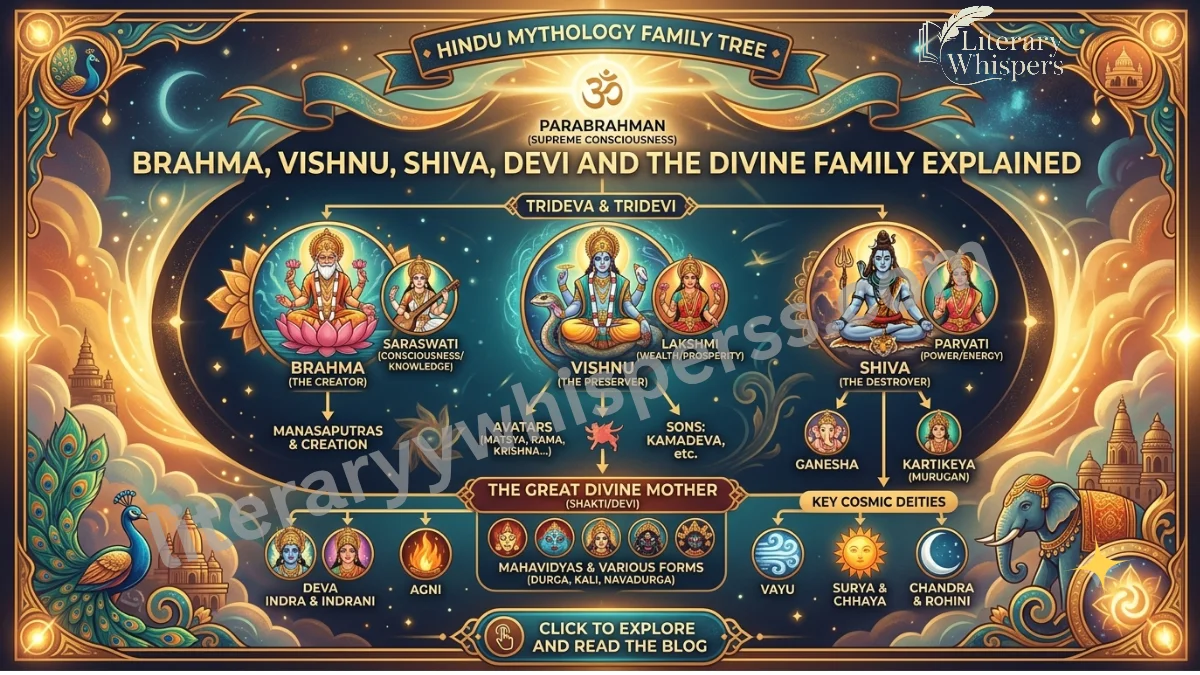
This post (Hindu Mythology Family Tree: Brahma, Vishnu, Shiva, Devi and the Divine Family Explained) opens it.
Hindu mythology is not simply the religious tradition of India — it is the oldest continuously living mythology in the world, with texts stretching back over three thousand years, and it has shaped Indian literature, philosophy, art, and culture in ways that make it impossible to fully read Indian writing — or understand the cultural context of English literature produced in India — without knowing its major figures.
This is your complete guide. The divine family explained — who they are, how they relate to each other, what they represent, and most importantly, why they matter for the literature you are studying.
The Foundation: Understanding Hindu Cosmology
Before the family tree, a brief understanding of how Hindu cosmology organises the divine.
Hindu religious thought does not present the divine as a single fixed hierarchy in the way that some other traditions do. Different texts, different philosophical schools, and different regional traditions emphasise different aspects of the divine. But certain structural principles are widely shared:
The Trimurti — the three primary aspects of the divine, each representing a cosmic function:
- Brahma — Creator
- Vishnu — Preserver
- Shiva — Destroyer (and regenerator)
This is not simply a division of labour. In Hindu philosophical thought, creation, preservation, and destruction are not separate processes but aspects of a single continuous cosmic cycle — the universe created, sustained, and dissolved, only to be created again. The Trimurti represents this cycle.
The Tridevi — the three primary goddesses, consorts of the Trimurti:
- Saraswati — consort of Brahma, goddess of knowledge and arts
- Lakshmi — consort of Vishnu, goddess of wealth and prosperity
- Parvati (Shakti/Devi) — consort of Shiva, goddess of power and energy
The divine feminine — Devi, Shakti — is as fundamental to Hindu cosmology as the divine masculine. The goddess is not subordinate to her consort but complementary and often equal in power.
Brahma — The Creator
Who he is: Brahma is the creator of the universe — the god who brings all things into existence from nothing, who fashions the world and all its creatures, who produces the Vedas (the sacred texts) from his four mouths.
What he looks like: Four faces (representing the four Vedas, the four directions, the four ages of time), four arms, seated on a lotus that grows from Vishnu’s navel. His vehicle (vahana) is the hamsa — the swan or goose — symbol of wisdom and the ability to separate the pure from the impure.
His consort: Saraswati — goddess of learning, knowledge, music, and the arts.
His place in the tradition: Despite being one of the Trimurti, Brahma is the least worshipped of the three in contemporary Hinduism. There are very few temples dedicated to him. The most famous explanation: he was cursed by Shiva for a transgression involving pride, or cursed by Saraswati for a marital dispute. His diminished role in active worship compared to his cosmic importance is one of the most interesting paradoxes in Hindu religious culture.
For a beautiful introduction to Hindu mythology for literature students, read: The Penguin Handbook of the World’s Living Religions edited by John R. Hinnells [Buy on Amazon →]
Brahma in Literature:
Brahma appears in Tagore’s poetry as the creative divine — the source from which all artistic expression flows. In Gitanjali, the speaker’s relationship to the divine creator is intimate, personal, and suffused with the awareness that human creativity is a participation in Brahma’s original act of creation.
The four faces of Brahma — each looking in a different direction — are frequently used in Indian writing as a symbol of the all-seeing divine, of wisdom that encompasses every perspective simultaneously.
If you are studying [Indian Authors Every Teenager Should Read Before Turning 20], understanding Brahma as the creative divine will enrich your reading of Tagore’s devotional poetry significantly.
Saraswati — Goddess of Knowledge, Arts, and Wisdom
Who she is: Saraswati is the goddess of learning in all its forms — language, literature, music, arts, wisdom, and the sacred knowledge of the Vedas. She is worshipped by students, scholars, musicians, artists, and writers. Her festival, Saraswati Puja (celebrated particularly in Bengal and other parts of India), involves placing books and instruments before her image for her blessing.
What she looks like: White-clad (representing purity of knowledge), seated on a white lotus, four arms holding a book (the Vedas), a rosary (spiritual knowledge), a water pot (creative power), and the veena (a stringed musical instrument). Her vehicle is the swan or the peacock.
Why she matters for literature: Saraswati is the divine patron of every literary endeavour. In the Indian tradition, writing is not a merely human activity — it is a participation in the sacred. The writer who invokes Saraswati is acknowledging that language, at its highest, participates in the divine speech that created the universe.
To understand the Hindu goddess tradition more fully: Devi: The Great Goddess by Vidya Dehejia [Buy on Amazon →]
The relationship between Saraswati and literature runs deep in Indian culture. The Sanskrit word saraswati itself means “the flowing one” — a river, and the sacred Saraswati River (now invisible, flowing underground according to tradition) represents the hidden flow of wisdom beneath the surface of the world.
In contemporary Indian English literature — in writers like Kamala Das, Arundhati Roy, and Anita Desai — the figure of Saraswati appears sometimes explicitly, more often in the cultural assumptions that surround the act of writing: the sense that language is sacred, that to misuse it is a moral offence, that the writer carries a responsibility beyond entertainment.
Vishnu — The Preserver
Who he is: Vishnu is the sustainer of the universe — the divine principle that preserves cosmic order (dharma) against the forces of chaos and destruction. When the universe is threatened — when evil becomes too powerful, when dharma is endangered — Vishnu descends to earth in one of his avatars (incarnations) to restore balance.
What he looks like: Blue-skinned (blue representing the infinite sky and the vast ocean — the colour of the all-pervading divine), four arms holding the Sudarshana Chakra (a spinning discus weapon), the Panchajanya (a conch shell), the Kaumodaki (a mace), and a lotus. He is often depicted resting on the cosmic serpent Shesha (Ananta) on the primordial ocean, with Lakshmi at his feet. A lotus grows from his navel, from which Brahma is born.
His vehicle: Garuda — the great eagle, king of birds, enemy of serpents.
His consort: Lakshmi.
For the stories of Vishnu’s avatars in accessible form: The Complete Illustrated Guide to Hinduism by Denise Cush, Catherine Robinson, and Michael York [Buy on Amazon →]
The Ten Avatars of Vishnu (Dashavatar)
The doctrine of the avatar — the descent of the divine into mortal form for the preservation of dharma — is one of the most important and most influential concepts in Hindu religious thought. Vishnu has ten principal avatars, of which the most important for literature are:
1. Matsya (the Fish) — Vishnu as a great fish who saves the first man (Manu) and the Vedas from a cosmic flood. This is the Hindu flood myth — parallel in structure to Noah’s flood and the flood of Utnapishtim in the Epic of Gilgamesh.
2. Kurma (the Tortoise) — Vishnu as a giant tortoise who supports Mount Mandara during the churning of the cosmic ocean (Samudra Manthan). This churning produces many of the divine objects and beings, including Lakshmi, the divine physician Dhanvantari, and the amrita (nectar of immortality).
3. Varaha (the Boar) — Vishnu as a cosmic boar who rescues the Earth goddess (Bhudevi) from the demon Hiranyaksha who has dragged her to the bottom of the cosmic ocean.
4. Narasimha (the Man-Lion) — Vishnu as a half-man, half-lion figure who defeats the demon Hiranyakashipu. This avatar appears because Hiranyakashipu had obtained a boon that he could not be killed by man or beast, inside or outside, by day or night — Narasimha defeats him by being neither fully man nor fully beast, at twilight, on a threshold (neither inside nor outside).
5. Vamana (the Dwarf) — Vishnu as a dwarf brahmin who asks the demon king Bali for three paces of land and then expands to fill the entire universe in three steps.
6. Parashurama (the Warrior with an Axe) — Vishnu as a brahmin warrior who destroys the corrupt kshatriya(warrior) class twenty-one times.
7. Rama — One of the two most important avatars. Rama is the hero of the Ramayana — the prince who is exiled, whose wife Sita is abducted by the demon king Ravana, and who, with the help of Hanuman and an army of monkeys, defeats Ravana and rescues Sita. Rama represents the ideal man — perfectly dharmic, perfectly dutiful, perfectly loyal.
For readers of Indian literature, the Ramayana is absolutely foundational. [Devdutt Pattanaik’s retellings] make it accessible for modern readers. The figures of Rama and Sita appear in virtually every Indian literary tradition and in countless works of contemporary Indian English writing.
The most accessible modern retelling: Sita: An Illustrated Retelling of the Ramayana by Devdutt Pattanaik [Buy on Amazon →]
8. Krishna — The other most important avatar, and arguably the most beloved figure in the entire Hindu tradition. Krishna appears in the Mahabharata (including the Bhagavad Gita) and in the Bhagavata Purana. He is simultaneously the divine child (playful, mischievous, stealing butter), the divine lover (his relationship with Radha is one of the great love stories of world literature), the divine warrior, and the divine teacher (the Bhagavad Gita is his teaching to Arjuna on the battlefield).
Krishna is the most complexly characterised divine figure in the Hindu tradition — he is simultaneously fully human and fully divine in every manifestation. His blue skin, his flute, his peacock feather crown are among the most recognisable images in Indian art and culture.
9. Buddha — In some Hindu traditions, Gautama Buddha is included as the ninth avatar of Vishnu. This incorporation of the Buddha into Vaishnava tradition is theologically complex and historically contested — but it is present in many canonical lists.
10. Kalki — The avatar yet to come. Kalki will appear at the end of the current age (the Kali Yuga — the age of darkness and confusion), riding a white horse, to destroy evil and restore dharma. He is the messianic figure of the Hindu tradition — the one who is awaited.
For the complete Mahabharata retold for modern readers: Jaya: An Illustrated Retelling of the Mahabharata by Devdutt Pattanaik [Buy on Amazon →]
Lakshmi — Goddess of Wealth, Prosperity, and Fortune
Who she is: Lakshmi is the goddess of all forms of wealth — not merely material wealth but the full abundance of life: prosperity, beauty, grace, good fortune, fertility, and auspiciousness. She is the divine energy that makes all good things flow.
What she looks like: Golden-skinned (representing wealth and abundance), seated or standing on a lotus, four arms often depicted with gold coins flowing from one hand, holding lotus flowers, making the gesture of blessing (abhaya mudra — bestowing fearlessness).
Her vehicle: The owl — a controversial choice for a goddess of prosperity, as owls in Indian culture can represent darkness and bad fortune. The owl as her vehicle has been interpreted as the divine’s ability to see in darkness, to find wealth even in impoverishment.
Why she matters for literature: Lakshmi is the most widely worshipped goddess in India — Diwali, the Festival of Lights, is centrally her festival. She represents what every household, every family, every person fundamentally desires: the fullness of life, the abundance that allows flourishing.
In Indian literature, Lakshmi’s presence or absence in a household or a life is a recurring motif. Characters are described as “Lakshmi-like” when they bring prosperity and grace; her departure is associated with ruin. The concept of shri — a word meaning auspiciousness, beauty, and prosperity — is essentially Lakshmi’s quality made linguistic.
If you are reading [The Most Beautiful Love Quotes Ever Written in Literature], note how the tradition of celebrating beauty in love poetry has a divine parallel in Lakshmi — the goddess whose beauty is itself a form of divine power.
Shiva — The Destroyer and Regenerator
Who he is: Shiva is the most complex figure in the Hindu trinity — simultaneously the god of destruction and the god of regeneration, the ascetic yogi and the passionate husband, the destroyer of the world and the source from which it is reborn. He holds contradictions together in ways that most other religious traditions separate.
What he looks like: Blue-throated (from swallowing the poison halahala that emerged during the churning of the cosmic ocean, to protect the world), matted hair containing the river Ganges and a crescent moon, the third eye on his forehead (which, when opened, destroys whatever it sees), the trident (trishula), covered in ash (symbolising the destruction of the ego and the impermanence of the body), wearing a tiger skin, the serpent Vasuki coiled around his neck.
His vehicle: Nandi — the sacred bull, who sits before every Shiva temple.
His consort: Parvati (also known as Shakti, Durga, Kali, Uma — different aspects of the same divine feminine).
For the most complete exploration of Shiva’s mythology: Shiva: Stories and Teachings from the Shiva Mahapuranatranslated by Jagannath Dubey [Buy on Amazon →]
Shiva as Nataraja — The Lord of Dance
One of the most important and most beautiful images in all of Hindu iconography: Shiva as Nataraja, the cosmic dancer. He dances the Tandava — the dance of creation and destruction simultaneously — within a ring of fire representing the cycle of the universe.
His four arms hold: a small drum (damaru — the rhythm of creation), fire (the force of destruction), one hand making the gesture of protection, one hand pointing to his raised foot (the gesture of liberation — the devotee who understands can be freed from the cycle).
The Nataraja image is one of the great artistic achievements of human civilisation — a visual condensation of the entire Hindu cosmological vision. The physicist Fritjof Capra, in The Tao of Physics, famously compared Shiva’s cosmic dance to the dance of subatomic particles — the ceaseless creation and destruction of matter at the quantum level.
For Shiva’s cosmic dance and its philosophical significance: The Dance of Shiva by Ananda K. Coomaraswamy[Buy on Amazon →]
Shiva in Literature
Shiva appears throughout Indian literature in his many aspects. In Tagore’s poetry, Shiva is the divine with whom the devotee seeks union — the destroyer of ego who makes genuine selfless love possible.
In contemporary Indian writing, Shiva’s presence is pervasive: in the imagery of destruction and regeneration, in the ascetic figures that recur in Indian fiction, in the third eye as a symbol of visionary insight, in the Ganges — Shiva’s river — as the sacred axis of Indian civilisation.
Amish Tripathi’s Shiva trilogy (The Immortals of Meluha, The Secret of the Nagas, The Oath of the Vayuputras) retells Shiva’s story as a human being who becomes divine — one of the most popular reimaginings of Hindu mythology in contemporary Indian fiction.
If you are following [Indian Authors Every Teenager Should Read Before Turning 20], the mythological background this post provides will make your reading of Indian texts significantly richer.
The enormously popular mythological retelling: The Immortals of Meluha by Amish Tripathi [Buy on Amazon →]
The Divine Feminine: Devi, Shakti, and the Great Goddess
In Hindu cosmology, the divine feminine — called Devi (the goddess), Shakti (divine energy or power), or Mahadevi (the Great Goddess) — is not simply the consort of the male divine. She is an independent, supreme divine principle — the cosmic energy without which the male divine cannot act.
This is expressed in the concept of Shakti: without Shakti, Shiva is shava (a corpse). The female energy animates and empowers the male divine principle. This is a theological position that has no direct equivalent in the Abrahamic traditions.
Important Note: The relationship between the divine feminine and the divine masculine in Hinduism is not a hierarchy with one above the other. Different philosophical schools (dvaita, advaita, Shakta traditions) understand this relationship differently — but the fundamental equality, and often the supremacy, of the divine feminine is a persistent principle.
Parvati — The Universal Mother
Who she is: Parvati is Shiva’s consort — the gentle, nurturing aspect of the divine feminine. She is the daughter of Himavat (the Himalayas) and Mena, born as a beautiful princess who won Shiva’s love through intense meditation and austerity after his first wife Sati died.
What she represents: Love, devotion, fertility, the domestic divine, the power of focused spiritual practice (tapas). She is the ideal wife and mother in the Hindu tradition — but also the divine practitioner of yoga and meditation who achieves what she seeks through her own spiritual effort.
Her children: Ganesha and Kartikeya (also called Murugan or Skanda).
The love story of Shiva and Parvati is one of the great divine love stories — the ascetic deity who has renounced the world drawn back into it by the patient love of Parvati. Kalidasa’s Kumarasambhava (The Birth of the War God) is the great classical Sanskrit poem of this love — and one of the masterpieces of world literature.
For Kalidasa’s masterpiece in beautiful English translation: The Birth of Kumara (Kumarasambhava) by Kalidasa, translated by David Smith [Buy on Amazon →]
Durga — The Warrior Goddess
Who she is: Durga is the fierce, warrior aspect of the divine feminine — created when the male gods were unable to defeat the buffalo demon Mahishasura, who was protected by a boon that no man or god could kill him. The gods combined their divine energies (tejas) to produce Durga — who defeated Mahishasura.
What she looks like: Ten arms, each holding a weapon given by a different god, riding a lion or tiger, radiantly beautiful in the midst of battle.
What she represents: The power that protects the cosmic order when the male divine is insufficient. Durga is the supreme warrior, the protector of the world, the divine energy that arises specifically to fight what cannot otherwise be fought.
Durga Puja: The great autumn festival of Bengal (and much of India) celebrates Durga’s victory over Mahishasura. It is one of the most significant cultural events in Bengal, and it suffuses Bengali literature — including Tagore’s work — with its imagery and emotional weight.
For students of Indian literature, Durga Puja is not merely a religious festival — it is a cultural event that structures the Bengali year and the Bengali imagination. Understanding it is essential for understanding Rabindranath Tagore, who wrote extensively about it, and for understanding the cultural context of any literature produced in Bengal.
For Tagore’s relationship to Bengali culture and its myths: Rabindranath Tagore: The Myriad-Minded Man by Krishna Dutta and Andrew Robinson [Buy on Amazon →]
Kali — The Goddess of Time and Transformation
Who she is: Kali is the most awe-inspiring and most misunderstood of the Hindu goddesses — the deity of time, death, transformation, and liberation. She is the aspect of the divine feminine that most radically challenges comfortable categories.
What she looks like: Dark blue or black skin (representing the infinite void, the colour of time before creation and after destruction), wild hair, tongue protruding (she stops herself from destroying the world by biting her tongue when she accidentally steps on Shiva, who has lain in her path to stop her frenzy), a garland of severed heads (representing the conquest of the ego), a skirt of severed arms.
What she represents: Kali destroys — but what she destroys is the illusion of the ego, the attachment to the impermanent, the fear of death. Her most devoted worshippers have included some of the greatest saints of the Bengali tradition: Ramakrishna Paramahamsa, who famously wept before her image seeking her vision.
For a profound exploration of Kali’s significance: Kali: The Feminine Force by Ajit Mookerjee [Buy on Amazon →]
Important Note: Kali is frequently misrepresented in Western popular culture as simply a goddess of death or evil. This is a fundamental misreading. Kali’s destruction is liberation — she destroys what binds the soul, including the greatest binding: the fear of death. Her devotees experience her as the most compassionate of all divine forms precisely because she removes the greatest obstacle to liberation.
Kali is central to the Bengal renaissance and to the reform movements of the 19th century that produced so much of modern Indian culture. Vivekananda, Ramakrishna, and the tradition of spiritual intensity associated with Bengal are inseparable from Kali worship.
In literature, Kali appears throughout Indian writing as the symbol of transformative power — the destructive force that makes new growth possible. The imagery of Kali suffuses much Bengali poetry and fiction, including the work of Bankimchandra Chattopadhyay, whose novel Anandamath (1882) gave India the song “Vande Mataram” and whose revolutionary nationalism was deeply connected to the figure of the Mother Goddess.
The Sons of Shiva and Parvati
Ganesha — The Elephant-Headed God
Who he is: Ganesha is perhaps the most widely worshipped deity in the entire Hindu tradition — the elephant-headed son of Shiva and Parvati, the remover of obstacles, the deity of beginnings, of wisdom, of writing, of good fortune.
The story of his birth and elephant head: In one of the most famous mythological stories, Parvati created Ganesha from her own body while Shiva was away, and set him as a guard at her bath. When Shiva returned and was refused entry by the child he didn’t recognise, he cut off the child’s head in anger. Parvati’s grief was devastating. Shiva sent his attendants to find the head of the first creature they encountered — it was an elephant. The elephant’s head was placed on the child, and he was restored to life.
What he represents: Ganesha is invoked at the beginning of every significant undertaking — every journey, every business venture, every examination, every written work. He is the gateway deity — the one who must be pleased before anything else can proceed. His form, combining the human body with the elephant’s head, represents the union of the human and the cosmic, of earthly wisdom and divine insight.
For an accessible and beautiful account of Ganesha’s mythology: Ganesha: The Auspicious… The Beginning by Shakunthala Jagannathan and Nanditha Krishna [Buy on Amazon →]
Ganesha in Literature:
Ganesha is associated with writing because in some traditions he served as the scribe who wrote down the Mahabharataas the sage Vyasa dictated it — breaking off one of his tusks to use as a pen when his quill broke.
This association between Ganesha and the act of writing is profound for literary study. In the Indian tradition, the writer does not begin work without invoking Ganesha — acknowledging that the capacity for expression is a gift of the divine, that obstacles to creative work are real and can be removed through divine grace, that writing is a sacred act.
This is why understanding Ganesha is important for reading Indian literature: it places the act of writing in a cosmic framework that is simply absent from the Western literary tradition. When an Indian writer begins work, they are — even secularly — participating in a tradition of invoking Ganesha, whether consciously or not.
For students working through [How to Build a Personal Reading Journal], consider how this tradition of sacred beginning — of invoking the muse, of preparing for the act of writing — relates to the habits of great writers across traditions.
Kartikeya (Murugan / Skanda) — God of War
Who he is: Kartikeya is the warrior son of Shiva and Parvati — born specifically to lead the divine army against the demon Tarakasura. He is known by many names: Murugan in South India (where he is the principal deity of Tamil culture), Skanda in Sanskrit texts, Kartikeya in North India.
What he looks like: Eternally young, radiant, six-faced (representing the six directions — including up and down), riding a peacock, holding a vel (spear).
His significance: Murugan/Kartikeya is one of the most important deities of Tamil culture and Tamil literature. The classical Tamil Sangam poetry — some of the oldest literature in the world — is organised in part around the five tinai(landscapes) associated with different emotional states, and Murugan presides over the kurinchi (mountain) landscape associated with love.
Understanding Murugan is essential for anyone engaging with Tamil literature — including the extraordinary classical tradition and contemporary Tamil writing in English.
The Extended Divine Family
Hanuman — The Devoted Servant
Who he is: Hanuman is the monkey god — the son of the wind god Vayu and the apsara Anjana — and the most devoted of Rama’s servants. He is the symbol of devotion (bhakti), of selfless service, of extraordinary strength placed entirely at the service of the divine.
His story: In the Ramayana, Hanuman leaps across the ocean to Lanka to search for Sita, burns the city with his tail when he is captured, carries an entire mountain of healing herbs to save Lakshmana, and ultimately helps Rama defeat Ravana and rescue Sita. He is present at every crucial moment — not as a hero pursuing his own glory but as the perfect servant whose only purpose is the service of Rama.
What he represents: Hanuman is the ideal of the devoted heart — the being whose extraordinary capacities (he can fly, change size, move mountains) are entirely in the service of love and devotion. He is worshipped across India by wrestlers (for his strength), by students (for his intelligence — he is also the master of grammar and Sanskrit learning), and by devotees of all kinds for his absolute, unconditional devotion.
For Hanuman’s story in beautiful retelling: Hanuman: An Introduction by Devdutt Pattanaik [Buy on Amazon →]
Important Note: The Ramcharitmanas of Tulsidas — the 16th century Hindi retelling of the Ramayana — contains what many consider the most beautiful and most emotionally powerful portrayal of Hanuman in all of Indian literature. The Hanuman Chalisa, composed by Tulsidas, is one of the most recited devotional texts in the world.
Hanuman’s influence on Indian literature is immeasurable. He is the paradigm of the devoted artist — whose craft is placed entirely in service of what is most sacred. For writers in the Indian tradition, Hanuman’s devotion to Rama is a model for the writer’s devotion to truth, beauty, and the highest values of the tradition.
The Hanuman Chalisa is recited daily by millions — its forty verses in Awadhi Hindi are among the most memorised literary texts in human history. Understanding this devotional tradition enriches your reading of the entire bhakti (devotional) literary tradition that has produced so much of North and South Indian literature.
The River Goddesses: Ganga, Yamuna, Saraswati
In Hindu cosmology, the three great rivers of India — the Ganges, Yamuna, and the invisible Saraswati — are goddesses as well as rivers. Their confluence at Prayagraj (Allahabad) is the most sacred site in Hinduism — the Triveni Sangam.
Ganga (Ganges): The most sacred river — she flows from Shiva’s hair, where she was contained after descending from heaven to earth (her direct fall would have destroyed the earth). She purifies — bathing in the Ganges removes sin, and the dying are brought to her banks or her waters are brought to them. She is simultaneously a goddess and the physical river.
In literature, the Ganges is one of the most persistent and powerful images in Indian writing — from Tagore’s river poetry to Narayan’s Malgudi (near the Kaveri, another sacred river) to the river in A Suitable Boy (Vikram Seth) to countless other texts where the river carries the weight of Indian spiritual and cultural life.
If you are reading any of the texts discussed in [Semester-Wise Book List for English Honours Students], you will encounter rivers and their sacred significance repeatedly — this context transforms such encounters from mere description to cultural depth.
For the sacred geography of India’s rivers and their literary significance: India: A Sacred Geography by Diana L. Eck [Buy on Amazon →]
The Demons — Necessary Antagonists
Hindu mythology’s demons (asuras, rakshasas, danavas) are not simply evil figures — they are complex beings who often serve important cosmological and narrative functions.
Ravana — the ten-headed king of Lanka who abducts Sita in the Ramayana. He is the scholarly, devoted son of Brahma, a master of the Vedas and of music, whose single fatal flaw is his desire for Sita. He is one of the most complexly portrayed antagonists in world mythology — simultaneously the greatest devotee of Shiva and the greatest obstacle to Rama’s dharma.
Many Indian literary retellings — including Valmiki’s original, Kamban’s Tamil Ramavataram, and modern retellings — explore Ravana with enormous complexity, making him a tragic figure rather than a simple villain.
Mahishasura — the buffalo demon defeated by Durga. His defeat is celebrated in Durga Puja and Navratri. The annual festival in which his defeat is enacted connects millions of Indians to this mythological narrative every year.
Hiranyakashipu — the demon defeated by Narasimha, who had declared himself God and forbidden the worship of Vishnu. His son Prahlada’s devotion to Vishnu, which survived his father’s persecution, is one of the great stories of the triumph of devotion over tyranny.
For a nuanced portrait of Ravana and the Ramayana from multiple perspectives: Ramayana: The Game of Life (Shubha Vilas Series) by Shubha Vilas [Buy on Amazon →]
The Cosmic Cycle: Yugas and the Structure of Time
Hindu cosmology understands time not as linear (moving from beginning to end) but as cyclical — a perpetually repeating cycle of creation, preservation, and destruction.
The Four Yugas (Ages):
Satya Yuga (Golden Age): The first age — perfect dharma, perfect virtue, universal truth. Life spans of thousands of years. No disease, no war, no suffering.
Treta Yuga: The second age — dharma begins to decline. The age of the Ramayana. Three-quarters dharma remains.
Dvapara Yuga: The third age — further decline. The age of the Mahabharata. Half dharma remains.
Kali Yuga (the present age): The age of darkness and confusion, in which we currently live. One-quarter dharma remains. This age ends when Kalki (Vishnu’s tenth avatar) appears.
Why this matters for literature: The concept of the Yugas gives Indian literature its sense of historical tragedy — we live in the worst of all possible ages, the inevitable decline from perfection. This is not pessimism but cosmic realism — and it shapes the melancholy, the nostalgia for a lost golden age, the awareness of decline that runs through so much Indian writing.
For students reading [Why “A Thousand Splendid Suns” Breaks Hearts Around the World] or other literature about societies in decline — the Yuga framework offers a fascinating comparative structure for understanding how different cultures narrativise historical deterioration.
How Hindu Mythology Appears in English Literature
Understanding Hindu mythology transforms your reading of Indian literature in English — but its influence extends far beyond.
Tagore: Virtually every poem in Gitanjali draws on the devotional tradition (bhakti) associated with Vishnu and Krishna worship. The beloved addressed in Tagore’s poems is simultaneously a human being and the divine. The longing expressed is simultaneously romantic and spiritual — a union of the human soul with the divine that is the fundamental aspiration of bhakti literature.
Arundhati Roy: The God of Small Things uses Hindu cosmological concepts — particularly the concept of kalam(appropriate time, ordained circumstances), and the caste system as a Hindu social institution — in ways that make the mythological background visible in every social interaction the novel depicts.
Kamala Das: Her poetry engages explicitly with the Krishna tradition — her most famous persona is the devotee of Krishna, longing for the divine lover who is simultaneously present and absent. Understanding the Radha-Krishna tradition — the great love of the cowherd girl for the divine — transforms the reading of her poetry entirely.
R.K. Narayan: The Malgudi novels are saturated with Hindu mythology and its social institutions — temples, festivals, pilgrimage, the sacred geography of South India. The Guide uses the concept of the accidental saint — the person who becomes divine without seeking divinity — that is deeply embedded in the Hindu understanding of grace.
For a comprehensive introduction to Hindu mythology that every literature student should own: Myth = Mithya: A Handbook of Hindu Mythology by Devdutt Pattanaik [Buy on Amazon →]
The Complete Divine Family Tree
THE TRIMURTI AND TRIDEVI

BRAHMA (Creator) × SARASWATI (Knowledge)
│
├── Created the universe and all living beings
│   from his own body or through divine speech
│
VISHNU (Preserver) × LAKSHMI (Wealth/Fortune)
│
├── AVATARS:
│   ├── Matsya, Kurma, Varaha, Narasimha,
│   ├── Vamana, Parashurama
│   ├── RAMA × Sita
│   ├── KRISHNA (beloved of Radha)
│   ├── Buddha (in some traditions)
│   └── Kalki (yet to come)
│
SHIVA (Destroyer/Regenerator) × PARVATI/SHAKTI
│
├── GANESHA (Remover of obstacles, god of writing)
└── KARTIKEYA/MURUGAN (God of war, Tamil culture)

PARVATI'S ASPECTS:
├── DURGA (Warrior goddess, 10 arms)
├── KALI (Goddess of time and liberation)
├── LAKSHMI (in Vaishnava tradition, also Shakti)
└── SARASWATI (Knowledge, also Shakti)

KEY RELATED FIGURES:
├── HANUMAN (Devotee of Rama, son of Vayu/Wind)
├── GANGA (Sacred river goddess)
├── INDRA (King of heaven, god of rain/thunder)
├── AGNI (Fire god)
├── VAYU (Wind god)
└── YAMA (God of death and dharma)
A Personal Reflection: The Mythology That Makes Sense of the Literature
The first time I read Tagore’s Gitanjali properly — not as beautiful verse in a foreign tradition, but with some understanding of what it was drawing from — was the first time I understood what devotional literature actually is.
“Leave this chanting and singing and telling of beads! Whom dost thou worship in this lonely dark corner of a temple with doors all shut? Open thine eyes and see thy God is not before thee! He is there where the tiller is tilling the hard ground and where the path-maker is breaking stones.”
I had read these lines before and thought: this is a beautiful religious poem. But knowing the bhakti tradition — knowing that Tagore is writing within a tradition of devotional poetry that has Kabir and Mirabai and the Alvars as its ancestors, that this poem is in conversation with centuries of devotion to Vishnu and Krishna — I understood something different:
This is not a rejection of religion. This is the bhakti tradition’s most radical and most consistent claim: that the divine is not found in the temple but in the human being, in labour, in love, in the world as it is.
Knowing the mythology made the theology legible. And knowing the theology made the poem completely alive.
That is what this post is for.
Quick Reference: The Most Important Names for Literature Students
| Name | What They Are | Most Important For |
|---|---|---|
| Brahma | Creator god | Creative divine, the sacred source of language |
| Saraswati | Goddess of knowledge and arts | Writers, students, musicians — the literary patron goddess |
| Vishnu | Preserver god | Avatars, dharma, the divine descending to save the world |
| Rama | Seventh avatar of Vishnu | The Ramayana, ideal of dharma, Hanuman’s devotion |
| Krishna | Eighth avatar of Vishnu | Bhagavad Gita, Radha-Krishna love, Tagore’s devotional poetry |
| Lakshmi | Goddess of prosperity | Abundance, Diwali, the auspicious |
| Shiva | Destroyer/Regenerator | Bengali literature, Nataraja, ascetic tradition |
| Parvati | Universal Mother | Divine love, Kalidasa’s Kumarasambhava |
| Durga | Warrior goddess | Durga Puja, Bengal literature, Bankimchandra |
| Kali | Goddess of time/liberation | Bengal mysticism, Ramakrishna, transformation |
| Ganesha | Elephant-headed deity | Beginnings, writing, removing obstacles |
| Hanuman | Monkey devotee of Rama | Devotion, Ramcharitmanas, Tulsidas |
| Ganga | Sacred river goddess | All Indian literature — the river is never merely a river |
A Warm Closing from Literary Whispers
Hindu mythology is not background to Indian literature. It is its foundation — the deep structure beneath every story, the water table from which every text draws.
When you know who Kali is, you understand Bengali literary intensity differently. When you know the Proserpina-like story of Proserpina and Ceres alongside the Lakshmi and Vishnu tradition, you understand how differently Indian and Western cultures narrativise prosperity and its loss. When you know who Ganesha is, you understand why the act of writing carries the weight it carries in Indian culture — why it is never purely secular, why the blank page is always, somewhere, a sacred threshold.
This knowledge does not close the texts you read. It opens them — into dimensions of meaning that remain invisible without it.
The divine family introduced in this post is waiting in every Indian text you will ever study. Learn their names. Learn their stories. And then go back to the literature with new eyes.
They have always been there.
Which deity’s story surprised or moved you most? Tell me in the comments — I want to know which one found you.
Share this post with every literature student reading Indian texts — this is the context they need.
With love and ink, Literary Whispers.
Where literature feels like home.

