
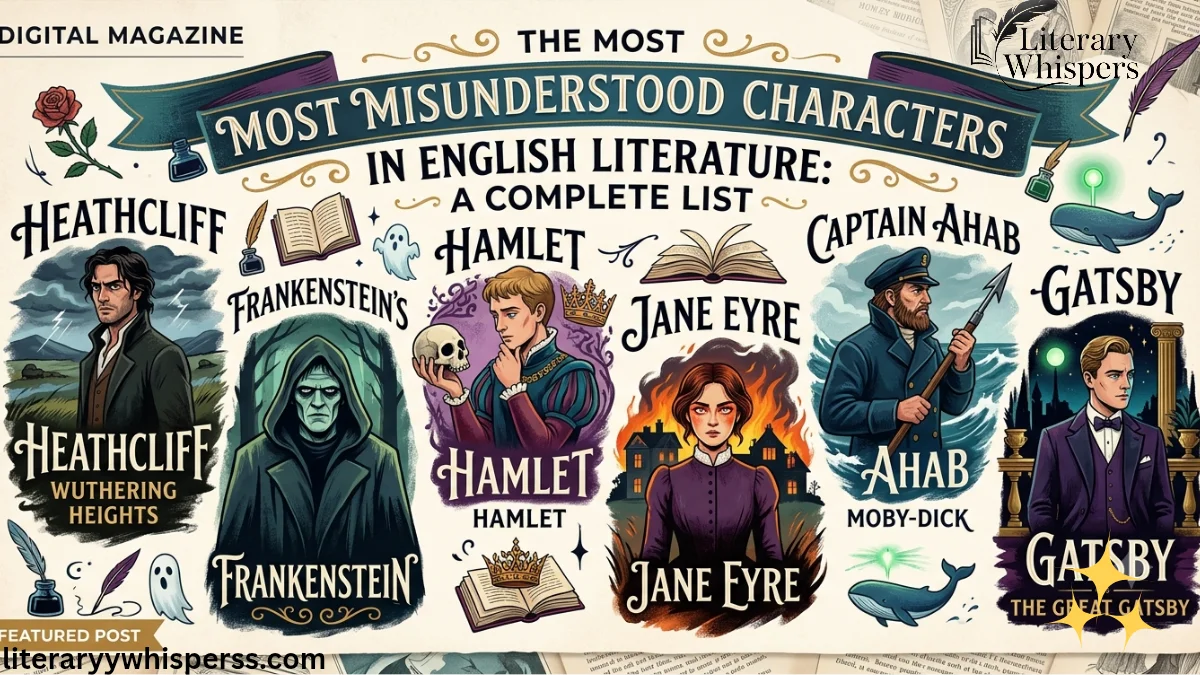
Every great literary character attracts a simplified version of themselves.
A version that travels further than the text, that circulates in common knowledge, that gets repeated in conversations and classrooms and culture until it becomes the accepted truth about who this character is — even when it contradicts what the text actually shows.
Shylock is the greedy moneylender. Heathcliff is the romantic hero. Hamlet is the coward who can’t make up his mind. Lady Macbeth is the calculating villain who drove her husband to murder. Iago is simply evil.
These simplifications are understandable. They are convenient. They make characters portable — able to travel across centuries without the weight of the full text accompanying them.
But they are wrong. Or rather, they are incomplete in ways that make them wrong — that invert the character’s actual meaning, that erase exactly the complexity that makes them worth studying, that turn the most interesting people in literary history into caricatures of themselves.
This post (The Most Misunderstood Characters in English Literature) sets the record straight.
Fifteen of the most misunderstood characters in English literature — who they are actually thought to be, what the text actually shows, and why the gap between the two matters for your reading, your essays, and your understanding of what literature is for.
Why Characters Get Misunderstood
Before the characters themselves, a brief understanding of why misreading happens — because the reasons are as illuminating as the corrections.
Cultural circulation strips context. When a character travels beyond their text — when Shylock becomes a shorthand for greed, or Ophelia becomes a symbol of tragic feminine innocence — the text’s complexity is left behind. What remains is a simplified image, often shaped by the cultural needs of whoever is doing the simplifying.
One character trait obscures the whole. We remember the most dramatic quality — Hamlet’s delay, Macbeth’s ambition, Iago’s scheming — and that quality becomes the character. Everything else — the grief, the love, the intelligence, the fear — disappears behind the dominant trait.
Sympathy is confused with endorsement. When a narrator gives us access to a character’s interiority — lets us feel what they feel, understand why they do what they do — we sometimes mistake this access for the author’s approval of the character. Literature can make us understand someone without asking us to agree with them.
First impressions stick. The early scenes of a novel or play often establish a character in ways that the rest of the text significantly complicates. Readers who remember the first impression without the full development misread the character as the early version.
Deep Insight:
The philosopher Paul Ricoeur argued that literary characters develop what he called “narrative identity” — they are not fixed entities but processes, whose identity is constituted by the story they move through. A character at the end of a novel is not the same character as at the beginning. Misreading often happens when we fix the character at one point in their narrative and ignore the development — when we read the early Pip as the whole Pip, or the early Heathcliff as the whole Heathcliff.
The Most Misunderstood Characters
1. Shylock
From: The Merchant of Venice — William Shakespeare
The Misreading: Shylock is the villain of the play — a greedy, vindictive moneylender who demands a pound of flesh because he hates Christians and loves money more than he loves his daughter.
What the Text Actually Shows:
Shylock is certainly the play’s antagonist — the figure whose plot drives the main action. But the text that contains him refuses to let him be simply a villain.
The “Hath not a Jew eyes?” speech (Act III, Scene 1) is one of the most powerful arguments for common humanity in all of Shakespeare:
“Hath not a Jew eyes? Hath not a Jew hands, organs, dimensions, senses, affections, passions? Fed with the same food, hurt with the same weapons, subject to the same diseases, healed by the same means, warmed and cooled by the same winter and summer, as a Christian is? If you prick us, do we not bleed? If you tickle us, do we not laugh? If you poison us, do we not die?”
This is not the speech of a cartoon villain. It is the speech of a man who has experienced sustained, systematic discrimination and is articulating, with devastating precision, the hypocrisy of the society that discriminates against him while claiming moral superiority.
What has happened to Shylock before he demands the pound of flesh: he has been publicly mocked, his daughter has eloped with a Christian taking his money, his religious community is regularly abused, and his bond has been repeatedly insulted before he offered it. The pound of flesh is extreme — but it is the extreme response of a man who has been driven to extremity.
The trial scene, read carefully, is also a legal travesty: Portia wins not through justice but through a technicality, and Shylock’s punishment — forced conversion to Christianity — is a horror that the play presents without direct authorial comment, but which many productions have staged as devastating rather than triumphant.
Why It Matters:
Understanding Shylock’s complexity is not about excusing his desire for revenge. It is about understanding what the play is actually doing: presenting a character whose villainy is produced, at least in part, by a society that has dehumanised him — and asking the audience to hold both his wrongness and his humanity simultaneously.
This is Shakespeare’s most uncomfortable play. The discomfort is the point.
2. Heathcliff
From: Wuthering Heights — Emily Brontë
The Misreading: Heathcliff is the Byronic romantic hero — dark, brooding, passionate, misunderstood. His love for Catherine is the great romance of Victorian fiction. He is the hero.
What the Text Actually Shows:
Heathcliff is not the hero of Wuthering Heights. He is one of the most fully realised depictions of psychological damage and consequent cruelty in Victorian fiction.
What Heathcliff does in the novel: — He psychologically abuses Isabella Linton throughout their marriage, ultimately driving her to flee with her child. — He manipulates Hindley Earnshaw’s alcoholism to gain control of Wuthering Heights, leaving Hindley to die degraded. — He engineers the marriage of his son Linton to young Cathy, knowing his son is dying, in order to gain control of Thrushcross Grange. — He raises Hareton — Hindley’s son, who could have been his own — in deliberate ignorance and degradation, as revenge on the family.
These are not the actions of a romantic hero. They are the actions of a man who was damaged by his treatment as a child — by the death of Catherine’s father who protected him, by Hindley’s subsequent cruelty, by the class system that made him nobody — and who spends his entire adult life destroying the people around him.
Brontë’s genius is that she makes us understand, through Catherine’s love for him, through glimpses of the child Heathcliff, why this damage happened. But understanding is not endorsement.
The novel is not a love story. It is a study in what happens when love is distorted by damage, injustice, and the desire for revenge — and what it costs everyone in its path.
Why It Matters:
The romanticisation of Heathcliff is a cultural problem that the text does not support. Reading him as a romantic hero requires ignoring what he does to Isabella, to Hareton, to young Cathy, to the entire second generation of his novel. The women in Brontë’s text suffer directly from Heathcliff’s cruelty. The romance myth erases their suffering.
3. Hamlet
From: Hamlet — William Shakespeare
The Misreading: Hamlet is a coward who cannot make a decision. He delays revenge because he is weak and indecisive. He is paralysed by overthinking.
What the Text Actually Shows:
This is one of the most debated characters in literary history — and the “coward” reading is the least supported by the text.
Consider what Hamlet actually does: he faces the Ghost of his dead father alone. He constructs an elaborate theatrical trap to catch his uncle’s guilt. He kills Polonius, without hesitation, when he believes it is Claudius behind the arras. He fights pirates. He returns to Denmark knowing he is walking into a trap. He kills the King in the final scene.
This is not the behaviour of a coward.
What prevents Hamlet from acting earlier is not cowardice but epistemological crisis: he cannot be certain the Ghost is truthful. In a world where the Ghost might be a devil come to damn him, where his uncle is performing grief convincingly, where his mother has apparently accepted the murder of his father without question — how can he act without certainty?
“To be, or not to be” is not a speech about suicide. It is a speech about whether action is possible in a world where truth is systematically obscured. The “undiscovered country from whose bourn no traveller returns” is not death — it is the unknowable consequences of action in a morally corrupted world.
Hamlet’s delay is a philosophical position, not a psychological weakness. It is the recognition that in a world where everyone is performing, where “seems” has replaced “is,” where the evidence for the crime is a ghost — action cannot produce reliable justice.
Why It Matters:
The “coward Hamlet” reading produces essays that miss the entire intellectual architecture of the play. Hamlet is not a study in psychological weakness. It is a study in the impossibility of ethical action under conditions of epistemic uncertainty. Understanding this transforms your analysis of every scene.
4. Lady Macbeth
From: Macbeth — William Shakespeare
The Misreading: Lady Macbeth is the cold, calculating, entirely heartless villain who manipulates her husband into murder. She feels nothing. She is pure ambition without conscience.
What the Text Actually Shows:
Lady Macbeth is initially presented as terrifying — she invokes spirits to “unsex” her, to “stop up the access and passage to remorse,” to make her “thick blood.” She appears to suppress her conscience by an act of will.
But watch what happens:
Lady Macbeth faints (or appears to) after the discovery of Duncan’s murder. She cannot go back to complete the murder herself: “Had he not resembled / My father as he slept, I had done’t.” The conscience she claimed to have eliminated is present. The father image stops her.
As the play progresses, she is increasingly excluded from Macbeth’s planning. She is not told about the murder of Banquo, or of Macduff’s family. She becomes isolated while Macbeth becomes more savage.
The sleepwalking scene (Act V, Scene 1) is the complete collapse of everything she performed in Act I. She relives every murder compulsively, unable to wash the imagined blood from her hands: “Out, damned spot! out, I say!” She cannot stop feeling what she told herself she had stopped feeling.
She dies by suicide — the text implies. Off-stage, without ceremony, reduced to nothing by the guilt she claimed not to have.
Lady Macbeth is not a woman without conscience. She is a woman who attempts to suppress her conscience in the service of ambition — and is destroyed by the conscience she could not actually eliminate.
Why It Matters:
Lady Macbeth is one of the most complex studies of gendered ambition and its cost in literary history. She is performing the hardness she doesn’t feel, because she believes — correctly, given Macbeth’s initial hesitation — that it is necessary. The performance costs her everything. This is a tragedy, not a villain story.
5. Iago
From: Othello — William Shakespeare
The Misreading: Iago is simply evil — a cartoon villain who destroys Othello because he can, because he enjoys it, because he is inherently malicious.
What the Text Actually Shows:
Samuel Taylor Coleridge’s famous phrase — “the motive-hunting of a motiveless malignity” — has been enormously influential and enormously misleading. It suggests that Iago has no real motive, that his evil is metaphysical rather than psychological.
But the text gives Iago multiple motives, all of which deserve attention:
He was passed over for promotion. Cassio was given the lieutenancy Iago believed he deserved and had earned. This is a concrete, comprehensible grievance.
He suspects Othello of having slept with his wife Emilia. He acknowledges this explicitly: “I do suspect the lusty Moor / Hath leaped into my seat.” Whether or not this is true, Iago believes it — and the wound to his professional pride and his sexual dignity compound each other.
He understands people with devastating precision — and his intelligence may have found in Othello both a target worthy of his capacities and an opportunity to prove his superiority to the system that overlooked him.
None of this makes Iago sympathetic. It makes him human — and therefore more frightening than a cartoon villain. A purely evil Iago is a monster. An Iago whose evil grows from recognisable grievances and wounded pride is a mirror — a recognition of how ordinary feelings can become destructive when combined with exceptional intelligence and the willingness to abandon moral constraint.
Why It Matters:
The “motiveless malignity” reading lets us off the hook. It allows us to believe that evil is always alien, always monstrous, always recognisable as Other. The more uncomfortable reading — that Iago’s evil is rooted in human feelings of grievance and wounded pride — is the reading the text actually supports, and the one that makes Othello genuinely disturbing.
6. Ophelia
From: Hamlet — William Shakespeare
The Misreading: Ophelia is the gentle, passive, tragic feminine victim — a beautiful, innocent girl destroyed by forces beyond her control, her madness a lovely sorrow.
What the Text Actually Shows:
Ophelia is consistently underestimated as a character precisely because her madness is read as purely passive suffering. But both before and after her breakdown, Ophelia shows more complexity than the romantic portrait allows.
Before the madness: Ophelia pushes back against her father in the first Act more than is often noticed. She is not entirely naive about Hamlet’s intentions — she tells Polonius she will “obey” but her hesitations are legible. She is a person navigating impossible constraints, not a passive object of other people’s stories.
The madness itself: Ophelia’s mad scenes are not simply beautiful incoherence. They contain pointed commentary — on her father’s death, on the sexual politics of the court, on the men who have used and abandoned her. Her flower distribution in Act IV is not random — she gives specific flowers to specific people with specific implied meanings. She is speaking truth in the only form available to her: the licensed speech of madness.
Her bawdy songs — often cut in productions — are evidence of a consciousness that has been so completely constrained in normal life that only in madness can its sexual and critical knowledge be expressed. Ophelia knew things she was never permitted to say directly.
Why It Matters:
Romanticising Ophelia — painting her as a beautiful victim, focusing on the lovely description of her drowning — performs exactly the erasure that the court performs on her. She becomes decorative in our reading as she was decorative in theirs. Reading her more carefully restores her agency and reveals a character whose tragedy is not simply that she suffers but that she cannot speak the truth she knows except through the medium of breakdown.
7. Pip
From: Great Expectations — Charles Dickens
The Misreading: Pip is a sympathetic protagonist — a good-hearted boy from humble origins who deserves better than what the world gives him.
What the Text Actually Shows:
Pip is one of literature’s great studies in self-deception and snobbery. He is sympathetic — Dickens gives us his interiority so completely that we feel with him throughout. But the novel is also a sustained critique of exactly the values Pip internalises.
Watch what Pip does as he becomes a “gentleman”:
He is ashamed of Joe — his honest, kind, devoted foster-father — and avoids him when Joe visits London because Joe’s manners are not genteel.
He treats Biddy with condescension.
He accumulates debts he cannot pay and lives beyond his means because the performance of gentility requires it.
He is drawn to Estella knowing she will make him miserable, because Estella represents the class position he aspires to.
Dickens makes all of this legible from the inside — we understand why Pip does what he does, because the class system has taught him that Joe represents poverty and shame and Estella represents worth and aspiration. But understanding why Pip is wrong doesn’t make him right.
The novel’s moral argument is precisely that Pip’s “great expectations” have corrupted him — that the aspiration to gentility has made him treat the genuinely good people in his life with contempt while pursuing what the class system has taught him to value. His redemption is not arrival at the aspirational ideal but return to authentic human connection.
Why It Matters:
Pip is a sympathetic narrator of his own moral failure. Reading him as simply sympathetic — as a good person mistreated by the world — misses the novel’s critique. The critique is embedded in the very feelings of sympathy the novel produces: we feel with Pip, and then we notice what he does to Joe, and the discomfort of that juxtaposition is Dickens’s argument.
8. Estella
From: Great Expectations — Charles Dickens
The Misreading: Estella is the cruel, cold woman who toys with Pip’s feelings because she is heartless and probably evil.
What the Text Actually Shows:
Estella is one of the most explicitly explained characters in Dickens’s fiction — Miss Havisham raises her deliberately to be cold, to have no heart, to break men’s hearts as revenge for Miss Havisham’s own heartbreak.
Estella tells Pip this herself, repeatedly, with complete clarity: “I have no heart — if that has anything to do with my memory. I have no softness there, no sympathy — sentiment, nonsense. If we are to be thrown together, you had better believe it at once.”
She is not deceiving Pip. She is warning him. The cruelty is not inherent — it is manufactured. She was turned into an instrument of Miss Havisham’s revenge before she had any self to offer in resistance.
By the novel’s end (in Dickens’s revised ending, which most editions use), Estella says: “I have been bent and broken, but — I hope — into a better shape.” This is the admission that she was not born cold but made cold — and that the making was its own form of violence.
Why It Matters:
Reading Estella as simply cruel ignores Dickens’s most pointed social argument: that children are shaped by the adults who raise them, that the damage done to Miss Havisham was transmitted through Estella to Pip, and that the cycles of emotional violence are perpetuated by precisely those who suffered them most.
9. Bertha Mason
From: Jane Eyre — Charlotte Brontë
The Misreading: Bertha is the madwoman — the monstrous obstacle to Jane and Rochester’s happiness, whose existence is simply a Gothic complication, a dark secret that must be removed for the love story to resolve.
What the Text Actually Shows:
Bertha Mason is one of the most contested characters in Victorian fiction — and her misreading is partly the novel’s own fault. We see Bertha only through Rochester’s account and Jane’s brief encounters, and both perspectives are deeply coloured by the interests of those who hold them.
Rochester’s account of Bertha: she was deceptively beautiful, she was mad from the start (he claims), her madness was hereditary, she was violent and debauched.
What Rochester doesn’t say: he was placed in a marriage arranged by the economic interests of his family and hers, in Jamaica, a colonial setting where power relations were structured by race and empire. He was given a Creole wife whose dowry enriched his family. He kept her for years in isolation, without consistent medical care, locked in a room.
Jean Rhys’s Wide Sargasso Sea (1966) is the definitive corrective: it tells the story from Antoinette (Bertha’s) perspective, showing a woman who was sane, passionate, culturally specific, and who was progressively driven mad by Rochester’s rejection, isolation, and refusal to see her as a person rather than an inheritance.
Why It Matters:
Bertha Mason’s misreading has consequences beyond the literary. She is the first significant Black or mixed-race woman in the Victorian novel — and she is presented as mad, monstrous, and an obstacle. Reading this uncritically — taking Rochester’s account at face value — participates in the colonial erasure of her subjectivity. Reading it critically — asking whose perspective shapes this account, what Bertha might say if she could speak — is one of the most important analytical moves available to a reader of Jane Eyre.
10. Heathcliff’s Second Half
From: Wuthering Heights — Emily Brontë
We have already discussed Heathcliff above — but the second half of the novel, in which his transformation is most extreme, deserves separate consideration.
The Misreading: The second half of Wuthering Heights is less interesting than the first — the passion is gone, replaced by legal scheming and a second generation that matters less.
What the Text Actually Shows:
The second half of Wuthering Heights is where Brontë’s most ambitious argument becomes fully visible. Heathcliff has achieved everything he sought: he owns Wuthering Heights, he has effectively destroyed Hindley and the Lintons, he has married off Linton to young Cathy and gained Thrushcross Grange.
He has won.
And he is completely hollow.
The victory means nothing because Catherine is dead. The revenge accomplished nothing because the pain is not resolved. Hareton — whom Heathcliff raised in deliberate ignorance — is becoming, in his rough, uneducated way, the image of Heathcliff’s own youth. And when Hareton and young Cathy fall in love, Heathcliff sees in them the echo of himself and Catherine.
He stops eating. He sees Catherine’s face everywhere. He tells Nelly: “I have a single wish, and my whole being and faculties are yearning to attain it. They have yearned towards it so long, and so unremittingly, that I’m convinced it will be reached — and soon — because it has devoured my existence: I am swallowed in the anticipation of its fulfilment.”
He wants to die. He wants to join Catherine. The entire life of vengeance has been an extended form of grief.
Why It Matters:
Understanding the second half of Wuthering Heights as the completion of Brontë’s argument — not a diminishment of the first half’s passion but its consequence — transforms your reading of the entire novel. The novel is not about romantic love triumphant. It is about what romantic love, unconsummated and then permanently lost, does to a person across a lifetime.
11. Emma Woodhouse
From: Emma — Jane Austen
The Misreading: Emma is a charming, spirited heroine who makes some mistakes but is fundamentally sympathetic and wise.
What the Text Actually Shows:
Austen described Emma as “a heroine whom no one but myself will much like” — and this self-deprecating joke contains a precise critical observation. Emma is genuinely difficult to like consistently, and this difficulty is the novel’s central achievement.
Emma is a snob. She discourages Harriet Smith from marrying Robert Martin — a kind, honest, prosperous farmer — because she has decided that Harriet is destined for a higher social sphere. She is wrong about this, and her interference damages Harriet’s happiness and nearly damages Robert Martin’s.
Emma is a bad reader of people. She misreads Frank Churchill entirely. She misreads Mr. Elton entirely. She misreads Jane Fairfax entirely — dismissing her partly out of unconscious jealousy.
Emma is also kind, intelligent, capable of genuine warmth, and ultimately able to recognise and correct her errors. But Austen refuses to let the kindness erase the snobbery. Both are real. The novel asks us to hold both.
The cruelest moment: Emma’s joke at Box Hill at Miss Bates’s expense. Mr. Knightley’s rebuke — quiet, precise, completely correct — produces Emma’s most significant moment of genuine shame in the novel. This is the hinge: before it, Emma is wrong and comfortable; after it, she begins to be right.
Why It Matters:
Reading Emma as straightforwardly sympathetic misses what Austen is actually doing. She is writing a novel in which the protagonist is wrong — not villanously, not irredeemably, but genuinely and consistently wrong — and tracking the process by which she becomes right. The novel is a comedy of errors in which the protagonist is the source of most of the errors. That demands a more critical engagement with Emma’s perspective than purely sympathetic reading allows.
12. Caliban
From: The Tempest — William Shakespeare
The Misreading: Caliban is the primitive, monstrous, would-be rapist — the embodiment of the uncivilised nature that Prospero’s art must control and contain.
What the Text Actually Shows:
Caliban’s misreading is one of the most politically consequential in literary history — because how you read Caliban determines how you read The Tempest, and how you read The Tempest determines how you understand Shakespeare’s relationship to empire.
Caliban says: “This island’s mine, by Sycorax my mother, / Which thou tak’st from me.”
This is the statement of dispossession. Caliban was born on the island. Prospero arrived. Prospero taught Caliban language and then used that language to control and diminish him. The relationship is explicitly colonial.
Caliban’s famous speech — “You taught me language, and my profit on’t / Is I know how to curse” — is one of the most resonant statements in postcolonial literature: the colonised person who learns the coloniser’s language and finds that the language itself carries the coloniser’s values, that fluency in it does not produce equality but enables the expression of rage.
The attempted rape of Miranda is real and cannot be excused. But it occurs in the context of Prospero’s complete domination of Caliban — his use of magic to punish and control, his reduction of a person to a servant, his contempt for a being he simultaneously depends on.
Why It Matters:
The postcolonial reading of Caliban — developed by Caribbean writers including George Lamming and Aimé Césaire — transformed understanding of The Tempest in the 20th century. Whether you read Caliban as monster, as colonial subject, or as both simultaneously determines the entire moral landscape of the play. This is one of the clearest examples in the canon of how a character’s meaning changes entirely depending on the critical framework you bring.
13. Daisy Buchanan
From: The Great Gatsby — F. Scott Fitzgerald
The Misreading: Daisy is a shallow, careless, ultimately unworthy object of Gatsby’s love — the human embodiment of the American Dream’s hollowness.
What the Text Actually Shows:
Daisy is narrated by Nick Carraway, who is in love with Gatsby and who filters everything through his adoration of what Gatsby represents. This makes Nick a deeply unreliable guide to Daisy.
What Nick cannot see is that Daisy is also a person — a person in an unhappy marriage to a man who is serially unfaithful and casually racist, who is economically dependent because her era offers her no alternative, who does have genuine feeling for Gatsby but who is also a person with rational self-interest.
When Daisy drives the car that kills Myrtle Wilson and allows Gatsby to take the blame, this is read as her worst moment. But consider: Gatsby’s plan was to ask her to tell Tom that she never loved him — to erase her history, her marriage, her child, her entire life — and start over. This is not a request. This is Gatsby’s fantasy imposed on another person.
Daisy chooses her existing life. She chooses her child. She chooses not to dismantle everything she has for a man who has constructed an elaborate fantasy around her that has very little to do with who she actually is.
Tom Buchanan is presented as obviously and completely awful — racist, unfaithful, brutal. Yet nobody asks why Daisy stays with him. The answer is: she has no economic alternative, no protected legal status, no social option that doesn’t require someone powerful to protect her. She is trapped, and her choices are between inadequate options.
Why It Matters:
Reading Daisy as simply shallow and careless does exactly what the novel’s male-centred perspective does: it erases the constraints on her choices and holds her responsible for her limitations as though they were personal failures. A more generous and accurate reading recognises Daisy as a person trapped by the same social forces that make Gatsby’s dream impossible.
14. Gollum
From: The Lord of the Rings — J.R.R. Tolkien
The Misreading: Gollum is a purely pathetic, purely treacherous creature — ultimately evil, entirely consumed by the Ring, with no redeeming value.
What the Text Actually Shows:
Tolkien gives Gollum one of the most sustained and compassionate analyses of addiction and corruption in all of fantasy literature. Sméagol — Gollum’s original self — was a hobbit-like creature who encountered the Ring and was destroyed by it. The creature called Gollum is what remained after centuries of the Ring’s possession.
Gandalf’s instruction to Frodo — not to desire Gollum’s death — and Frodo’s mercy throughout the journey are not sentimentality. They are the novel’s moral centre. The mercy shown to Gollum is what makes the quest’s success possible: in the end, when Frodo cannot destroy the Ring himself, it is Gollum’s desire for it that removes it. The mercy bears fruit.
Tolkien himself described Gollum as a figure who had been corrupted but not beyond the reach of pity — whose pathetic state was precisely what made him deserving of mercy rather than contempt.
The two voices inside Gollum — Sméagol’s and Gollum’s — are not just a narrative device for expressing inner conflict. They are a portrait of a person divided against himself by an addiction he cannot defeat, who loves and hates the thing that has destroyed him, who is simultaneously the agent of his own destruction and its victim.
Why It Matters:
Reading Gollum as simply contemptible misses one of Tolkien’s most humane arguments: that the most pathetic creatures deserve pity, that pity is not weakness but wisdom, and that the mercy shown to someone at their worst may produce consequences that justice alone could never achieve.
15. Miss Havisham
From: Great Expectations — Charles Dickens
The Misreading: Miss Havisham is the grotesque, eccentric old woman — slightly absurd, deliberately theatrical, a Gothic curiosity in her rotting wedding dress among the decayed wedding feast.
What the Text Actually Shows:
Miss Havisham was jilted on her wedding day. She stopped all the clocks at the moment of abandonment, left the wedding breakfast to decay on the table, never removed the wedding dress, never let daylight into the house. This is madness — but it is also a comprehensible response to an incomprehensible humiliation.
She was abandoned by a man who had plotted to take her money. The plot was partly organised by her half-brother. She was destroyed by the people who should have protected her. And she has spent the decades since then in a performance of the worst moment of her life — unable to move past it, unable to let it pass.
She has also weaponised her damage, raising Estella to break hearts as hers was broken. This is the transmission of trauma — the way the hurt person reproduces their hurt in the next generation.
But Dickens gives Miss Havisham a recognition scene. When Pip confronts her with what she has done to him — used him as a dupe, encouraged his love for Estella knowing Estella could not return it — she sees herself: “What have I done! What have I done!” She recognises the cycle. She tries to make amends. She is unable to.
Why It Matters:
Miss Havisham is not absurd. She is devastating. She is the person who was so catastrophically hurt that she could not survive it — who built a tomb around herself and her wedding day and never left. The absurdity is the surface; the tragedy is what lies beneath it. Reading only the absurdity misses everything Dickens is doing with one of his most complex creations.
What Misreading Costs
Every misreading on this list costs something.
Misreading Shylock costs us the play’s uncomfortable examination of how communities produce the monsters they then condemn. Misreading Heathcliff costs us Wuthering Heights‘s honest account of what romantic obsession looks like from the outside — from the perspectives of those who suffer it. Misreading Hamlet costs us the most sophisticated examination of epistemic uncertainty and ethical action in English drama.
The characters in literature are not designed to be simple. They are designed to be complex in ways that resist comfortable summary — that require sustained attention, careful reading, and the willingness to hold contradiction without resolving it prematurely.
This is what we explored in [100 Most Important Literary Terms Every English Honours Student Must Know] — E.M. Forster’s distinction between flat and round characters. Every character on this list is round in the fullest possible sense: they surprise us, they contain more than we expect, they function differently from different angles of approach.
And every misreading converts a round character into a flat one — reduces a complex, contradictory, fully human creation into a type, a symbol, a convenient shorthand.
The recovery of the full character is always worth the effort.
How to Avoid Misreading Characters
Read the whole text. The character at the end of the novel is not the character at the beginning. Track the development. Don’t fix the character at their most dramatic moment.
Distinguish between narrator and author. The narrator’s view of a character is not necessarily the text’s view. Nick Carraway’s view of Daisy is not Fitzgerald’s view of Daisy. Jane Eyre’s view of Bertha is not Brontë’s view of Bertha.
Ask who is speaking. Every character description is filtered through someone’s perspective. Whose perspective? What are their interests? What might they not see, or not want to see?
Consider what the text shows versus what characters claim. Rochester claims Bertha was always mad. The text shows a woman progressively destroyed by isolation and rejection. The gap between claim and showing is the location of the true reading.
Apply multiple critical frameworks. A feminist reading of Ophelia, a postcolonial reading of Caliban, a psychoanalytic reading of Lady Macbeth — different frameworks reveal different things. The character that looks one way through one framework may look entirely different through another.
Be suspicious of your sympathy. Literature is designed to produce sympathy — to make you feel with characters whose positions may not deserve uncritical sympathy. Pip is sympathetic. His treatment of Joe is not. Both are true simultaneously.
A Personal Reflection: The Character Who Changed My Reading
The character who most changed how I read was Bertha Mason.
I had read Jane Eyre twice and thought I understood it. Then I read Wide Sargasso Sea. Then I read Jane Eyre again.
The third reading was completely different. Every scene involving Rochester, every scene set at Thornfield, every mention of the locked room and its occupant — all of it read differently when I knew whose perspective was structuring the account, whose voice was absent, and what that absence cost.
Bertha Mason is in the attic of Jane Eyre — present but unspeaking, framed by Rochester’s account and Jane’s encounters. Reading her absence — asking who is absent from this scene and why, what the absent voice might say — is one of the most powerful analytical moves I learned in three years of English Honours.
That reading taught me a principle I have applied to every text since: every narrative has an absent perspective. Finding it doesn’t change the text — it completes it.
Summary: The Most Misunderstood Characters at a Glance
| Character | Text | Common Misreading | What the Text Actually Shows |
|---|---|---|---|
| Shylock | The Merchant of Venice | Pure villain, greedy moneylender | A man whose villainy is produced by systematic dehumanisation |
| Heathcliff | Wuthering Heights | Romantic Byronic hero | A man damaged by injustice who transmits his damage to everyone around him |
| Hamlet | Hamlet | Cowardly, indecisive | A man whose delay is a philosophical position, not a psychological weakness |
| Lady Macbeth | Macbeth | Heartless calculating villain | A woman who suppresses conscience she actually has, destroyed by what she suppressed |
| Iago | Othello | Motiveless, purely evil | A man whose evil grows from recognisable human grievances |
| Ophelia | Hamlet | Passive, beautiful victim | A consciousness constrained by convention, speaking truth through madness |
| Pip | Great Expectations | Sympathetic protagonist | A study in the corruption of aspiration; the narrator of his own moral failure |
| Estella | Great Expectations | Cruel and heartless | A person manufactured into coldness by deliberate upbringing |
| Bertha Mason | Jane Eyre | Monstrous obstacle to love | A colonial subject whose subjectivity is erased by the novel’s perspective |
| Emma Woodhouse | Emma | Charming, wise heroine | A snob whose errors drive the novel’s moral argument |
| Caliban | The Tempest | Primitive, monstrous | A colonial subject articulating dispossession |
| Daisy Buchanan | The Great Gatsby | Shallow, unworthy of Gatsby | A person with constrained choices, seen through an unreliable narrator |
| Gollum | The Lord of the Rings | Purely pathetic, purely evil | A portrait of addiction and corruption that demands pity rather than contempt |
| Miss Havisham | Great Expectations | Gothic curiosity, absurd | A person catastrophically destroyed by trauma who transmits it to the next generation |
| Heathcliff’s second half | Wuthering Heights | Less interesting than the first | The completion of Brontë’s argument about what loss does to a person |
A Warm Closing from Literary Whispers
The most misunderstood characters in literature are misunderstood for a reason.
They are complex in ways that make us uncomfortable. They require us to hold contradiction — to sympathise with someone we don’t approve of, to condemn someone we understand, to see the humanity in the monstrous and the monstrousness in the sympathetic.
Literature’s most demanding moral request is exactly this: that we attend fully to the complete character rather than the comfortable simplification. That we resist the urge to sort fictional people into heroes and villains, victims and monsters, the sympathetic and the condemnable.
Because the characters on this list are not simple. Shylock is both wronged and wrong. Heathcliff is both understandable and cruel. Hamlet is both brilliant and stuck. Lady Macbeth is both terrifying and destroyed. Bertha Mason is both the obstacle in the text and the person the text erases.
All of this is true simultaneously. The complexity is not a problem to resolve. It is the point.
Pay attention to the full character. Read every scene. Ask whose perspective is shaping the account. Be suspicious of the comfortable reading.
The most interesting literary analysis always begins in the gap between the character’s reputation and what the text actually shows.
That gap is where the real thinking lives.
Which character on this list surprised you most? Tell me in the comments — I want to know which misreading you held before reading this.
Share this post with every literature student who has ever been told a character is simply good or simply evil — nothing in great literature is that simple.
With love and ink, Literary Whispers.
Where literature feels like home.

