
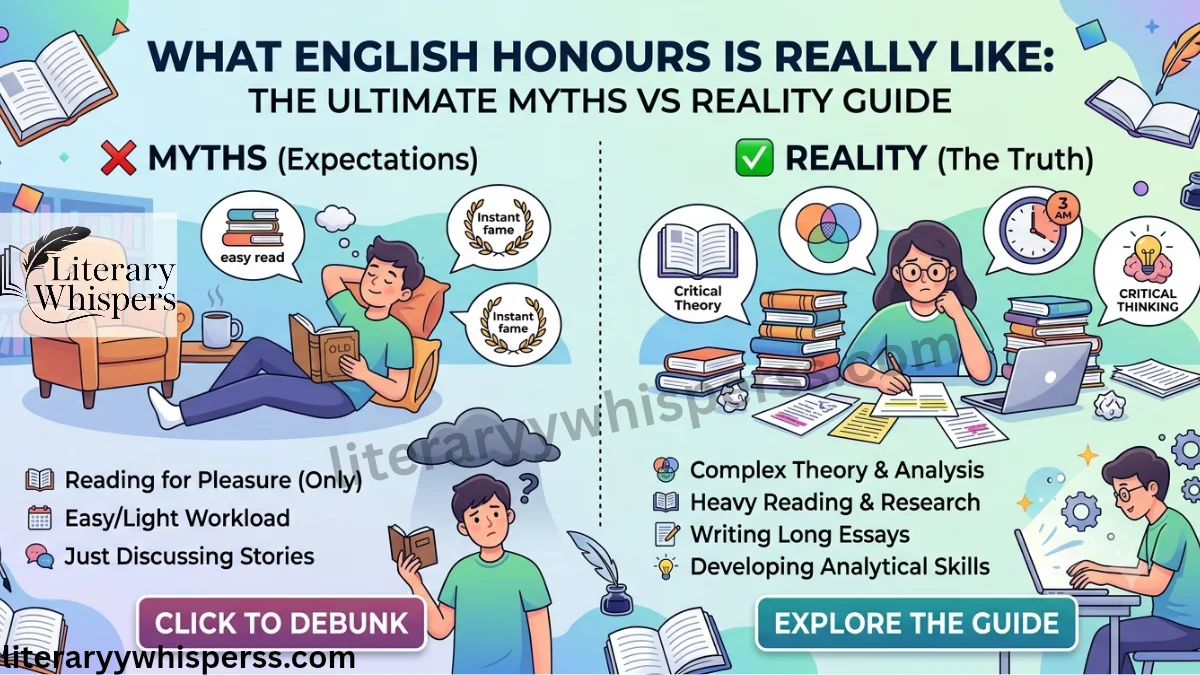
Before you begin your first semester, English Honours already has a reputation.
You have heard things about it. From people who studied it, from people who considered studying it, from relatives who cannot quite understand it, from classmates who chose different subjects and feel the need to explain why yours was the easier option. From the internet, from seniors, from the particular mythology that surrounds any subject that is simultaneously widely chosen and widely misunderstood.
Some of what you have heard is true. Some of it is wildly wrong. Some of it is true in a way that is completely different from how it was presented.
And the gap between what people believe English Honours is and what it actually is — that gap is one of the most consistent sources of difficulty for first-year students. Students who expected one thing and found another. Students who were prepared for a version of the degree that doesn’t exist. Students who missed what was actually remarkable about the experience because they were watching for the wrong things.
This post (What English Honours Is Really Like: The Ultimate Myths vs Reality Guide) closes that gap.
Twelve myths about English Honours — the things people believe before they begin, the stories that circulate in corridors and family dinners and orientation sessions. And twelve realities — what it is actually like, from someone who has been inside it long enough to know.
Not to discourage. Not to intimidate. To prepare you. Because the version of English Honours you are about to discover is stranger, harder, more demanding, and more genuinely rewarding than almost any myth about it suggests.
Myth 1: “English Honours Is Easy Because You Just Read Books”
This is the most common myth and the one that does the most damage.
The logic seems sound: English is a subject you have been studying your whole life. You can read. You enjoy reading. How difficult can a degree in reading be?
The reality:
English Honours is not a degree in reading. It is a degree in reading, thinking, arguing, and writing — simultaneously, at a level of precision and originality that most students have never been asked to operate at before.
Reading for English Honours is not the same activity as reading for pleasure. When you read Hamlet for English Honours, you are reading a specific text in a specific language that has changed significantly over four hundred years, produced by a specific writer in a specific theatrical context, received by four centuries of scholars and critics whose arguments you are expected to know and engage with. You are reading it in order to construct an original, specific, evidenced argument about what it does and how it works. You are then expected to write that argument in clear, precise prose under time pressure.
The reading is the beginning, not the end.
Students who arrive expecting English Honours to be a formalisation of what they already do for pleasure — reading books and enjoying them — encounter a significant cognitive shock. The degree is rigorous. The standards are demanding. The skills required — close reading, analytical argument, theoretical literacy, precision of language — must be developed from the ground up for most students.
It is not easy. It is rewarding. Those are different things.
Myth 2: “You Can Just Use Your Own Opinion”
“English is subjective — there are no wrong answers. So I can say whatever I think.”
This belief arrives with almost every fresher and causes more examination failures than any other single misconception.
The reality:
Your opinion matters in English Honours — but only if it is a developed opinion. An opinion supported by specific textual evidence. An opinion that engages with what critics have argued. An opinion that acknowledges complexity and counterargument. An opinion, in other words, that is an argument.
“I think Hamlet delays because he is indecisive” is an opinion. “In this essay I argue that Hamlet’s delay is not a character flaw but a philosophical position — the recognition that in a world structured by systematic deception, action cannot produce reliable justice” is an argument. The first earns no marks beyond demonstrating that you have read the play. The second earns marks according to how well you support it.
Literature is not subjective in the sense that all responses are equally valid. It is subjective in the sense that its truths are not numerical or empirical — they are interpretive. But interpretation is not opinion. Interpretation requires evidence, logic, engagement with the text, and awareness of what others have argued. It is an intellectual discipline with standards, not a space of free expression.
The student who understands this distinction will write much better essays than the student who doesn’t.
We addressed this in detail in [How to Write Better Literature Answers in University Exams] and [Can You Score 80%+ in English Honours?] — both posts are essential reading before your first essay.
Myth 3: “English Honours Students Are Quiet Introverts Who Don’t Do Anything Social”
The stereotype: the English student is a pale, bookish recluse who lives in the library and has no friends outside of the literary society.
The reality:
English Honours students are among the most socially engaged, intellectually lively, and culturally active students at any university. The subject attracts people who are curious about the world, fascinated by human behaviour, and passionate about ideas — qualities that tend to produce interesting, engaged people, not recluses.
Seminars — the core teaching format of English Honours — require you to speak, to argue, to engage with other people’s thinking in real time. The student who cannot participate in discussion is genuinely disadvantaged. The subject actively develops social and communicative capacities.
The literary society events, the theatre trips, the reading groups, the late-night arguments about whether Wuthering Heights is a love story or a horror novel — these are the culture of English Honours departments across India. They are social. They are lively. They are some of the most genuinely pleasurable intellectual experiences available in university life.
The quiet introvert stereotype is a lazy caricature. English Honours contains introverts and extroverts in equal measure, people who are socially anxious and people who are confident, people who prefer books and people who prefer people. What it requires of all of them is the willingness to engage — with texts, with ideas, with each other.
Myth 4: “You Have to Have Read Everything Before You Begin”
“Everyone in my seminar will have read all of Shakespeare and Austen and the major Victorian novelists. I haven’t. I am behind before I have even started.”
The reality:
Nobody has read everything before they begin. Nobody. The student who appears to have read everything has read some things and is performing familiarity with the rest. The student who has genuinely read widely but honestly is more prepared than the one who has skimmed more widely but superficially.
English Honours is not a test of prior reading. It is an education in how to read. The texts you will encounter in your first semester — Beowulf, Chaucer, Shakespeare — will be approached as new material by almost every student in the room, regardless of their prior exposure. The analytical skills required to study them are developed during the degree, not brought to it.
What matters before you begin: not a particular reading history, but the willingness to engage seriously with what you encounter. Curiosity, not a catalogue.
We addressed this directly in [50 Frequently Asked Questions by New English Honours Students] — particularly questions 1 and 6, which deal precisely with this anxiety.
Myth 5: “The Professors Will Tell You What Everything Means”
“I just need to write down what the professor says and reproduce it in the examination. That’s how it worked at school.”
The reality:
This is the most consequential misconception about university-level literary education, and we have addressed versions of it throughout this website — most directly in [10 Biggest Mistakes Every English Honours Fresher Makes] and [Your First English Honours Class: What Actually Happens?]
Professors do not tell you what texts mean. They model ways of reading. They introduce critical conversations. They demonstrate analytical approaches. They ask questions — often more questions than they answer. They challenge your assumptions. They tell you when your argument is weak. They point you toward the scholarship that will help you develop your own position.
But the position — the interpretation, the argument, the specific claim about what a text does and why it matters — that must come from you.
This is not a failure of the educational system. It is the entire point. The development of independent analytical and argumentative capacity is what a university education is for. The professor who tells you what Hamlet means has produced a student who knows what one person thinks about Hamlet. The professor who teaches you how to read Hamlethas produced a student who can read any text.
The adjustment from “the teacher gives me the answer” to “I construct the answer with the teacher’s guidance” is the central transition of English Honours. Make it early.
Myth 6: “English Honours Is All About Literature — Theory Is Extra”
“I don’t need to understand Derrida or Foucault or Spivak. I’m here for the books.”
The reality:
Literary theory is not extra. It is the intellectual framework within which modern literary study takes place. Understanding how to read a text is, necessarily, a theoretical activity — it involves assumptions about what a text is, what it does, how it relates to its context, whose experience it represents, and what counts as evidence for an interpretation.
You are already operating within theoretical frameworks. Every time you read a text and notice the power relations it depicts, you are doing something close to Marxist criticism. Every time you notice how it represents women, you are doing something close to feminist criticism. Every time you ask what the historical context tells you about the text’s meaning, you are doing something close to new historicism.
Literary theory makes these implicit frameworks explicit and rigorous. It gives you a more precise vocabulary for what you are already doing when you read carefully. And it introduces you to frameworks you haven’t yet used — frameworks that will allow you to see things in texts you would otherwise miss.
The student who understands feminist theory reads Jane Eyre differently — and better — than the student who doesn’t. Not because theory tells you what the text means, but because it gives you better questions to ask of it.
We introduced the major theoretical frameworks in [100 Most Important Literary Terms Every English Honours Student Must Know] — entries 86 through 100 cover close reading, New Criticism, deconstruction, postcolonialism, feminist criticism, Marxist criticism, and psychoanalytic criticism.
Myth 7: “Good Writers Make Good English Honours Students”
“I write beautifully. Therefore English Honours will be easy for me and I will do well.”
The reality:
Good writing helps. Good writing in the style required by academic literary analysis — analytical, precise, argumentative, evidenced — is a specific skill that most people, even excellent writers, have not yet developed when they begin the degree.
The student who writes beautiful personal essays, evocative creative fiction, or compelling journalistic prose is not automatically equipped for academic literary argument. The conventions of academic writing — the thesis statement, the evidenced paragraph, the engagement with secondary sources, the acknowledgement of counterargument — must be learned regardless of your prior writing ability.
Conversely: the student who does not consider themselves a “writer” in any creative sense can become an excellent academic literary essayist. Academic writing is not about voice, style, or expressive beauty. It is about clarity, precision, and the quality of the argument. These are learnable skills, not natural gifts.
The relationship between creative writing ability and academic essay writing is real but indirect. The sensitivity to language that makes a good creative writer will serve you in close reading and in the precision of your analytical prose. But it will not automatically produce the kind of structured, evidenced, argumentative writing that English Honours requires.
Develop both. They are not the same skill.
Myth 8: “English Honours Has No Future”
“You can’t get a job with English Honours. It’s a useless degree. You should have done something practical.”
The reality:
This myth is so thoroughly addressed in [English Honours Career Guide: 25 Career Options After Graduation] that we will be brief here.
English Honours is one of the most broadly applicable undergraduate degrees available. The skills it develops — critical thinking, analytical writing, research, communication, the ability to hold complexity — are precisely the skills the professional world most consistently reports needing and not finding.
Law. Journalism. Management consulting. Content strategy. UX writing. Publishing. Public policy. Digital marketing. Education. Civil services. Entrepreneurship. Screenwriting. Human resources. Technical writing. Non-profit work.
These are not aspirational outcomes for lucky graduates. They are the actual careers of English Honours graduates across India and worldwide. The degree is not a limitation. It is a launchpad — for any field that requires you to read carefully, think analytically, and communicate precisely.
The people who say “English Honours has no future” are wrong in ways that are easily documented. The evidence is the careers of the people who have the degree.
Myth 9: “Three Years Is Too Long to Study Literature”
“How much can there be to study? Surely by the end of the second year you’ve covered everything important.”
The reality:
Three years is not enough.
This is not a complaint — it is a fact about the nature of the subject. English literature spans over a thousand years of continuous production in a language of extraordinary complexity, produced across multiple national and cultural contexts, shaped by every major intellectual and political development in human history. The secondary criticism of this literature — the scholarly conversation about what it means and how it works — is itself larger than any individual could read in a lifetime.
Three years of English Honours is a beginning. A rigorous, demanding, genuinely transformative beginning — but a beginning.
What changes over the three years is not that you cover “everything.” What changes is that you develop the capacity to engage with literary texts at a level of depth and sophistication that continues to grow after the degree ends. The graduate who leaves with a first-class degree is not a person who has read everything or understood everything. They are a person who has developed the analytical and interpretive capacities that will allow them to continue reading and understanding for the rest of their life.
The three years is not the container for all the literature. It is the development of the capacity to engage with literature. That capacity does not expire.
Myth 10: “You Either Love or Hate Every Text You Study”
“I read Beowulf and I was bored. This is going to be a disaster.”
“I read The Canterbury Tales and I loved it. This degree is perfect for me.”
Both responses — positive and negative — are treated as decisive by many students.
The reality:
Your first response to a text is data, not a verdict.
Some texts reveal themselves slowly. Beowulf on first reading can feel remote and alien. On second reading, with some understanding of the elegiac tradition and the warrior culture that produced it, it can feel extraordinarily powerful. The Waste Land is famously difficult on first encounter and famously rewarding on sustained engagement. Middlemarch can seem slow in the first fifty pages and revelatory by the end.
Some texts you will never love — and that is fine. You can write excellent essays about texts you don’t love. Critical distance is often an advantage, not a limitation. The student who loves Hamlet so much that they cannot be objective about it is sometimes less useful analytically than the student who finds it interesting rather than personally moving.
The honest reality of English Honours is that you will encounter many texts. Some will find you — will arrive at exactly the right moment in your life and mean something that surprises you. Some will become better on second reading. Some will never move you and you will still have to study them with care and professionalism. A few will become lifelong companions.
All of this is normal. None of it is decisive.
Myth 11: “English Honours Students Are Always Reading”
The image: the English student perpetually immersed in a book, always in the library, never without a novel or a poetry collection in hand.
The reality:
English Honours students read a great deal — more than students in most other subjects. But the reality of the reading experience is less romantic and more varied than the stereotype suggests.
Some of the reading is deeply pleasurable — the texts that find you, the poems that stay, the novels you read in a single sitting because you cannot put them down.
Some of the reading is effortful. Paradise Lost at 9am on a Tuesday requires genuine effort even from the most enthusiastic reader. Old English grammar is a genuine obstacle before it becomes familiar. The first fifty pages of The Name of the Rose are dense with medieval theology before the narrative fully opens.
Some of the reading feels like a task rather than a pleasure, and that is honest and normal. The discipline of reading carefully and consistently even when it does not come easily is itself a skill that English Honours develops. The student who only reads when inspiration strikes will not read enough. The student who has built the reading habit — who reads regularly because it is part of how they organise their days — will read what is required and more.
The reading life of an English Honours student is not a continuous experience of literary bliss. It is a practice — regular, sometimes effortful, occasionally transcendent.
Myth 12: “English Honours Will Make You Love All Literature Equally”
“After three years of English Honours, I will appreciate everything.”
The reality:
The opposite tends to be true. The more seriously you study literature, the more specific your taste becomes. The development of genuine literary discrimination — the ability to recognise what is excellent and what is merely competent, to feel the difference between a precise metaphor and a clichéd one, to understand why certain structural choices work and others don’t — is one of English Honours’ actual achievements.
This discrimination is not snobbery. It is the natural consequence of spending three years attending closely to how language works. You become less tolerant of carelessness because you have developed the sensitivity to notice it.
It also means becoming more passionately attached to the writers and texts that genuinely move you. The English Honours graduate who says “Keats is the most important thing that has ever happened to me intellectually” is not performing sophistication. They are reporting what three years of close engagement with the odes produced.
You will not love all literature equally. You will love specific things deeply and recognise others as less essential for your particular sensibility. That specificity is a form of development, not a failure of open-mindedness.
What Nobody Tells You — The Things That Are True But Rarely Said
Beyond the myths and their corrections, there are things about English Honours that are true but rarely stated plainly.
The loneliness of the independent study.
English Honours involves a great deal of time alone with a book. This is the nature of the subject. For many students — particularly those who find their social energy in group activity — the long hours of solitary reading can be genuinely difficult. This is not a personal failing. It is the reality of a subject that requires deep, sustained, individual attention. Finding the balance between the necessary solitude of reading and the social engagement of seminars and student life is an ongoing practice.
The imposter syndrome is almost universal.
Almost every English Honours student, at some point in their first year, sits in a seminar and feels that they are the only person in the room who doesn’t understand what is happening. This feeling is almost never accurate. It is the product of comparing your private uncertainty to other people’s public performance. The other people in your seminar are managing the same uncertainty — some more successfully, some less. The difference is usually the willingness to acknowledge it.
The feedback can sting.
When you have written an essay that you believed in, that you spent real time on, that expressed genuine thinking — and the feedback says “unclear argument” or “too much summary” or “where is your evidence?” — it stings. This is not a pleasant aspect of English Honours. It is a necessary one. The feedback is information. Acting on it makes you better. Not acting on it keeps you stuck. The student who takes feedback personally and retreats is less well-served than the student who takes it seriously and revises.
The examiners are not your enemies.
Examinations produce anxiety. That anxiety sometimes produces a specific paranoia: the belief that the examiners are looking for ways to penalise you, that the questions are designed to confuse, that the marking is arbitrary. This is almost never true. Examiners want to find good answers. They are marking a great number of answers and they are genuinely pleased when one is excellent. They are not adversarial. They are assessing. Treat them as such.
Some seminars will be better than others.
Not every seminar will be a revelatory intellectual experience. Some will be slow. Some will be dominated by one or two voices that aren’t the most interesting in the room. Some will take on a life of their own and produce something you couldn’t have predicted from the reading. The quality of the seminar depends on who attends, what they have prepared, how much they are willing to risk, and whether the tutor can create the conditions for genuine discussion. Not all of these variables are in your control. What is in your control is your preparation and your willingness to contribute.
The texts change with time.
A poem that does nothing for you at eighteen may be the poem that saves your life at twenty-eight. The texts on your reading list are not items to be consumed and discarded — they are introductions. They will be available to you for the rest of your life, and your relationship with them will develop as you develop. The degree is planting seeds, many of which will not flower until long after it ends.
What English Honours Actually Is — The Honest Version
Here is the description that no prospectus, no official university website, no orientation session gives you but that is the most accurate available:
English Honours is three years of sustained, demanding engagement with some of the greatest writing in the English language and beyond. It is intellectually rigorous in ways that will require you to develop capacities you didn’t know you needed. It is sometimes lonely and sometimes exhilarating and frequently both simultaneously. It will require you to read things you find difficult and write arguments you aren’t sure about and sit in seminars where you feel out of your depth.
It will also give you — if you engage with it honestly and seriously — a quality of mind that very few educational experiences produce. The ability to read closely, to argue precisely, to hold complexity without forcing premature resolution, to encounter language at the level of its actual workings, to find in the texts of four centuries and multiple cultures a living conversation about what it means to be human.
It is not what most people think it is. It is harder. It is stranger. It is more alive.
It is also, for the people it is for — the curious, the serious, the genuinely invested — one of the most rewarding intellectual experiences available in any university in the world.
A Personal Reflection: The Moment the Myth Broke
I arrived at English Honours with the first myth fully intact.
I expected to read books I loved and discuss them with people who loved them too, in an atmosphere of gentle literary enthusiasm, for three years. I expected my natural affinity for reading to carry me through. I expected the degree to be an expansion of what I already did — reading for pleasure — into a formal, credentialed context.
The first essay came back. The feedback said: “Where is the argument? You have described the poem but you have not said anything about it.”
I read this in the corridor outside my tutor’s office, and something shifted.
Not collapse. Not discouragement. Something more useful: the recognition that I had been wrong about what I was doing. That the degree was not a formalisation of what I already did. It was an invitation to do something I had never done before.
I went home. I read the poem again. I asked myself: what do I actually think this poem is doing? Not what does it describe. What does it do?
An answer arrived. Imperfect, uncertain, but mine. I wrote it in my notebook. I wrote an essay from it.
That shift — from enjoying literature to thinking about literature, from responding to a text to arguing about it — is what English Honours is actually for.
I was lucky to discover it in the first semester rather than the third year.
This post is my attempt to help you discover it before you even begin.
Summary: Myths and Realities at a Glance
| Myth | Reality |
|---|---|
| “It’s easy — you just read books” | It’s rigorous; reading is the beginning, not the end |
| “You can just use your own opinion” | Opinions must become arguments, supported by evidence and analysis |
| “English students are quiet introverts” | Seminars require active participation; the culture is socially engaged |
| “You need to have read everything before starting” | Prior reading helps but the degree teaches how to read |
| “Professors tell you what texts mean” | Professors model reading; you construct the argument |
| “Theory is extra — I’m here for the books” | Theory is the intellectual framework of modern literary study |
| “Good writers automatically do well” | Academic essay writing is a specific, learnable skill |
| “English Honours has no future” | It develops the most sought-after transferable skills in the professional world |
| “Three years is too long” | Three years is a beginning; the capacity developed continues growing |
| “You either love or hate a text from first reading” | First responses are data, not verdicts; texts reveal themselves over time |
| “English students are always reading blissfully” | The reading life is a practice — regular, effortful, occasionally transcendent |
| “You’ll love all literature equally after three years” | You’ll develop specific, passionate taste and genuine critical discrimination |
A Warm Closing from Literary Whispers
The version of English Honours you are about to discover is not the one most people think they are signing up for.
It is more demanding. More rigorous. More genuinely intellectual than the image of “reading books for three years” suggests. It will require things of you that no one told you it would require — analytical precision, argumentative discipline, theoretical literacy, the willingness to be wrong and revise and be wrong again and eventually be right.
And it will give you things that no one fully prepared you for either.
The moment a poem you have read six times suddenly opens and means something you didn’t see before. The essay that surprises you by saying something you didn’t know you thought. The seminar discussion that continues in your head for weeks. The book that finds you at exactly the right moment and does something irreversible to how you see the world.
These are not mythological outcomes. They are the ordinary experiences of serious literary study, available to any student who engages honestly with the degree.
The myths are not the degree. The reality is better.
Go find out for yourself.
Which myth did you believe most strongly before you began? Tell me in the comments — I want to know what you were expecting and what you found instead.
Share this post with every incoming English Honours student you know — let them arrive prepared for the real thing.
With love and ink, Literary Whispers.
Where literature feels like home.

