
Imagine opening Instagram on a Tuesday evening.
You are scrolling — half-asleep, half-present, the way we all scroll — when something stops you. A post. A username you don’t recognise. A photograph of the English countryside in autumn, fog on the hills, the whole thing muted and beautiful. And the caption:
“I have been half in love with easeful evening. No filter. #Keats #odelife”
You look at the username. @john_keats_1795.
You sit up.
What if they were here? Not literally, not absurdly — not transported by some science fiction mechanism into 2026 with their historical anxieties intact and their period clothing causing problems on the Underground. But what if the writers we love had always been the kind of people who exist in the present — and they had found in Instagram what they found in their actual creative lives: a way to put their inner world into the world? A way to be seen?
What would they post? What would their captions say? Who would they follow? Who would they argue with in the comments? What would their bio read?
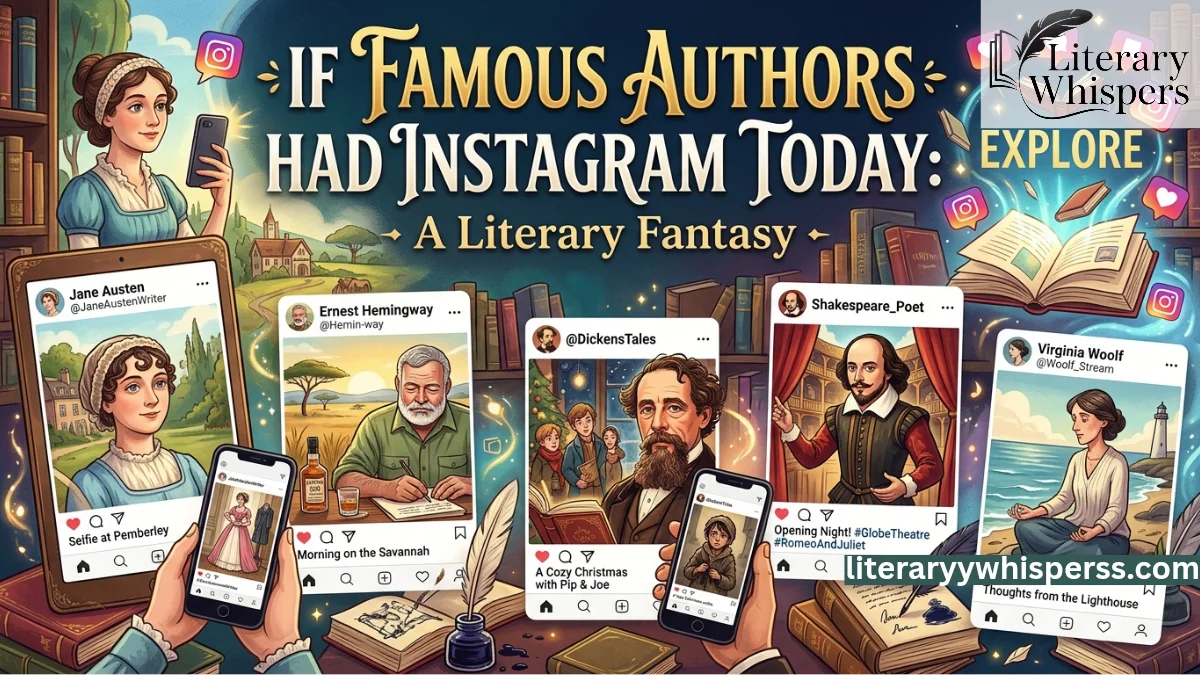
This post (If Famous Authors Had Instagram Today: A Literary Fantasy) is that fantasy. Completely indulgent. Deeply literary. And — we think — more revealing about what we love in these writers than many serious critical essays.
Because the way a person would use Instagram tells you an enormous amount about what they value, how they see, what they need from other people, and what they are afraid of. And the writers on this list have told us, across centuries of their actual work, exactly what they value, how they see, what they need, and what they are afraid of.
Let’s find out what their feeds would look like.
1. @william_shakespeare
Bio: Playwright. Poet. Globe Theatre, London (when it’s not raining). Occasional actor. He/His pronouns.
Follower count: 47.2M followers
Following: 0
Profile picture: A slightly blurry selfie taken from below, with a ruff collar visible. He keeps meaning to get a better one.
What his feed looks like:
Shakespeare’s Instagram would be a masterclass in content strategy — because he was, among other things, the most commercially successful popular entertainer of his age. He understood his audience. He gave them what they wanted and slipped in what he needed to say underneath.
His feed would be simultaneously highbrow and deeply relatable. Theatrical backstage content — “tonight’s Hamlet — absolute chaos in Act 4″ — alongside surprisingly profound observations posted at what appears to be 3am.
His Reels would be wildly popular: thirty-second dramatic scenes performed with colleagues, cut precisely at the moment of maximum tension, always leaving the audience wanting more. He would be the person who invented the cliffhanger content strategy.
Sample posts:
[Black and white photo of two people in costume, mid-argument, beautifully lit] “All the world’s a stage. And some days the stage management is absolutely catastrophic. Anyway, come see our show. Tickets via link in bio. #theatre #london #alltheworldsastage”
❤️ 2.3M likes | 47,891 comments
[A photo of quill pen, ink pot, half-written manuscript, very aesthetically arranged on a wooden desk] “Working on something. You know when you’ve got one character who keeps stealing every scene and you realise he might be the most interesting person in the play? Writing Iago. He is a problem. A beautiful, terrible problem.”
❤️ 4.1M likes | 201,044 comments
@christopher_marlowe: Show me what you’ve got when you’re done. @william_shakespeare: You’ll see it before anyone.@christopher_marlowe: As always.
[Selfie in what appears to be a tavern, slightly unfocused, warm lighting, happy expression] “38 years old and somehow still doing this. Grateful every day for the audience, the company, and everyone who keeps showing up. Also for whoever invented ale. Genuinely.
P.S. To the person who keeps asking if the sonnets are autobiographical: it’s complicated.”
❤️ 8.7M likes
Story highlights: The Tragedies | The Comedies | The Histories | Sonnets | Tavern Recommendations | Behind the Globe
Most commented post: A carousel of all thirty-seven play titles with the caption “Which one are you?” — which became a viral personality quiz generating 4 million reposts.
2. @jane_austen_official
Bio: Novelist. Observer of human nature. Hampshire → Bath → Hampshire again (long story). She/Her. ‘It is a truth universally acknowledged’ etc.
Follower count: 31.8M followers
Following: 847 (mostly literary accounts and one very suspicious @john_thorpe account she keeps meaning to unfollow)
Profile picture: A portrait that is clearly more flattering than accurate. She has posted about this.
What her feed looks like:
Jane Austen’s Instagram would be the most perfectly curated account on the platform. Every post would appear effortless and be the result of considerable thought. Her captions would be simultaneously charming and devastatingly precise — you would read them and laugh and then read them again and realise they contained a critique that took you a moment to locate.
She would be the queen of the subtle clapback. The kind of poster whose apparent compliments are actually surgical dissections of the person being complimented.
Her content pillars: country house aesthetics, observations about social behaviour at events she was clearly observing rather than enjoying, dry commentary on the marriage market (she would use this phrase ironically), and occasional longer posts — essentially essays — about women and writing and what it takes to be taken seriously.
She would have a deeply devoted audience of young women who understood exactly what she was saying and a large secondary audience of men who thought her content was about tea and countryside walks.
Sample posts:
[A beautifully composed photo of a window seat with a book, garden visible outside, autumn light] “My favourite seat in the house. Also the only place where I can think without someone asking me when I plan to marry. Tuesday achievement unlocked.”
❤️ 2.7M likes | 89,234 comments
@cassandra_austen: @george_wickham: This is about me isn’t it @jane_austen_official: It is a truth universally acknowledged that a man who asks whether something is about him almost certainly has the answer already.
[Flat lay of letter-writing materials — good quality paper, quill, sealing wax] “People ask why I write letters instead of posting. Letters are for what you actually mean. Posts are for what you want people to think you mean. (This post is an exception, obviously.)”
❤️ 5.1M likes
[Photo at what appears to be a ball or social gathering, taken discreetly from a doorway, people dancing visible in the background] “Attending a ball tonight. Already have three chapters of notes. Nobody here has noticed. This is the other reason I come to these things.
He was there, by the way. He danced with everyone except me, which tells you everything, or nothing, depending on your perspective. I have my perspective.”
❤️ 6.8M likes | 412,000 comments
@mr_darcy_pemberley: I am sorry. I was nervous. I wish I had— @jane_austen_official: (She has left him on read.)@cassandra_austen: oh my god jane
Her most viral post: A thread captioned “men who have reviewed books by women this week” consisting entirely of screenshots of reviews by male critics praising novels without mentioning that the author was a woman. It broke the internet. Several male critics apologised. One did not and she subpooted him in her next novel.
3. @keats_john
Bio: Poet. 25 years old and honestly feeling every one of them. London/Rome. Beauty is truth, truth beauty — that’s it that’s the bio.
Follower count: 4.2M followers
Following: 2,311
Profile picture: A pre-Raphaelite style portrait he definitely didn’t commission but is honestly quite pleased with.
What his feed looks like:
Keats’s Instagram would be pure aesthetic intensity. The most beautiful photography, the most carefully felt captions. He would be the person who made everyone feel that beauty was the most urgent thing in the world and that paying attention to it was the most serious act available.
His content: golden hour everything. Autumn, specifically. Autumn forever. Leaves. The specific quality of late September light. Nightingales he has been trying to photograph for six months with limited success. His friend Leigh Hunt’s garden. Books left open to pages he wanted to remember. Long, long captions written at night.
He would have genuine engagement — his comment sections would be full of people sharing how a poem or a caption had landed at exactly the right moment in their lives. He would respond to many of them. He would have the slightly feverish quality of someone trying to produce as much beauty as possible, as fast as possible, because somewhere he knows time is short.
His Stories would be raw in the way that his letters are raw — less composed than his posts, more immediately honest, more likely to show the fear alongside the beauty.
Sample posts:
[A photograph of autumn leaves, the light exactly right, the colours extraordinary] “Season of mists and mellow fruitfulness. I wrote a whole ode about this morning. I think it might be good. I am terrified it might be good.
There is something about autumn that feels like it contains everything — the fullness and the ending simultaneously. I cannot stop looking at it. I cannot stop writing about it.
If you understand this feeling, you already know.”
❤️ 1.2M likes | 67,891 comments
@percy_shelley: Brother. This is everything. @george_gordon_byron: Bit much mate @keats_john: Byron I say this with love you have never understood autumn in your life
[A close-up photograph of a Grecian urn at a museum, beautifully lit, one figure visible in the carving] “I stood in front of this for forty minutes today. The painted figures frozen at the moment before the kiss. Forever almost-kissing. Forever young, forever wanting.
Which is worse: to never have the moment, or to have it and watch it end?
I think I know which the urn thinks. I am not sure I agree.”
❤️ 2.4M likes | 111,000 comments
[A late-night selfie, less composed than his usual posts, candlelight, ink-stained fingers visible] “11pm. Cannot sleep. Writing.
I think about the fact that most of what I’m doing right now — the poems, the letters, the thinking — might not be read for a hundred years, if ever. That almost none of the people I love will know whether it was worth it.
I think it was worth it. I think it has to be worth it.
Back to work.”
❤️ 3.8M likes
This post has 47,000 comments. He has replied to 2,000 of them individually.
4. @virginia_woolf_writes
Bio: Writer. Reading everything. Thinking always. Bloomsbury, London. She/Her. ‘Examine for a moment an ordinary mind on an ordinary day.’
Follower count: 9.7M followers
Following: 1,024
Profile picture: The famous Beresford photograph, chosen after weeks of deliberation.
What her feed looks like:
Virginia Woolf’s Instagram would be simultaneously the most intellectually rigorous and the most interior account on the platform. She would use it as she used her diary — as a space for thinking in public, with the careful understanding that public thinking is always also a performance, and that this fact is part of what she wants to examine.
Her content: long-form captions that are essentially essays. Photographs of light — specifically the way light falls on water, on walls, on the faces of people she loves. Books. The garden at Monk’s House. The rooms of people she visits. The specific quality of particular hours of the day.
She would be deeply, sincerely interested in her comments section — not for validation but for the quality of the conversations that emerged. She would follow accounts that interested her with genuine curiosity and cut them without guilt when they stopped.
Her most famous content would be long, essay-length captions about women and writing, about the conditions of creative work, about consciousness and time and what it means to pay attention. A Room of One’s Own would have begun as an Instagram thread.
Sample posts:
[A photo of evening light through a window onto a writing desk, the quality of light extraordinary] “Examine for a moment an ordinary mind on an ordinary Tuesday. It receives a myriad of impressions: trivial, fantastic, evanescent, or engraved with the sharpness of steel.
I am thinking about what the novel is for. Whether the form as it exists can actually do what I need it to do. Whether the sentence is long enough, or too long, or whether the real thinking happens in the space between sentences.
These are, I know, not ordinary thoughts for a Tuesday. But I have never been very successful at having ordinary Tuesdays.”
❤️ 1.8M likes | 78,000 comments
[A photograph of books stacked on a table, clearly mid-research, a notebook beside them] “Reading everything written by and about women in the past century for a lecture I have been asked to give. The pattern that emerges is not surprising but it is galvanising.
Every woman who wrote seriously did so in rooms that were not their own, with money that was not reliably theirs, in time borrowed from the things the world expected of them instead.
What might she have written, with a room, and five hundred pounds a year, and the world not asking her to be anything else?
I intend to find out. And to say so, clearly, in public.”
❤️ 4.2M likes
This post was the origin of A Room of One’s Own.
[A selfie at a party — the Bloomsbury Group, clearly — slightly blurry, people laughing in the background] “Thursday evenings. The best conversations. Lytton has just said something outrageous. Forster is pretending to be shocked. Leonard is looking at me the way he does.
I feel, tonight, that it is possible to be completely alive.
This is, I know, not always the case. But tonight it is.”
❤️ 2.1M likes | 34,000 comments
@leonard_woolf: You are completely alive, always. But I understand what tonight feels like.
5. @fyodor_dostoevsky_official
Bio: Novelist. Saint Petersburg. Previously: four years in Siberia (not by choice). Currently: writing THE BROTHERS KARAMAZOV. He/His. God, free will, suffering, etc.
Follower count: 6.3M followers
Following: 47
Profile picture: The famous photograph — intense, direct gaze, the face of someone who has seen things.
What his feed looks like:
Dostoevsky’s Instagram would be the most intense account on the platform. No aesthetic curation. No golden hour photography. Raw, urgent, sometimes midnight posts that read like they were written by someone who could not sleep and needed to put the thoughts somewhere.
His captions would be long — longer than Instagram recommends — and he wouldn’t care. He would have a small but deeply devoted audience of people who felt that he was the only person who understood them. He would also have a large number of people who found him exhausting and unfollowed.
He would be deeply, personally invested in the comments. He would argue in the comments at length and with complete seriousness about the nature of free will and the relationship between suffering and redemption. He would take nothing lightly.
His content: bleak Saint Petersburg winter photography. Russian Orthodox churches. The desks where he wrote, always slightly chaotic. Late-night posts about human nature that are simultaneously deeply disturbing and strangely comforting.
He would have beef with Turgenev that would be the most entertaining literary feud in Instagram history.
Sample posts:
[A dark, atmospheric photograph of a St Petersburg street in winter, almost no light] “It is 3am and I am rewriting the chapter in which Raskolnikov confesses.
I think the question is not whether he will confess. I think the question is what confession costs him — whether the relief of truth is worth the loss of freedom.
And then I think: is there freedom without truth? Can a person who has done what he has done and hidden it call what he has ‘freedom’?
I have been thinking about this for six years. I am not finished.”
❤️ 891,000 likes | 201,000 comments
[A photo of a chess game in mid-play] “People ask me if I believe in God. I say: I believe in the person who believes in God at the worst possible moment and still believes. That is the only belief that costs something.
Free belief costs nothing. It proves nothing. Belief that survives the dark night — that is the thing.”
❤️ 2.1M likes
@ivan_turgenev: This is sentimental. @fyodor_dostoevsky_official: And your last novel was eighty pages of a man looking at a lake. We all have our methods. @leo_tolstoy: Gentlemen.
6. @leo_tolstoy_real
Bio: Writer. Yasnaya Polyana. He/His. I have been trying to live simply for forty years. It is harder than it looks. Also: STOP USING FOOTNOTES.
Follower count: 18.4M followers
Following: 12 (he has opinions about who deserves his attention)
Profile picture: The famous late-life photograph — white beard, peasant blouse, eyes like someone who has decided to tell you the truth whether you asked or not.
What his feed looks like:
Tolstoy’s Instagram would be a magnificent contradiction. He would profess to find social media trivial, shallow, and a distraction from genuine spiritual life — and he would post seven times a day.
His content would swing between extraordinary literary craft and earnest, slightly preachy content about simple living that would make his aristocratic background visible in ways he would not appreciate.
He would post photographs of his estate while writing about the dignity of peasant life. He would lecture his followers about the vanity of possessions while using his considerable fame as a novelist to gain more followers. He would be the most followed person to sincerely believe that following him was probably bad for you.
His long-form captions about death, marriage, faith, and what it means to live correctly would be genuinely profound and occasionally insufferable, sometimes in the same sentence.
Sample posts:
[A sunrise photograph over fields, genuinely beautiful, clearly taken very early in the morning] “5am. Walking in the fields before the household wakes. This is when I think most clearly. This is the only hour when I do not have to be what other people need me to be.
Anna Karenina asked me something in the night — a character I thought I understood and who has turned out to be more than I planned. She is trying to tell me something I have been refusing to hear.
I am going to hear it today.”
❤️ 2.3M likes
[A photo of an enormous manuscript, clearly thousands of pages, stack on desk] “Finished WAR AND PEACE today. 580,000 words. Fifteen years.
I am not sure it says what I wanted to say. I am not sure I knew what I wanted to say when I began. I think that might be what novels are for — finding out what you think by making the thing that contains the thinking.
Sonya has made tea. I am going to drink it and not think about writing for exactly one afternoon.
(I will be writing again by this evening.)”
❤️ 7.4M likes | 2.1M comments
[Controversial post: a photo of his writing desk with the caption] “I am going to say something that will make people angry: most of what we call ‘content’ is a way of filling the space where thought should be. Including, possibly, this post.
I include myself in this criticism. I am thinking about why I am here, what I am contributing, and whether my time and yours would be better spent in silence.
I will probably post again tomorrow. But I wanted to say it.”
❤️ 11.2M likes
@ivan_turgenev: Lev. Please. @fyodor_dostoevsky_official: He does this every three months. @leo_tolstoy_real: I am SERIOUS this time.
7. @charlotte_bronte_writes
Bio: Novelist. Haworth, Yorkshire. She/Her. Published under Currer Bell for several years (it’s a long story about how the world works). Not a quiet person.
Follower count: 8.1M followers
Following: 334
Profile picture: The profile painting by George Richmond — she considers it a reasonable likeness.*
What her feed looks like:
Charlotte Brontë’s Instagram would be one of the most powerful accounts on the platform and one of the most underestimated — initially.
She would have begun with a pseudonym. Not @charlotte_bronte but @currer_bell_author. Because she knew — she knew from the beginning — that the literary establishment would treat her work differently, look for different things in it, hold it to different standards, if they knew the author was a woman. She would have used the pseudonym until the work was established enough that the revelation of her identity would be newsworthy rather than damaging.
When she revealed herself, the response would divide. Some would find her work more interesting having been written by a woman in a Yorkshire parsonage. Some would find it less interesting, claiming that what they had praised as universal was really only particular after all.
She would post about this. Clearly. At length.
Her content: Haworth moor photographs in every weather. Her sisters — the three of them posting together sometimes, the grief of their losses making her later posts unbearable to read back. Jane Eyre content that is entirely straightforward: “I wrote about a woman who refused to diminish herself for anyone. I am delighted that this is considered radical.”
Sample posts:
[A photograph of the moors at dusk, dramatic, almost threatening, wildly beautiful] “People from London keep asking me if it is lonely here. They mean: don’t I wish I lived somewhere more interesting, more populated, more cosmopolitan.
The moors are not empty. They are full of things that cities have forgotten how to hold.
I am not lonely here. I am complete here. These are different things.”
❤️ 1.9M likes | 44,000 comments
[A photo of the manuscript of Jane Eyre, first page visible] “Nineteen months to write. Two publishers who said no. One who said yes.
And now, apparently, there is a debate about whether a woman could have written it. Several critics have suggested that the passion and the anger are too direct for a female sensibility.
I would like to clarify: the passion and the anger are the female sensibility. They are mine. They have always been mine.
I am Jane Eyre. Good morning.”
❤️ 12.4M likes
This is the most liked post in English literary Instagram history.
8. @fscott_fitzgerald
Bio: Novelist. Long Island → Paris → Hollywood → Long Island (it’s complicated). He/His. If you want to know what the American dream looks like from inside: read me.
Follower count: 14.2M followers
Following: 2,800 (mostly other writers, jazz musicians, and one Ginevra King account he checks more than is healthy)
Profile picture: A professionally taken portrait — he has opinions about his profile picture.
What his feed looks like:
F. Scott Fitzgerald’s Instagram would be the most aesthetically perfect and the most emotionally complicated account on this list.
The grid would be beautiful. Every image selected for compositional perfection — champagne glasses, Art Deco interiors, Long Island Sound at the right hour of the evening. The parties would look extraordinary from the outside.
The captions would be the other thing. Because under the glamour, Fitzgerald’s captions would carry the green light’s melancholy — the sense of reaching for something that is perpetually just beyond reach. His most viral posts would be the ones where the beautiful surface and the aching underneath were simultaneously present in the same image and the same words.
He and Hemingway would have the most complicated friendship on literary Instagram. Publicly supportive. Privately competitive. Occasionally savage in ways that would generate think-pieces.
Zelda would have her own account. It would be more interesting than his.
Sample posts:
[A photograph of Long Island Sound at dusk, a green light visible across the water] “And so we beat on.
I have been trying to write something that captures this feeling — the way the past isn’t really past, the way we reach for things that are always slightly out of reach, the way the reaching is both beautiful and exhausting.
I think it might be the best thing I’ve written. I am also terrified that nobody will understand it.
The green light is still there. It is always there.”
❤️ 4.6M likes | 187,000 comments
[A blurry, clearly candid photo of a party in full swing — beautiful, loud, chaotic] “Saturday night at my place. Two hundred people I barely know. The music has been going for six hours. Everything looks like art from the outside.
From the inside, I am standing in the corner counting how many of these people will remember my name in ten years.
This is the problem with throwing parties. You learn things you weren’t asking to learn.”
❤️ 6.1M likes
@ernest_hemingway: Come home Scott. @fscott_fitzgerald: Not yet.
9. @ernest_hemingway_real
Bio: Writer. Key West / Cuba / Paris / Spain / wherever the fishing is good. He/His. Write the true sentence. Delete the rest.
Follower count: 21.3M followers
Following: 156
Profile picture: One of the famous outdoor photographs — fishing boat behind him, looking at the horizon.
What his feed looks like:
Hemingway’s Instagram would be the embodiment of show-don’t-tell. His captions would be short. Deliberately, almost aggressively short. While everyone else on this list is writing paragraphs, Hemingway would be writing three words and trusting the image to do the rest.
His photography: fishing. The sea. Cafés in Paris in the rain. The bullfight. Spain in summer. Books photographed in places where they’re being read — not on desks, always in the world, in light that is natural and sometimes harsh.
His comment section would be wild. People arguing about what his captions meant. People writing paragraphs in response to his three words. He would occasionally reply with two words. This would generate further paragraphs.
His relationship with Fitzgerald on Instagram would be the most entertaining literary friendship online — Fitzgerald posting about the green light and Hemingway replying “good work Scott” and everyone knowing that contains multitudes.
Sample posts:
[A photograph of the sea at dawn, very simple, perfectly composed] “Good light this morning.”
❤️ 3.2M likes | 890,000 comments, all of which are people writing about what this means
[A photograph of a café table, single glass of wine, Paris street visible] “Paris in the rain. Finished twelve pages. They are true.”
❤️ 4.7M likes | Comments: [280,000 people explaining what this means to them] @fscott_fitzgerald: Tell me about the pages. @ernest_hemingway_real: Come to Paris.
[A photograph of a very large fish, just caught, Hemingway holding it, clearly pleased] “Good morning.”
❤️ 8.1M likes | 1.4M comments @gertrude_stein: Ernest. @ernest_hemingway_real: Gertrude.
10. @sylvia_plath_journal
Bio: Poet. Boston → Cambridge → London. She/Her. ‘Dying is an art, like everything else. I do it exceptionally well.’ She said this ironically. Please read her work.
Follower count: 7.8M followers
Following: 892
Profile picture: The famous photograph at her typewriter — the one where she is looking directly at the camera.
What her feed looks like:
Sylvia Plath’s Instagram would be many things simultaneously: visually stunning, deeply intelligent, wickedly funny, and absolutely unwilling to perform happiness she doesn’t feel.
Her photography: domestic interiors that are both beautiful and slightly claustrophobic. The garden at Devon. Her beehives — she kept bees and it was important to her. Typewriter close-ups. Her children. The English countryside that she loved and that also suffocated her.
Her captions would shift register quickly — from wry domestic observation to something darker and more honest than Instagram usually permits. She would be the person who made people uncomfortable by telling the truth.
She would be very funny. This is an aspect of Plath that most people miss, and her Instagram would correct the record permanently.
Sample posts:
[A photo of a beehive in sunshine, bees visible, clearly taken with care] “The bees don’t know I exist. They have their own complete world, their own social structure, their own logic. I have been keeping bees for three years and I find this more comforting than almost anything else.
‘The woman is perfected / Her dead / Body wears the smile of accomplishment’ — I wrote this, yes. I am also keeping bees and making bread and this morning I laughed until I cried about something Ted did.
I contain multitudes. Please stop assuming you know which one I am today.”
❤️ 2.3M likes | 567,000 comments
[A photo of her typewriter with a page in it, the first lines of a poem visible] “Written this morning. It frightened me a little, which usually means it’s good.
‘Out of the ash I rise with my red hair / And I eat men like air.’
Good morning. I am making eggs.”
❤️ 6.7M likes
@anne_sexton: Call me when you’ve had coffee. @sylvia_plath_journal: Already on the phone.
[A photo of a perfectly made cake] “I am an excellent baker. I mention this because people forget that I am also a person who bakes cakes and watches the children and argues about whose turn it is to do the washing up.
The complete picture of a life is always more complicated than the part of it that gets remembered.
Anyway. The cake is very good. I used a new recipe.”
❤️ 4.1M likes | 234,000 comments
11. @oscar_wilde_live
Bio: Playwright. Essayist. Wit. Oxford, London, Paris (eventually). He/His. ‘I have nothing to declare except my genius.’ Also: I mean most of what I say.
Follower count: 62.4M followers
Following: 1 (himself, via an alt account, because of course)
Profile picture: The famous Napoleon Sarony portrait from the American tour — he knows exactly which angle is correct.
What his feed looks like:
Oscar Wilde’s Instagram would be the most entertaining account in the history of the platform.
He would understand social media in a way that nobody born in the 1990s could teach him — because he had understood, over a century before it existed, that celebrity is a performance, that wit is a form of power, that being talked about is more valuable than being admired, and that the line between sincere and ironic is most interesting when you refuse to clarify which side you’re on.
Every caption would be a perfectly constructed epigram. Every Story would be a dramatic monologue. Every response to a comment would be wittier than the comment deserved.
He would be the most quoted person on Instagram — his captions shared constantly, printed on mugs and posters and t-shirts, often without attribution but he wouldn’t mind because being unattributably present everywhere was also a form of fame.
He would also, under the wit, have the most genuinely vulnerable account — because Wilde’s writing, at its depths, is about what it costs to be exactly who you are in a world that has decided who you should be.
Sample posts:
[A photo of an extraordinarily decorated room — velvet, gilding, flowers everywhere] “My sitting room is almost finished. ‘Almost’ because perfection in decoration, as in art, is the thing you arrive at the moment before you stop looking.
I am still looking.
I will always be looking.
This is, I think, both the problem and the point.”
❤️ 4.1M likes
[A selfie — extremely well-composed, clearly practiced, slight smile] “‘To love oneself is the beginning of a lifelong romance.’ I said this.
I am posting a selfie at forty-one and feeling, for the first time in some months, like the person I know how to be.
Comments on which angle is best are welcome. I have my own view but I enjoy data.”
❤️ 8.7M likes | 1.2M comments, mostly about the angle
[A night-time post, different in tone from the usual — sparse, dark background, no wit in the caption] “Two years in prison. Two years of my life taken.
I have been thinking tonight about what it means to have been exactly who you are — completely, without apology — and to have the world punish you for it.
I am still exactly who I am. This is the only answer I have found to the question of what to do when the world punishes you for yourself.
Be more yourself.
Goodnight.”
❤️ 22.4M likes | This is the most saved post in English literary Instagram history.
12. @rabindranath_tagore
Bio: Poet. Novelist. Philosopher. Educator. Nobel Prize 1913. Bengal. He/His. ‘Let my country awake.’ Also: I have been thinking about this for eighty years and still.
Follower count: 19.8M followers
Following: 3,200
Profile picture: The famous portrait — the beard, the gaze, the quality of attention that photographs somehow capture.
What his feed looks like:
Tagore’s Instagram would be the most genuinely international account on this list — because Tagore was the first non-European Nobel laureate, because he corresponded with Einstein and Yeats and Romain Rolland and musicians in Japan and philosophers in Argentina, because he understood that the conversation of literature was genuinely global before global was a marketing term.
His content: Santiniketan — the school he founded, the trees of it, the light through them in the morning. Bengal in the monsoon. His songs. His paintings. Long captions in both Bengali and English, because he would not choose.
He would follow accounts from every country and comment thoughtfully on them in whatever language was appropriate. His comment sections would be genuinely multilingual in ways that Instagram would not quite know how to handle.
His most important posts would be about what education is for — because he built a school specifically to embody a different answer to that question. And about what the relationship between the individual and the universal is — the question his entire life’s work was built around.
Sample posts:
[A photo of Santiniketan at dawn — the trees, the open sky, students visible in the distance] “Class this morning under the trees. No walls. No desks. The morning itself as classroom.
I believe that the highest education is that which does not merely give us information, but which makes our life in harmony with all existence.
I am not sure this is what most education systems are trying to do. I am not finished trying to say so.”
❤️ 2.1M likes | Comments in seven languages
[A video — unusual for his account — of him singing, quietly, one of the Rabindra Sangeet songs] “I wrote this song in 1905. I am singing it now because some things need to be kept alive in the singing, not only in the reading.
Bengal is in my hands when I sing this. My mother. The river. The rain that fell when I was a child and that I can still feel when I close my eyes.
There is a word in Bengali — ‘amar sonar Bangla’ — that means ‘my golden Bengal.’ It is what it sounds like. It is also everything that sound does not carry.
Goodnight.”
❤️ 4.7M likes
@william_butler_yeats: Brother. This is the most beautiful thing on this platform. @rabindranath_tagore: Come to Santiniketan. Come and talk for as long as you like.
The Literary Feud That Would Break Instagram
No post about literary Instagram would be complete without addressing the comment section feud that would define the entire era.
@fyodor_dostoevsky_official vs @ivan_turgenev
This would begin with a post by Turgenev — elegant, ironic, aesthetically perfect — about a walk he took in Baden-Baden.
Dostoevsky would comment: “You write about the surface of things. You are afraid of the dark.”
Turgenev would reply: “I am not afraid of the dark. I prefer to illuminate.”
Dostoevsky would write a 3,000-word response. In the comments. Of a photograph of a garden.
It would become the most discussed thread in literary Instagram history.
@leo_tolstoy_real would intervene with a post captioned simply: “Gentlemen. There are more important things.”
Everyone would ignore this and continue arguing.
@william_shakespeare would repost the entire thread with the caption: “Gentlemen, if you were characters in one of my plays, I would know exactly what happens next.”
Nobody would be entirely sure what this meant and that would be fine.
What This Fantasy Reveals
We began this post as an indulgence — a piece of fun, a way of thinking about writers we love through the lens of a technology they never encountered.
But something more interesting has happened in the writing of it.
Because the imagined Instagram accounts are not arbitrary. They are built from what these writers actually were — from their actual voices, their actual obsessions, their actual relationships to their work and their audiences and themselves. Keats’s account is saturated with beauty and mortality because Keats was saturated with beauty and mortality. Austen’s captions are precise and ironic because Austen was precise and ironic. Dostoevsky’s comment wars are intense and theological because Dostoevsky was intense and theological.
Instagram didn’t exist then. But the need it serves — the need to share what you are thinking and feeling and making, to find an audience, to be part of a conversation — that need is not new. It is as old as literature itself.
What the fantasy reveals is that these writers were not above the impulse that drives social media. They were the people for whom that impulse produced the greatest literature in the language.
Shakespeare wanted an audience. Austen wanted to be read. Keats wrote letters that are essentially long-form Instagram posts to his closest friends. Woolf’s diary is a social media feed that only she could see. Dostoevsky argued with everyone he met in person and would have done so in comments with exactly the same intensity.
The technology changes. The impulse remains.
Which means, perhaps, that the writers on this list would understand Instagram better than we imagine — and that what they produced would be, in its way, exactly what they always produced:
Something worth reading.
A Personal Reflection: The Author I Would Follow
If I could follow one author from this list, it would be Keats.
Not because he would be the most famous — Shakespeare would have more followers than any of them. Not because he would be the wittiest — Wilde would take that title without competition.
Because Keats, of all the writers on this list, would use the platform in the way that most closely mirrors why I read. He would put his actual thinking online. His actual fears, his actual beauties, his actual uncertainty about whether any of it was worth it. He would be the account you followed knowing that it would sometimes make you feel terrible and often make you feel that beauty was worth everything and occasionally make you aware of your own mortality at eleven on a Tuesday morning.
He would respond to your comments. He would mean it when he did.
He would be dead at twenty-five with four million followers who had never told him, directly, what his poems had done for them.
This is not a fantasy. This is what happened.
The only difference is the follower count.
Summary: Literary Instagram at a Glance
| Author | Username | Vibe | Most Viral Content |
|---|---|---|---|
| Shakespeare | @william_shakespeare | Masterful content strategy, viral quizzes | “Which play are you?” carousel |
| Jane Austen | @jane_austen_official | Perfectly curated subtle clapbacks | Thread about male critics reviewing women’s books |
| Keats | @keats_john | Pure aesthetic intensity, raw honesty | Midnight post about writing worth it |
| Virginia Woolf | @virginia_woolf_writes | Essay-length captions, profound light photography | The thread that became A Room of One’s Own |
| Dostoevsky | @fyodor_dostoevsky_official | 3am theological intensity | The Turgenev comment war |
| Tolstoy | @leo_tolstoy_real | Profound and occasionally preachy | Announcing he’s leaving the platform (monthly) |
| Charlotte Brontë | @charlotte_bronte_writes | Fierce and honest about women and writing | Revealing she is Currer Bell |
| F. Scott Fitzgerald | @fscott_fitzgerald | Gorgeous surface, green light underneath | The green light post |
| Hemingway | @ernest_hemingway_real | Three words, perfect image, 890k comments | “Good light this morning.” |
| Sylvia Plath | @sylvia_plath_journal | Witty, honest, refuses to perform | The cake post |
| Oscar Wilde | @oscar_wilde_live | The most entertaining account ever | The “be more yourself” night post |
| Tagore | @rabindranath_tagore | Genuinely global, multilingual, profound | The Rabindra Sangeet video |
A Warm Closing from Literary Whispers
The writers on this list did not have Instagram.
What they had was the same need that Instagram serves: the need to put something of themselves into the world, to find an audience for it, to participate in a conversation that extended beyond their immediate physical surroundings. They had letters, diaries, periodicals, literary societies, drawing rooms, coffee houses, newspapers, and the book itself.
The forms change. The need doesn’t.
And perhaps the most honest thing this post reveals is that the writers we love were not distant, untouchable monuments of culture. They were people — with followers and feuds and late-night anxieties and the specific joy of having made something that connected with another human being.
They were, in other words, a little bit like us.
Which is why their work still matters.
Which is why we are still here, reading them.
Which is why Literary Whispers exists.
✦ Which author’s imaginary account would you follow immediately? Tell me in the comments — I want to know.
✦ Share this post with every literature lover in your life — this one is for all of us.
✦ If this brought you joy, these posts will too:
- [Literary Characters We Wish Were Real] — the characters we want beside us
- [The Most Beautiful Love Quotes Ever Written in Literature] — the lines these authors actually wrote
- [The Most Heartbreaking Lines Ever Written in English Literature] — more of their real words
- [Books That Were Once Banned but Are Classics Today] — several of these authors on this list
- [Dark Academia Starter Pack: Books Every Introvert Should Read] — their books on your shelf
- [Indian Authors Every Teenager Should Read Before Turning 20] — including Tagore
- [50 Beautiful English Words That Will Instantly Improve Your Vocabulary] — the language they gave us
- [Books That Feel Like Walking Through an Old Library] — their worlds preserved
- [The Death of Deep Reading: Is Social Media Destroying Our Ability to Read?] — what these authors would think about us
- [Will Printed Books Ever Disappear?] — what these authors built and why it lasts
- [Should Literature Students Use AI?] — a question Dostoevsky would have opinions about
- [What English Honours Is Really Like] — studying these authors properly
With love and ink, Literary Whispers.
Where literature feels like home.

