There is a moment in the reading of a great literary work when something shifts.
You have been following the story. You know the characters. You understand what is happening — literally, on the surface, in the plot. And then something appears in the text — an object, a colour, a recurring image, a seemingly small detail — and you notice it with a quality of attention that the story’s surface alone doesn’t require.
The green light across the water. The white whale. The locked room. The albatross. The moors.
And you sense — before you can fully articulate it — that this thing is doing more than it appears to do. That it carries a weight beyond its literal presence. That it means something the text is not stating directly but is somehow saying more powerfully for the indirection.
This is the experience of encountering a literary symbol.
Symbols are one of the oldest and most powerful tools available to writers — and one of the most underestimated by readers who encounter them only at the surface level. The student who reads The Great Gatsby and notes that “there is a green light” has noticed something. The student who understands what the green light is doing — what it accumulates across the novel, what it represents at multiple levels simultaneously, what it says about the American Dream and human desire and the impossibility of recovering the past — has entered the text at a completely different depth.
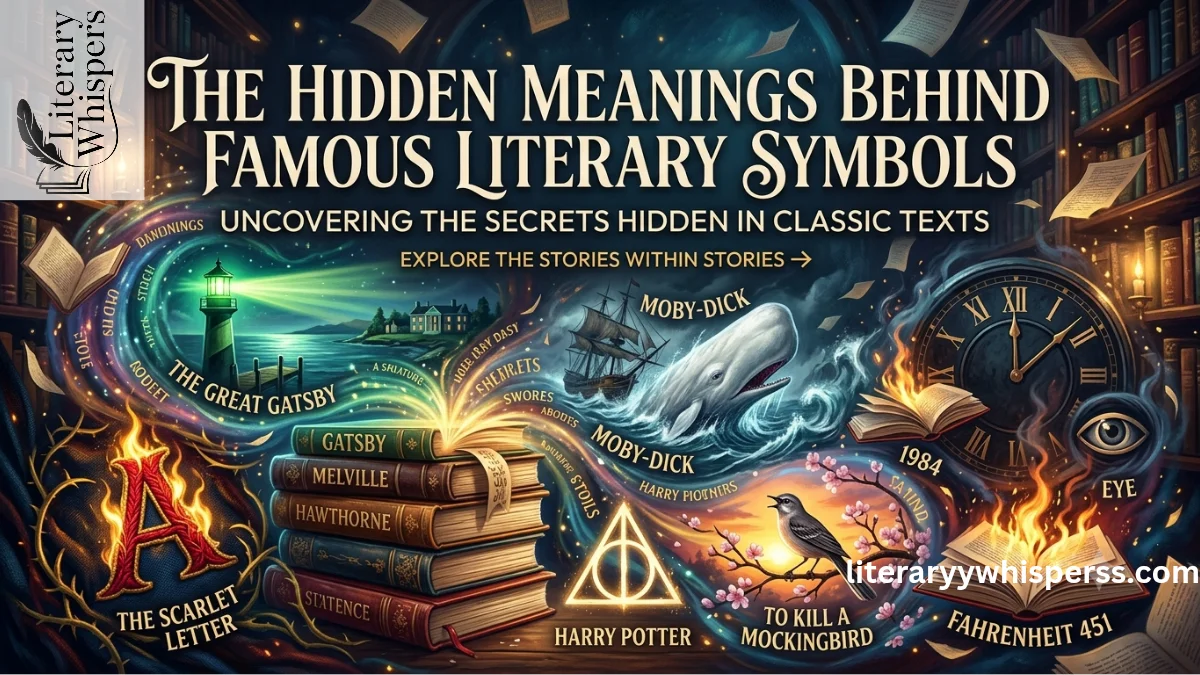
This post (The Hidden Meanings Behind Famous Literary Symbols) opens that depth.
Fifteen of the most famous symbols in English and world literature — explained fully, historically, and with the specific analytical precision that literary study requires. Not just what each symbol “means” in the simple sense, but what it does: how it functions, how it accumulates meaning, how it connects to the text’s larger argument, and why these particular objects and images became some of the most resonant symbols in all of human storytelling.
What a Symbol Actually Is — and Isn’t
Before we meet the symbols, let’s be precise about what we’re talking about.
A symbol is an object, person, place, colour, or event in a literary text that represents something beyond its literal meaning — an idea, an emotion, a value, a social condition, a psychological state.
This definition contains an important implication: symbols are not puzzles with single solutions. A symbol does not “mean” one thing. It accrues meaning — gathering significance from its context in the text, from its historical and cultural associations, from the specific way the writer uses it. The best symbols are polysemic: they carry multiple meanings simultaneously, and those meanings enrich rather than contradict each other.
This is what distinguishes a symbol from an allegory. In an allegory, each element represents exactly one other thing: the Red Cross Knight represents Holiness, the monster Errour represents Error, and so on. The relationship is fixed and one-to-one.
In a symbol, the relationship is open and multiple. The white whale in Moby-Dick is not simply “evil” or “nature” or “God” — it is all of these simultaneously and more, and the richness of the novel comes partly from the symbol’s resistance to being pinned to a single meaning.
Deep Insight:
The literary theorist Tzvetan Todorov distinguished between “restricted” symbolism (where the symbolic meaning is fixed by convention — a white flag means surrender) and “productive” symbolism (where the symbolic meaning is generated by the specific work and its context). All the great literary symbols belong to the second category: they produce meaning through their specific use in a specific text, drawing on but not limited to cultural conventions. Understanding a great literary symbol requires understanding both its conventional associations and its specific deployment.
The Fifteen Great Literary Symbols
1. The Green Light — The Great Gatsby by F. Scott Fitzgerald
What it is literally: A small green light at the end of Daisy Buchanan’s dock across the water from Gatsby’s mansion in West Egg.
The accumulation:
The green light appears three times in the novel, and each appearance deepens and transforms its meaning.
The first time: Nick sees Gatsby at night, standing at the end of his dock, reaching toward something across the water. He is reaching toward the green light — though Nick doesn’t know this yet.
The second time: After Gatsby is reunited with Daisy, Nick observes: “The colossal significance of that light had now vanished forever… His count of enchanted objects had diminished by one.” The light was the dream. Now that Daisy is present — now that the dream has been partly achieved — the light loses its power.
The third time: The novel’s closing lines. “And so we beat on, boats against the current, borne back ceaselessly into the past. Gatsby believed in the green light, the orgastic future that year by year recedes before us.”
What it represents:
The green light is, simultaneously:
Daisy specifically — the object of Gatsby’s particular desire, the woman across the water.
The American Dream — the belief that the future is always achievable, that aspiration is sufficient to produce arrival.
The impossibility of recovering the past — Gatsby’s real desire is not Daisy’s present self but the memory of what they were five years earlier. The green light is always across the water: the past is always across the present, unreachable.
Desire itself — the philosophical truth that desire requires distance to function. Once achieved, the desired thing loses its power. The green light is most powerful when Gatsby is reaching toward it, not when he possesses what it represents.
The colour green: renewal, money, envy, spring, hope. Every association that the colour carries in Western culture is available to the symbol simultaneously.
The analytical move:
Notice how Fitzgerald controls the symbol’s meaning through its strategic placement. The first appearance establishes the image. The second appearance (when the light loses its significance after reunion) provides the symbol’s philosophical argument: the value of a dream is its unachieved state. The third appearance universalises it from Gatsby’s personal story to the human condition.
This is how the greatest literary symbols work: they accumulate meaning through repetition and variation, expanding from the specific to the universal.
2. The White Whale — Moby-Dick by Herman Melville
What it is literally: A sperm whale, albino, enormous, that bit off Captain Ahab’s leg on a previous voyage.
What it represents:
This is the most debated symbol in American literature — and the debate itself is part of the point.
To Ahab: The white whale is malicious — the embodiment of everything malevolent in the universe, the force that disfigured and humiliated him. He pursues it as an act of revenge against evil itself.
To Starbuck (the rational first mate): The white whale is just a whale. Ahab’s attribution of malice to it is a category error — a projection of human moral categories onto an indifferent natural force.
To the reader: The white whale is what you bring to it. Melville deliberately makes Moby Dick resistant to single interpretation — the whale is white, which in Western culture conventionally represents purity and innocence, not evil. The whale is sublime — vast, beautiful, terrifying, awesome. The whale may be God, or nature, or fate, or the unconscious, or the limits of human knowledge.
The whale’s whiteness is the key: Melville has an entire chapter (The Whiteness of the Whale) devoted to analysing why whiteness is both the most pure and the most terrifying colour. White is the combination of all colours or the absence of all colour. It is blank, void, full of potential and full of nothing. The whale resists meaning because meaning requires colour — requires specificity — and the whale is white.
The analytical move:
Moby Dick teaches us that the most powerful symbols may be those that resist interpretation — that the attempt to fix the symbol’s meaning is itself dramatised in the novel as Ahab’s fatal error. The lesson is epistemological as well as moral: some things resist the human desire to impose meaning on them.
3. The Moors — Wuthering Heights by Emily Brontë
What it is literally: The wild, open, windswept moorland surrounding Wuthering Heights in Yorkshire.
What it represents:
The moors in Brontë’s novel are not setting in the conventional sense — backdrop against which the human action occurs. They are an active presence that embodies the novel’s emotional and philosophical concerns.
Heathcliff and Catherine’s passion: The moors are wild, ungovernable, untameable — like the love between the novel’s central figures. They cannot be domesticated any more than the moors can be cultivated into garden.
Freedom and constraint: The moors represent the freedom that exists outside social convention — the space where class, propriety, and social expectation are irrelevant. Catherine feels most herself on the moors. The house — with its social hierarchies and gendered constraints — is the space of constraint. The moors are the space of authenticity.
Death and the supernatural: The moors are dangerous — characters get lost on them, die on them. They are also the space of Heathcliff’s ghost, of the continuation of passion beyond death. The moors do not end — they stretch to the horizon, suggesting an eternity that social life cannot contain.
The natural sublime: The moors embody the Romantic concept of the sublime — the overwhelming natural experience that exceeds ordinary categories of beauty, that produces both terror and awe. Standing on the moors is not a comfortable aesthetic experience. It is an encounter with something larger than the human.
The analytical move:
The moors demonstrate how setting can become symbolic through the specificity of description. Brontë doesn’t merely mention the moors — she returns to them repeatedly, associates them with specific emotional states, and makes the landscape mirror the psychological condition of the characters. When Heathcliff dies, the moors are wild and stormy. When the second generation finds peace, the moors are calmer. The landscape is the emotional weather of the novel.
4. The Albatross — The Rime of the Ancient Mariner by Samuel Taylor Coleridge
What it is literally: A large seabird that follows a ship through the Antarctic. The Mariner shoots it with a crossbow for no stated reason.
What it represents:
The albatross in Coleridge’s poem has become so culturally resonant that “having an albatross around one’s neck” entered the English language as a phrase for a burden of guilt. But the poem’s symbol is more complex than its common cultural use suggests.
Before the killing: The albatross is a good omen — associated with the breaking of the ice, with wind and progress, with something benevolent and almost divine about the natural world.
After the killing: The albatross becomes a sign of sin and guilt — the crew hang it around the Mariner’s neck as a symbol of his responsibility for what follows (the calm, the death of the crew, the supernatural punishment).
After the blessing of the water snakes: The albatross falls from the Mariner’s neck and he can pray. The act of blessing — of recognising the beauty and value of natural creatures — releases him from the guilt of the destruction of a natural creature.
What the albatross represents: The natural world as sacred. The sin of destroying something beautiful and harmless without reason. The connection between humanity and nature that the Mariner breaks and must labour to restore. The guilt that becomes a burden when we act against what is good and beautiful in the world.
The poem’s moral — stated but not simple — is “He prayeth best, who loveth best / All things both great and small.” The albatross is the symbol of what the Mariner failed to love — and the weight of that failure.
The analytical move:
The albatross demonstrates how a symbol can transform meaning through the course of a narrative. The bird means one thing before the killing (natural grace, good fortune) and another after (guilt, burden, punishment). The transformation of the symbol’s meaning is itself the poem’s argument.
5. The Locked Room / Bertha Mason — Jane Eyre by Charlotte Brontë
What it is literally: A room on the third floor of Thornfield Hall that is kept locked. In it lives Bertha Mason, Rochester’s first wife, who is mad.
What it represents:
The locked room and its occupant are the most discussed symbol in Victorian fiction — partly because Jean Rhys’s Wide Sargasso Sea (1966) gave Bertha her own voice and transformed the debate.
The Gothic secret: The locked room is the classic Gothic device — the hidden, repressed truth that the respectable surface of Thornfield Hall conceals. The house as a respectable exterior hiding a terrifying interior is a symbol of Victorian respectability itself: ordered, beautiful on the outside, with something monstrous concealed within.
The repressed self: Sandra Gilbert and Susan Gubar, in their landmark feminist study The Madwoman in the Attic, argued that Bertha represents Jane’s repressed rage — the passionate, ungovernable self that the socially constrained Victorian woman cannot express. Bertha does what Jane cannot: she tears the wedding veil, she attacks her brother, she sets fire to the house. She enacts the violence that Jane must sublimate.
The colonial other: Bertha is Creole — from Jamaica. Her madness and her confinement are inseparable from her racial and colonial status. Read through a postcolonial lens, her imprisonment is the violence of empire made domestic — the colonised figure locked in the attic of the coloniser’s house.
Specifically: Bertha as symbol demonstrates how a single literary element can carry completely different meanings depending on which critical framework you bring to it. The locked room is Gothic convention, feminist symbol, and colonial allegory simultaneously.
The analytical move:
The most sophisticated literary symbols generate multiple valid interpretations from different theoretical perspectives. Knowing these perspectives — and being able to deploy them selectively in relation to specific essay questions — is one of the marks of advanced literary analysis.
6. The Green Light (Revisited) → The Valley of Ashes — The Great Gatsby by F. Scott Fitzgerald
What it is literally: A grey industrial wasteland between West Egg and New York City, covered in ash from the factories. Above it, on a faded billboard, are the eyes of Doctor T.J. Eckleburg — two enormous blue eyes behind yellow spectacles.
What the eyes represent:
The faded American moral conscience: The billboard is an advertisement for an oculist — an eye doctor. The eyes watch over the Valley of Ashes but see nothing, correct nothing, judge nothing. They have been reading as the eyes of God: present, enormous, watching — but faded, commercial, ultimately meaningless.
The decline of spiritual values: George Wilson, the mechanic who lives in the Valley of Ashes, tells his wife before she dies: “God sees everything.” He is looking at the billboard. Fitzgerald uses this moment to make explicit what the symbol implies: in the moral landscape of the novel, God has been replaced by advertising. The eyes that watch over the American Dream are not divine but commercial.
The blind witness: The eyes see everything that happens in the Valley of Ashes — including Myrtle Wilson’s death, the foundational injustice of the novel — and do nothing. They are the symbol of a culture that has the apparatus of moral watching but has lost the substance of moral judgment.
The analytical move:
The Valley of Ashes and Doctor Eckleburg’s eyes work in the novel as a counter-symbol to the green light. The green light is Gatsby’s aspiration — the hope, the dream, the future. The eyes are the moral witness to what that aspiration costs — the wasteland of the people ground up by the pursuit of the American Dream.
7. The Scarlet Letter — The Scarlet Letter by Nathaniel Hawthorne
What it is literally: A red letter “A” that Hester Prynne is condemned to wear on her chest as punishment for adultery in Puritan Boston.
What it represents:
This is one of the most dynamic symbols in American literature — a symbol whose meaning changes across the novel.
Initially: The “A” stands for Adultery — the community’s judgment, Hester’s shame, the punishment of transgression.
As Hester’s life develops: The community begins to interpret the letter differently. Some say it stands for Able — because of Hester’s skill and the charity she shows to the poor. Others, seeing her tend the sick during a plague, say it stands for Angel.
By the novel’s end: The letter has become a symbol of something the Puritan community cannot contain — Hester’s individuality, her moral strength, her capacity for love that survives punishment.
The letter is also embroidered in gold and crimson — made beautiful. Hester transforms the mark of shame into a work of art. The act of beautification is itself a symbolic act: she refuses to wear the letter in the spirit of shame it was designed to produce.
What it represents ultimately: The instability of moral judgment — the way communities impose meanings on individuals that the individuals themselves can transform. The scarlet letter means what the community says it means, and then what Hester makes it mean, and then something that exceeds both.
8. The Conch — Lord of the Flies by William Golding
What it is literally: A large conch shell found on the beach of the island. Whoever holds the conch has the right to speak at assembly.
What it represents:
Democratic order: The conch is the parliament of the boys’ civilisation — the mechanism by which speech is regulated, turns are taken, and the group functions as a collective rather than as a mob. It is the symbol of rational governance, of the social contract, of the idea that rules can be agreed upon and maintained by consent.
The fragility of civilisation: The conch is beautiful but breakable. Its authority is only as strong as the boys’ collective will to honour it. As the novel progresses and the boys’ civilisation breaks down, the conch’s authority is increasingly ignored — first by Jack, then by his hunters, finally by everyone except Ralph and Piggy.
The death of reason: The conch is shattered when Roger pushes the boulder onto Piggy. In the same moment that Piggy — the voice of reason and science — is killed, the conch is destroyed. The two deaths are simultaneous and inseparable: the death of rational governance and the death of the person who embodied it.
The analytical move:
The conch demonstrates how a symbol can be destroyed — and how the destruction of a symbol is as significant as its presence. When the conch shatters, the reader feels its significance physically, because Golding has built its symbolic weight across the entire novel. The moment of destruction is the novel’s moral catastrophe in symbolic form.
9. The Mockingbird — To Kill a Mockingbird by Harper Lee
What it is literally: A bird that only sings — that produces beauty and causes no harm.
What it represents:
The mockingbird is introduced through Atticus’s instruction to his children: “Shoot all the bluejays you want, if you can hit ’em, but remember it’s a sin to kill a mockingbird.” Miss Maudie explains: “Mockingbirds don’t do one thing but make music for us to enjoy. They don’t eat up people’s gardens, don’t nest in corncribs, they don’t do one thing but sing their hearts out for us. That’s why it’s a sin to kill a mockingbird.”
The novel has two mockingbirds:
Tom Robinson: The Black man falsely accused of rape, who works for white people, causes no harm, and is destroyed by a society that finds it convenient to destroy him. He only ever helped — and he is killed anyway.
Boo Radley: The reclusive neighbour who is rumoured to be monstrous, who in reality leaves small gifts for the children and saves their lives. When he kills Bob Ewell to protect Jem and Scout, Sheriff Tate and Atticus agree not to report it. “Mr Arthur’s real name is Arthur,” said Atticus, “and he’s well enough to know it… Let the dead bury the dead this time.” To expose Boo to public attention would be to “sort of like shootin’ a mockingbird.”
What it represents: The destruction of innocence by the prejudice and cruelty of a social system. The mockingbird is the person who gives and never harms — and who is destroyed or threatened by those who cannot tolerate pure goodness.
10. The Wandering Jew / The Ancient Mariner — The Rime of the Ancient Mariner
What it is literally: A man condemned to wander from place to place, compelled to tell his story of sin and punishment to strangers.
What it represents:
The Mariner draws on the medieval legend of the Wandering Jew — condemned to wander the earth until the Second Coming because he mocked Christ. Coleridge’s Mariner is similarly condemned: he must tell his story repeatedly, must relive his sin repeatedly, must bear witness repeatedly.
Guilt as compulsion: The Mariner cannot rest. He cannot return to ordinary life. His sin has made him a permanent outsider — someone who exists between the living and the dead, between the past and the present. The compulsion to repeat the story is both his punishment and his redemption: by telling the story, he shares its moral with the listeners who need to hear it.
The artist as outsider: The Mariner has been read as a symbol of the artist — the person who has seen something others haven’t, who is compelled to communicate it, who exists outside the comfortable social world precisely because of what they know.
The analytical move:
The Ancient Mariner demonstrates how literary symbols can draw on existing cultural and mythological resources. Coleridge didn’t invent the figure of the cursed wanderer — he transformed it. Understanding the tradition a symbol draws on enriches your understanding of what the writer does with it.
11. The Handkerchief — Othello by William Shakespeare
What it is literally: A small embroidered handkerchief — Othello’s first gift to Desdemona, decorated with strawberries.
What it represents:
The handkerchief is the most compact and most devastating object-symbol in Shakespeare. It concentrates the entire tragic mechanism of the play in a single small thing.
Love and trust: Othello tells Desdemona the handkerchief was a gift from his mother, who told her to give it to the man she married, and if she lost it, her husband’s love would leave her. The handkerchief is the physical token of the marriage bond — a small, fragile, embroidered thing.
Chastity: The strawberries embroidered on the white handkerchief have been read as suggesting drops of blood on white fabric — an image of the consummation of marriage and the proof of virginity. The handkerchief is literally evidence of Desdemona’s sexual history.
The mechanism of Iago’s manipulation: When Iago plants the handkerchief in Cassio’s possession and tells Othello Cassio has it, the handkerchief becomes “evidence” of Desdemona’s infidelity. A small piece of embroidered cloth destroys a marriage and kills three people.
The fragility of trust: The handkerchief demonstrates how easily the architecture of love and trust can be dismantled — that the entire edifice of Othello and Desdemona’s relationship can be toppled by a small object placed in the wrong location.
The analytical move:
The handkerchief is a perfect example of how Shakespeare uses objects to concentrate meaning. It is simultaneously literal (a cloth object), symbolic (love, trust, chastity), and theatrical (it is visible to the audience while its manipulation is visible only to Iago). Three levels of meaning simultaneously embodied in one small thing.
12. The Fog — Bleak House by Charles Dickens
What it is literally: Dense London fog, described in the famous opening pages of the novel.
What it represents:
The opening of Bleak House is one of the most deliberate and sustained uses of environmental symbolism in English fiction:
“London. Michaelmas Term lately over, and the Lord Chancellor sitting in Lincoln’s Inn Hall. Implacable November weather. As much mud in the streets as if the waters had but newly retired from the face of the earth… Fog everywhere. Fog up the river, where it flows among green aits and meadows; fog down the river, where it rolls defiled among the tiers of shipping and the waterside pollutions of a great (and dirty) city. Fog on the Essex marshes, fog on the Kentish heights… And hard by Temple Bar, in Lincoln’s Inn Hall, at the very heart of the fog, sits the Lord High Chancellor in his High Court of Chancery.”
The legal system: The fog is the Court of Chancery — the law’s opacity, its obscurantism, its ability to envelop and obscure and prevent clear sight. The Jarndyce and Jarndyce case that is the novel’s central legal action has been going on so long that nobody can remember its origin. It is the legal equivalent of fog.
Social confusion: The fog connects every social class in the novel — it touches the river workers and the lawyers alike. The fog is the condition of Victorian society: obscure, pervasive, disabling, particularly for those who lack the resources to navigate through it.
Moral and epistemic blindness: The fog prevents sight — and the novel’s characters are repeatedly unable to see clearly, to understand their situations, to navigate the world as it actually is.
13. The Sea — Multiple Texts
The sea is one of the oldest and most persistent symbols in Western literature — appearing in Homer, in Beowulf, in Shakespeare, in Victorian poetry, in Conrad, in Woolf.
Its meanings accumulate across the tradition:
The unconscious: The sea is deep, dark, and largely uncharted — the exterior world’s equivalent of the Freudian unconscious. What lies beneath the surface is unknown and potentially dangerous.
Death and eternity: The sea does not end. Its continuity — always moving, always present, indifferent to human lives — makes it a symbol of the eternal and the mortal’s relationship to it.
The unknown and the sublime: The sea is the beyond — the space of exploration, of what lies outside the known world. Tennyson’s Ulysses sails “beyond the sunset, and the western stars, before I die.” The sea is always the direction of the unknown.
Freedom and danger: The sea is simultaneously the space of freedom (no social conventions, no fixed land, no property) and the space of danger (storm, wreck, death).
In Virginia Woolf’s The Waves, the sea’s rhythmic movement structures the entire novel — the waves are time itself, constantly advancing and retreating, shaping and eventually erasing the characters’ lives.
In Conrad’s The Nigger of the ‘Narcissus’ and Heart of Darkness, the sea is the threshold — the space between the known world and the darkness beyond.
14. Light and Darkness — Throughout Literary History
Light and darkness are the oldest symbolic pair in literature — present in Genesis, in Homer, in Shakespeare, in Milton, in every subsequent tradition.
Their conventional associations:
Light: Knowledge, goodness, God, consciousness, truth, civilisation. Darkness: Ignorance, evil, chaos, the unconscious, the unknown, barbarism.
But the most interesting literary uses of light and darkness complicate these conventions:
In Heart of Darkness, Conrad inverts the conventional symbolism: the “dark” continent of Africa is associated with truth and moral clarity, while the “light” of European civilisation is revealed as the real darkness — the darkness of exploitation, denial, and moral corruption. The title’s “darkness” refers as much to European hearts as to the African landscape.
In Paradise Lost, Satan is associated with light — he was Lucifer, “light-bearer” — while God’s brightness blinds rather than illuminates. Milton complicates the conventional association to suggest that brightness can be its own form of obscurity.
In Keats‘s Ode to a Nightingale, the darkness of the forest is associated with beauty and escape, while the light of ordinary consciousness is associated with the painful awareness of mortality.
The analytical move:
When you encounter light and darkness in literary analysis, your first question should not be “which is which?” but “is this text using the conventional association or inverting it?” The inversion — darkness as truth, light as illusion — is often where the most interesting analysis begins.
15. The Garden — Multiple Texts
The garden is the site of the original human story — the Garden of Eden — and carries that origin into every subsequent literary garden.
Paradise and innocence: The garden before the fall — enclosed, abundant, protected, harmonious. In English literature, the walled garden is consistently associated with a lost innocence, a prelapsarian state that cannot be recovered.
The controlled and the wild: Gardens require cultivation — they are nature under human management. The gardened nature of the garden, versus the ungoverned nature of the moor or the sea, represents civilisation’s imposition on the natural. The tension between the formal garden and the wild beyond its walls is a recurring symbolic structure.
In The Secret Garden by Frances Hodgson Burnett: The secret, walled garden that has been locked for ten years is a symbol of the grief and isolation of the characters — and its restoration is the novel’s central symbolic act.
In Rebecca by Daphne du Maurier: The formal garden of Manderley is Rebecca’s domain — beautiful, controlled, oppressive. The wild rock garden, by contrast, is where the narrator finds some freedom. The contrast embodies the opposition between Rebecca’s dominating perfection and the narrator’s fragile autonomy.
*In Wuthering Heights: The kitchen garden of Thrushcross Grange, versus the wild moors, represents the civilised versus the untamed — and the novel’s characters choose between them according to their nature.
How to Use Symbols in Your Essays
Understanding symbols is one thing. Using them in literary analysis is another. Here is the framework.
Step 1: Identify. Note the symbol and where it appears. How many times? In what contexts? Who is associated with it?
Step 2: Establish the conventional meaning. What does this object, colour, or image conventionally represent in the cultural tradition? A white dress, a red rose, a locked room — what do these mean in the cultural repertoire the text draws from?
Step 3: Examine the specific use. How does this text use the symbol? Does it confirm the conventional meaning, complicate it, or invert it? What specific details of the text’s use of the symbol are most analytically interesting?
Step 4: Track the accumulation. How does the symbol’s meaning develop across the text? What is added each time it appears? Is there a moment of transformation — where the symbol’s meaning changes?
Step 5: Connect to the text’s larger argument. What does the symbol contribute to the text’s central concerns? How does understanding the symbol deepen your understanding of what the text is doing?
Step 6: Make the claim. State your analytical conclusion about the symbol: not “the green light symbolises the American Dream” (too simple) but “the green light’s transformation across the novel — from unreachable desire to lost significance to universal human condition — enacts the novel’s argument that the American Dream is not achievable but is not therefore meaningless: the reaching is the dream, and the reaching never ends.”
A Personal Reflection: The Handkerchief Moment
The first time I understood what a literary symbol was doing — really understood it, as an experience rather than a concept — was reading Othello.
I had read the play. I knew the handkerchief appeared. I knew it was significant. But I was thinking about it as a plot device — the mechanism of Iago’s manipulation — rather than as a symbol.
Then a professor said, in a seminar: “Look at the handkerchief carefully. What is it? A small, fragile, embroidered thing. What is it decorated with? Strawberries — which look like drops of blood on white fabric. What does it represent? The consummation of the marriage. The proof of the virginity that makes Desdemona’s purity legible to Othello. The entire architecture of his love for her. All of that — in a cloth. And then: Iago plants it in Cassio’s lodging. And that small, fragile, embroidered thing — that little piece of cloth — destroys two lives.”
I sat with that for a long time.
Not because it was new information. Because it suddenly made visible something that had been present all along: that the handkerchief is not just in the play, it is the play. Everything the tragedy is about — love’s fragility, the ease of destroying trust, the vulnerability of the greatest human relationships to the smallest manipulation — is concentrated in that small object.
That is what literary symbols do. They concentrate the whole into the small. They make visible, in a single thing, what the text has been working to say all along.
Once you learn to see them, you see them everywhere.
Summary: The Fifteen Great Literary Symbols
| Symbol | Text | Conventional Meaning | Specific Use | Key Insight |
|---|---|---|---|---|
| The Green Light | The Great Gatsby | Hope, money, renewal | Gatsby’s dream; the American Dream; desire requiring distance | Desire is most powerful when unachieved |
| The White Whale | Moby-Dick | Purity, the void | Evil (to Ahab), nature, God, the unknowable | Symbols resist fixed meaning; imposing meaning is Ahab’s fatal error |
| The Moors | Wuthering Heights | The wild, the sublime | Heathcliff and Catherine’s passion; freedom beyond convention | Setting can embody psychological states |
| The Albatross | Ancient Mariner | Good omen, freedom | Sacred nature; sin of destruction; guilt as burden | Destroying beauty without reason is the original sin |
| The Locked Room/Bertha | Jane Eyre | Gothic secret | Repressed rage; colonial violence; Victorian hypocrisy | One symbol can carry multiple critical meanings |
| Doctor Eckleburg’s Eyes | The Great Gatsby | Divine surveillance | Faded moral conscience; God replaced by advertising | Counter-symbol to the green light |
| The Scarlet Letter | The Scarlet Letter | Shame, punishment | Transforms across text from shame to ability to angel | Community imposes meanings individuals can transform |
| The Conch | Lord of the Flies | Order, democracy | Social contract; its destruction is civilisation’s death | Destroying the symbol destroys what it represents |
| The Mockingbird | To Kill a Mockingbird | Innocence, harmlessness | Tom Robinson; Boo Radley; pure goodness destroyed | Sin is the destruction of what only gives |
| The Handkerchief | Othello | Love token, proof of chastity | The fragility of trust; love’s vulnerability to manipulation | Small objects can concentrate vast meanings |
| The Fog | Bleak House | Obscurity, confusion | Legal system; social opacity; moral blindness | Environment as symbol of social condition |
| The Sea | Multiple texts | The unconscious, eternity | Freedom and danger; the unknown; time | Meaning accumulates across the literary tradition |
| Light and Darkness | Multiple texts | Knowledge vs ignorance | Often inverted: darkness as truth, light as illusion | Always ask whether text confirms or inverts convention |
| The Garden | Multiple texts | Paradise, innocence | Lost wholeness; controlled vs wild; grief and restoration | The garden’s history shapes every use |
| The Wandering Figure | Ancient Mariner | Guilt, exile | The artist as outsider; compulsion to witness | Symbols can draw on cultural mythologies |
A Warm Closing from Literary Whispers
The best literary symbols are not decorations. They are not the writer’s way of making the text more literary or more impressive. They are the writer’s most precise tool — the thing that allows them to say, in one charged image, what it would take pages of direct statement to convey less powerfully.
The green light does more work than any paragraph about the American Dream could do. The handkerchief says more about the fragility of love than any speech about trust could say. The conch’s shattering tells us more about the death of civilisation than any authorial intervention could convey.
Symbols work because they work on multiple levels simultaneously — because they are concrete objects that carry abstract meanings, because they are immediately visible and gradually comprehensible, because they accumulate significance across the text in ways that produce the reader’s growing awareness of depth beneath the surface.
Learning to read symbols — to notice them, to understand their conventional associations, to track their specific use in the text, to understand what they contribute to the text’s larger argument — is one of the most rewarding skills in literary analysis.
Because once you have the skill, the texts you love open in new directions. The small things become large. The decorative becomes architectural. The detail becomes the whole.
The symbol makes the surface transparent. And what you see through the transparency is what the text was always trying to show you.
Which literary symbol has stayed with you longest? Tell me in the comments — the one that changed how you read.
Share this post with every literature student who has ever been told to “find the symbolism” — this is how to actually do it.
With love and ink, Literary Whispers.
Where literature feels like home.

