
There are two completely different ways to read a novel.
The first way is the way most of us learned — instinctively, naturally, the way you read the first book that found you. You open the cover. The story begins. You follow. You are carried forward by the momentum of what happens next, by your investment in the characters, by the pleasure of the prose, by the world the novel creates around you. You read until you can’t keep your eyes open. You start again in the morning. You finish and feel something. You recommend it to someone.
This is good reading. This is essential reading. This is the reading that made you love books in the first place, and you should never stop doing it.
The second way is what this post is about.
It is not instead of the first way. It happens alongside it, beneath it, in the spaces between pages. It is the reading that asks, while following the story: how is this working? What is the writer doing with language here that produces this specific effect? Why is this chapter structured this way? What does the choice of this narrator — this voice, this perspective — make possible that a different narrator would not? What is the novel seeing about human experience that could only be seen from inside this particular form?
Literature students read both ways simultaneously. This is the skill this post teaches.
Not because analytical reading makes reading better in every sense — it doesn’t, always. Sometimes it slows you down. Sometimes it makes you put the book down and stare at the ceiling thinking about what just happened formally rather than emotionally. Sometimes the analysis interrupts the experience.
But it also does something the purely experiential reading cannot. It makes the book permanently accessible — not just as a memory of having been moved, but as a structure of choices that can be understood, argued about, written about, taught. It turns the experience into knowledge. And knowledge of how literature works is what allows you to go deeper into the next novel, and the one after that, and the ones you will encounter for the rest of your reading life.
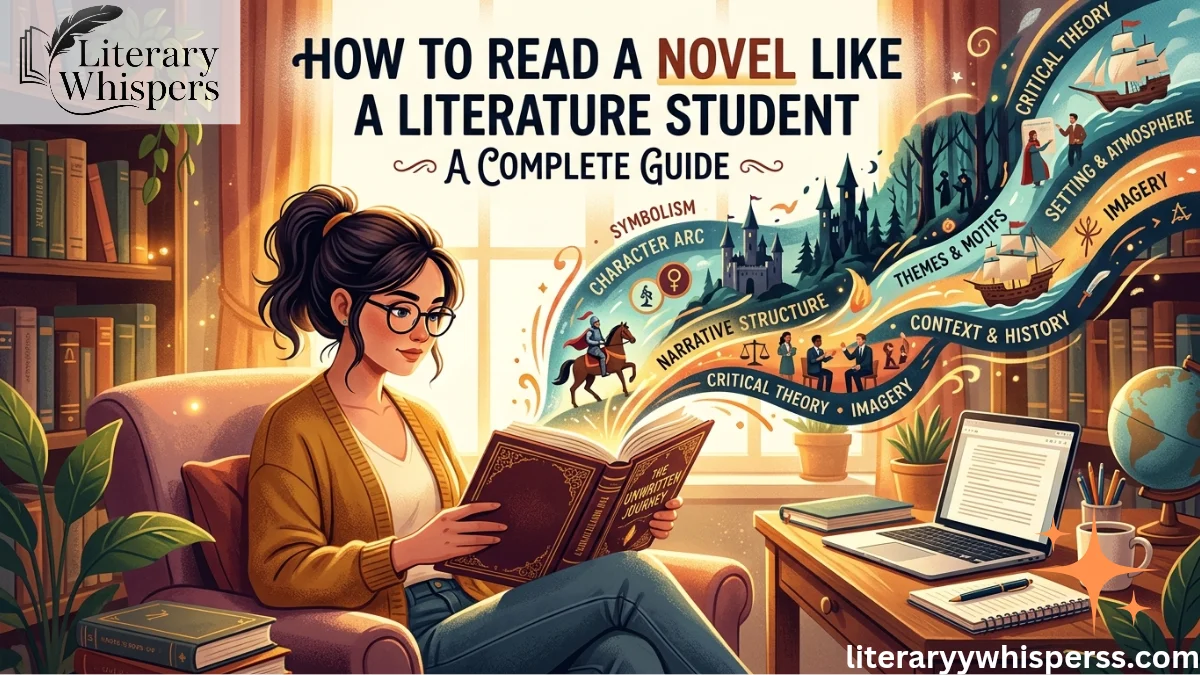
This post (How to Read a Novel Like Literature Student: A Complete Guide) is the complete guide to reading a novel like a literature student. Seven areas of attention, applied in sequence and in combination, that will change how you read everything.
Before You Begin: The Preparation That Changes Everything
The reading begins before the first word of the novel. Not because research replaces the experience of encountering a text fresh — it doesn’t, and it shouldn’t — but because a small amount of preparation makes the fresh encounter richer and more focused.
Know the context — briefly.
Five minutes with the edition’s introduction or with a reliable online source: when was this novel written? By whom, in what circumstances? What literary period does it belong to, and what were that period’s dominant concerns?
This is not about having all the answers before you read. It is about having the frame. The reader who opens Jane Eyreknowing that it was written in 1847 by a woman publishing under a male pseudonym, in a period when the “Woman Question” was being actively debated, reads the novel’s famous declarations of female independence with a different quality of attention than the reader who knows none of this.
Context is the frame. The text is the picture. Knowing the frame doesn’t determine what the picture is — but it changes how you see it.
Know the form — generally.
What kind of novel is this? A Gothic novel has different conventions and expectations than a Bildungsroman, which has different conventions than a novel of manners. Knowing the genre gives you expectations — and the interesting analytical work often happens when the novel confirms, subverts, or complicates those expectations.
Is it narrated in first person or third? Is the narrator named? Is the narrative present-tense or past-tense? These formal features, noticed before you begin, prime your attention for the choices the novel will make.
The before-reading note.
Write three things in your reading journal before you begin — following the method we described in [How to Build a Personal Reading Journal]:
What do you expect from this novel? What two questions will you carry into the reading? What do you already know, and what do you not know?
This note is your baseline. When you finish the novel, you will compare what you expected to what you found. The gap between expectation and experience is often where the most interesting analytical observations live.
Deep Insight:
The literary theorist Wolfgang Iser developed what he called “reader-response theory” — the idea that a text’s meaning is not contained entirely within the text itself, but is produced in the act of reading, in the encounter between the text’s structures and the reader’s responses. What you bring to a novel — your prior reading, your cultural knowledge, your current emotional state — is part of what the novel means when you read it. Your preparation is not neutral context. It is part of the reading.
Area 1: The Narrative Voice — Who Is Telling This Story?
The first question a literature student asks of any novel is not “what happens?” but “who is telling me what happens, and why does it matter?”
The narrative voice is the single most consequential formal choice in a novel. Every other element — what we know about characters, how much we trust the information we receive, what the novel’s emotional temperature is, what perspectives are available to the reader — flows from the choice of narrator.
The basic categories:
First-person narrator: The narrator is a character within the story, speaking as “I.” They have limited access to the truth — they can only know what they have witnessed, experienced, or been told. They have their own perspective, their own biases, their own blind spots.
Third-person omniscient narrator: The narrator exists outside the story and knows everything — the thoughts of all characters, past and future events, things happening simultaneously in different locations. This narrator has the authority of a god. But gods, in fiction, are also choices — and the choice to know everything is itself significant.
Third-person limited narrator: The narrator stands outside the story but is closely aligned with one character — we access the thoughts and perceptions of that character, but not others. This creates a partial perspective that is more intimate than omniscience and more distant than first-person.
Second-person narrator: Rare and notable when it appears. The narrator addresses the reader as “you” — placing you inside the story. Jay McInerney’s Bright Lights, Big City, Mohsin Hamid’s How to Get Filthy Rich in Rising Asia. The second person creates a specific complicity between narrator and reader.
The unreliable narrator:
The unreliable narrator — one whose account of events cannot be fully trusted — is one of the most powerful and most discussed devices in novelistic fiction.
Stevens in The Remains of the Day (Ishiguro) tells us about his life with great confidence and increasing evidence that his confidence is misplaced. Holden Caulfield in The Catcher in the Rye (Salinger) filters everything through a consciousness that is grieving, adolescent, and deeply subjective. Nick Carraway in The Great Gatsby (Fitzgerald) presents himself as a neutral observer while showing us, through the details he chooses to notice and what he chooses to omit, that he is anything but.
The key to reading an unreliable narrator: attend to the gap between what the narrator claims and what the text shows. The unreliable narrator is always telling you two stories simultaneously — the story they want you to believe and the story the text is actually telling. Finding that gap is some of the most exciting close reading available.
Questions to ask about the narrative voice:
Who is speaking? What is their relationship to the events they describe?
What can this narrator know? What can they not know? What might they be choosing not to tell?
Is the narration temporally separated from the events? Is the narrator looking back? How does that retrospective distance shape what is told and how?
Where does the narrator seem to be telling the truth, and where does their account seem strained, incomplete, or self-serving?
How does the narrator’s voice affect the novel’s emotional register — its tone, its intimacy, its irony?
Area 2: Character — How Are People Made on the Page?
Novels are, among other things, machines for the creation of people who don’t exist but feel as though they do.
The literature student asks not just who the characters are but how they are made. What techniques does the novelist use to produce the effect of a full human being? What is selected, and what is excluded?
The techniques of characterisation:
Direct statement: The narrator tells us directly what a character is like. “Dorothea Brooke had that kind of beauty which seems to be thrown into relief by poor dress.” (George Eliot, Middlemarch). This is the novelist asserting authority — claiming to know the character and telling us.
Dialogue: What a character says, and how they say it, reveals character more powerfully than almost any other technique. The rhythms of speech, the vocabulary chosen, the things left unsaid — these are the fingerprint of a fictional self.
Action: What a character does — especially under pressure, when choice is most costly — is the most reliable index of who they are. Characters reveal themselves most fully in moments of decision.
The thoughts of others: How other characters perceive and describe the character in question. These perceptions are themselves characterised — coloured by the perceiver’s own interests and limitations — but they create a sense of a character existing in a social world, being seen from multiple angles.
Free indirect discourse: The most sophisticated and most modern characterisation technique — where the narrator’s voice and the character’s voice merge, so that we are simultaneously inside the character’s consciousness and at a narrative distance from it.
Jane Austen invented modern free indirect discourse. When she writes, in Emma: “Emma Woodhouse, handsome, clever, and rich, with a comfortable home and happy disposition, seemed to unite some of the best blessings of existence” — the word “seemed” is doing extraordinary work. Is this the narrator’s assessment or Emma’s own self-image? The ambiguity is the point. We are simultaneously in Emma’s consciousness and being ironically distanced from it.
Questions to ask about character:
How is this character revealed? Through which of the techniques above?
What is the character’s central desire? What prevents them from achieving it?
What does the character know about themselves? What don’t they know?
What is their function in the novel’s larger argument? Are they a protagonist, an antagonist, a foil, a mirror?
Does the character change over the course of the novel? If so, what changes them? If not, why not — and what does their stasis mean?
Area 3: Plot and Structure — How Is the Novel Built?
Plot is what happens. Structure is how what happens is arranged.
This distinction is essential and frequently missed. A novel’s story — the chronological sequence of events — is not the same as its plot. The plot is the sequence of events as the novel presents them. These may be the same, or they may be radically different.
Non-linear structure:
Many of the most important novels of the 20th and 21st centuries are structured non-linearly — beginning in medias res (in the middle of action), using flashbacks (analepsis) and flash-forwards (prolepsis), telling the same events from multiple temporal perspectives.
Rebecca (du Maurier) opens after the main events have occurred and circles back. The God of Small Things (Roy) begins with its ending and spirals toward the catastrophe from both directions. Slaughterhouse-Five (Vonnegut) jumps through time with a character who is “unstuck in time.”
Why does structure matter analytically? Because the order in which a reader receives information is a moral and aesthetic choice. The narrative that reveals the ending first and then asks “how did we get here?” creates a completely different reading experience — and makes a completely different argument about cause and consequence — than the narrative that withholds the ending until the final page.
The five-act structure and its variations:
Traditional dramatic structure — exposition, rising action, climax, falling action, resolution — appears in many novels, often modified. Understanding where a novel departs from this structure is as important as understanding where it follows it.
Chapters and their functions:
Why does a chapter end where it ends? The chapter break is a choice — a decision about what to withhold, what to delay, where to create the next pause in the reading experience. Dickens, who published serially, was a master of the chapter break as cliffhanger. Woolf barely uses chapter divisions at all — because her structure is not episodic but continuous, like consciousness.
Questions to ask about plot and structure:
Is the plot chronological or non-linear? Why might the novel be structured this way?
Where does the novel begin? Why here and not earlier or later?
What is withheld from the reader, and when is it revealed? How does the timing of revelation create meaning?
Where is the climax — the moment of highest tension? How does the novel’s emotional structure lead up to and away from it?
How do the chapter divisions work? Where do chapters end, and what is the effect of those endings?
Area 4: Setting and World — Where and When Does This Novel Take Place?
Setting is not background. In a literary novel, the setting is an active participant in the novel’s meaning — it shapes the characters who live in it, reflects their emotional states, embodies the novel’s themes.
The symbolic landscape:
In the greatest novels, place is never merely geography. Wuthering Heights (the house) in Emily Brontë’s novel is not just where the characters live — it is a manifestation of Heathcliff and Catherine’s passion: wild, ungovernable, terrifying, impossible to domesticate. Thornfield Hall in Jane Eyre is not just a house — it is the Gothic mystery, with its locked rooms and hidden floors, that embodies the novel’s central secret.
When a novelist returns repeatedly to a specific location — a room, a garden, a view — the repetition is not accidental. It is accumulation. The location is becoming symbolic.
Historical and social setting:
When is this novel set? What social structures, economic conditions, political realities shape the characters’ choices? Characters in novels are not free agents existing in an abstract space — they exist in specific historical conditions that constrain what they can do, whom they can marry, what ambitions are available to them.
Understanding the historical setting of a novel is not background knowledge that is separate from literary analysis. It is part of the analysis. The marriage plot of Austen’s novels is not just a romantic formula — it is an exact representation of the economic and social reality of women in early 19th century England. The women must marry because they have no other viable option for economic survival. The love story is also a story about the conditions that make love a financial necessity.
Questions to ask about setting:
What is the specific physical setting? What details does the novelist emphasise?
Does the setting change over the course of the novel? What does that change reflect about the characters or the plot?
What is the historical period, and what social constraints does it impose on the characters?
Are there recurring settings that seem to carry symbolic weight? What do they represent?
How does the weather, the season, the quality of light contribute to the novel’s emotional atmosphere? Is the natural world used to mirror or contrast with the human action?
Area 5: Language and Style — How Does This Novel Sound?
The literature student never asks merely what a novel says. They ask how it says it — because how is part of what.
Diction:
The specific vocabulary a novelist uses creates a register — formal or informal, elevated or colloquial, technical or poetic. Hemingway’s diction is characteristically simple: short words, Anglo-Saxon roots, the language of direct physical experience. Henry James’s diction is characteristically complex: long words, Latinate roots, the language of refined psychological perception. These are not merely stylistic preferences — they are arguments about how reality should be approached and rendered.
Sentence structure:
Long, complex, accumulative sentences create one effect; short, fragmented sentences create another.
Woolf’s sentences in Mrs Dalloway flow continuously, accumulating perception and memory in ways that mirror the stream of consciousness they describe. McCarthy’s sentences in The Road are often fragments — no quotation marks around dialogue, minimal punctuation, prose stripped to its bones — because the world the novel describes has been stripped to its bones.
Metaphor and imagery:
When a novelist reaches for a metaphor, the choice of the comparison — what two things are being linked and what qualities of one illuminate the other — is always significant. Track the metaphors in a novel. Are they drawn from a consistent domain? Natural imagery, mechanical imagery, economic imagery? The pattern of metaphor is often the pattern of the novel’s deepest concerns.
Rhythm:
Prose has rhythm — the pattern of stressed and unstressed syllables, the length of sentences, the placement of pauses. Reading prose aloud reveals its rhythm in ways that silent reading misses. Some novelists — Woolf, McCarthy, Nabokov — have prose rhythms so distinctive that a paragraph could be identified as theirs from rhythm alone.
The signature style:
Every significant novelist has a style that is recognisable across their work — a combination of diction, syntax, rhythm, and imagery that is distinctively theirs. Learning to recognise and describe a novelist’s style is a fundamental skill of literary analysis.
Questions to ask about language and style:
What is the characteristic diction of this novel? Formal or informal? Simple or complex?
What is the characteristic sentence structure? What effect does it produce?
What imagery dominates? What domain do the dominant metaphors come from?
Are there specific recurring words or phrases? What work do they do?
Read a paragraph aloud. What is its rhythm? What does that rhythm contribute?
Area 6: Theme — What Is This Novel About at Its Deepest Level?
This is the question that most readers ask first and most literature students ask last. Not because theme is unimportant — it is the most important — but because you cannot accurately identify a novel’s themes without first understanding its narrative structure, characters, setting, and style. The themes emerge from the analysis of these elements. They are not announced at the beginning.
The distinction between subject and theme:
The subject of a novel is what it is about at the surface level. The theme is what it is saying about that subject.
The subject of Great Expectations is a young man’s journey from poverty to wealth and back again. The theme is the moral bankruptcy of the aspiration to gentility in a society that makes wealth the measure of human worth — and the possibility of a more authentic life that survives the disillusionment.
The subject of To Kill a Mockingbird is a rape trial in Alabama in the 1930s. The themes include racial injustice, moral courage, the education of conscience, and the relationship between innocence and experience.
Notice: subjects are specific, historical, plot-level. Themes are general, moral, philosophical. The transition from one to the other is the central move of literary interpretation.
How themes develop:
Themes in novels are developed through accumulation — through the repetition and variation of images, motifs, situations, and choices that gradually build a pattern of meaning.
A motif is a recurring element — an image, a phrase, a situation — that develops meaning through repetition. The colour green in The Great Gatsby: the green light, Daisy’s description, money, the grass. Each appearance of green adds to the motif’s meaning. By the end of the novel, green carries the full weight of Gatsby’s dream — its beauty, its distance, its ultimate impossibility.
Questions to ask about theme:
What is the novel’s subject? What is its theme?
What patterns of repetition — images, motifs, situations — develop the theme?
What does the novel seem to argue about its central concerns? Does the ending endorse or complicate that argument?
What is the relationship between the novel’s form and its themes? Does the way it is narrated, structured, or styled reflect what it is saying?
Area 7: The Wider Conversation — How Does This Novel Speak to Other Texts?
No novel exists in isolation. Every novel is in conversation with other novels — with the tradition it inherits, the conventions it follows or subverts, the texts it explicitly or implicitly responds to.
This is what the literary theorist Julia Kristeva called “intertextuality” — the way every text is woven from other texts. Understanding the intertextual relationships of a novel is part of reading it as a literature student.
The conversation with genre:
Every novel positions itself in relation to the genres it belongs to or departs from. Wuthering Heights uses and transforms the conventions of the Gothic novel. Pride and Prejudice uses and ironises the conventions of the courtship novel. Ulysses rewrites Homer’s Odyssey in the context of a single day in Dublin.
Understanding what genre conventions a novel is working with — and where it departs from them — gives you a precise language for describing what it achieves.
The conversation with other novels:
When a novelist echoes, alludes to, or explicitly responds to another text, the relationship is analytically significant. Jean Rhys’s Wide Sargasso Sea is an explicit response to Jane Eyre — it gives Bertha Mason, the silenced madwoman in Brontë’s attic, her own voice and her own story. Reading Wide Sargasso Sea alongside Jane Eyre changes what both novels mean.
The conversation with literary history:
Where does this novel sit in literary history? Is it Modernist, Victorian, Romantic, contemporary? What does it inherit from the tradition that precedes it? What does it reject or transform?
Questions to ask about the wider conversation:
What genre conventions does this novel belong to? Where does it follow them, and where does it depart?
What other texts does this novel echo, allude to, or explicitly respond to?
What is the literary period in which this novel was written? What are that period’s concerns, and how does this novel engage with them?
What traditions of literary criticism has this novel generated? What are the main debates about its meaning?
Putting It All Together: Reading Pride and Prejudice as a Literature Student
Let us apply all seven areas to a single novel — quickly, to show how they interact.
Pride and Prejudice (Jane Austen, 1813)
Narrative Voice: Third-person narration closely aligned with Elizabeth Bennet, using Austen’s signature free indirect discourse. The opening line — “It is a truth universally acknowledged, that a single man in possession of a good fortune, must be in want of a wife” — is ironic: the “truth” is not universal but specific to the mercenary social world the novel satirises. The narrator and Elizabeth share a perspective — but the novel also gently ironises Elizabeth, showing us the moments when her intelligence fails her.
Character: Elizabeth is a dynamic character whose central flaw is her tendency to form quick judgments and maintain them. Darcy is a dynamic character whose central flaw is pride. Their development — Elizabeth’s acknowledgement that she has misjudged Darcy, Darcy’s transformation under Elizabeth’s criticism — is the novel’s emotional arc. Their final union is not merely romantic but moral: they have become, through the relationship, better versions of themselves.
Plot and Structure: Largely chronological, though the narrative accelerates and slows with the movement of the plot. The novel is structured around Darcy’s two proposals — the first refused, the second accepted — with the middle section devoted to Elizabeth’s education in the gap between her judgment and the truth.
Setting: Rural England — Hertfordshire, Netherfield, Rosings, Pemberley, Brighton, London. Each location has social significance: Netherfield represents the arrival of wealth into Elizabeth’s world; Rosings represents the apex of the social hierarchy Elizabeth is being asked to submit to; Pemberley represents genuine cultivation and taste, transforming Elizabeth’s view of Darcy.
Language and Style: Austen’s signature: elegantly balanced sentences, irony embedded in apparent praise, free indirect discourse that moves seamlessly between narrator’s voice and character’s consciousness. The famous opening is the most compressed example: the voice that claims universality while ironising it in the same sentence.
Theme: The novel argues against the mercenary calculation of marriage while fully acknowledging the economic reality that makes marriage necessary. It argues for the union of genuine affection and mutual respect as the only basis for a marriage worth having — while showing that this union is extremely difficult to achieve and requires both parties to overcome significant self-deception. The “pride” and “prejudice” of the title are both Elizabeth’s and Darcy’s.
The Wider Conversation: Pride and Prejudice is both a courtship novel and a satire of the courtship novel. It uses the genre’s conventions while consistently ironising them. It is in conversation with the eighteenth-century tradition of the novel of sensibility — Samuel Richardson’s Pamela and Clarissa — and represents a significant departure from that tradition in its emphasis on wit and social intelligence over feeling as the primary value.
The Reading Journal and the Novel
Reading a novel like a literature student requires a companion document — the reading journal we described in [How to Build a Personal Reading Journal].
As you read, record observations in each of the seven areas. Not systematically — not a checklist completed at the end of each chapter — but responsively. When something in the narrative voice surprises you, write it down. When a character’s action seems inconsistent with what you know of them, write down the inconsistency. When a setting returns for the third time, note it and begin to think about what the repetition means.
These notes become the raw material of your essays and examinations. More importantly, they become the permanent record of your encounter with this text — the evidence that you were there, that you paid attention, that the novel did something to your thinking.
A Complete Checklist: Reading a Novel Like a Literature Student
Print this or keep it beside you as you read.
Before reading: ☐ Know the historical and literary context briefly ☐ Identify the genre and its conventions ☐ Write your before-reading note
Narrative voice (throughout): ☐ Identify the type of narrator ☐ Assess reliability — where does the narrator seem strained or incomplete? ☐ Notice free indirect discourse when it appears ☐ Track what the narrator knows and what they cannot know
Character (as characters develop): ☐ Identify each major character’s central desire and obstacle ☐ Note the techniques of characterisation being used ☐ Track character development — or note its absence ☐ Identify the character’s function in the novel’s larger argument
Plot and structure (as the novel unfolds): ☐ Note where the novel begins and why ☐ Identify the main structural turns — the moments when the plot changes direction ☐ Track the timing of information revelation ☐ Notice chapter breaks — where they fall and what they withhold
Setting (throughout): ☐ Note the specific details of setting that the novelist emphasises ☐ Track recurring locations and consider their symbolic significance ☐ Connect setting to historical period and its social constraints ☐ Notice how weather, season, and natural detail contribute to atmosphere
Language and style (at the level of specific passages): ☐ Read significant passages aloud — attend to rhythm ☐ Note characteristic diction — simple or complex, formal or colloquial? ☐ Identify the dominant metaphor domain ☐ Mark recurring words, phrases, or images
Theme (developing throughout, articulated after finishing): ☐ Distinguish subject from theme ☐ Identify recurring motifs and their development ☐ Articulate the novel’s central argument in one to three sentences ☐ Consider how form relates to theme
The wider conversation (after reading): ☐ Identify genre conventions followed and departed from ☐ Note explicit or implicit allusions to other texts ☐ Place the novel in its literary-historical moment ☐ Research the major critical debates about this text
A Personal Reflection: The Chapter That Changed How I Read
The first time I noticed free indirect discourse — really noticed it, as a technique, as a choice — was reading Emma.
I had read the novel twice before. I liked it. I thought I understood it.
And then I was reading the scene in Chapter One where Emma reflects on her friendship with Miss Taylor, now married: “With all these surroundings of comfort and innocence, Emma Woodhouse, handsome, clever, and rich, with a comfortable home and happy disposition, seemed to unite some of the best blessings of existence; and had lived nearly twenty-one years in the world with very little to distress or vex her.”
I stopped at “seemed.” One word.
Was this the narrator’s assessment or Emma’s? Austen doesn’t tell you. The ambiguity is the point. The narrator who “seems” to agree with Emma’s self-assessment is simultaneously — through that single word — stepping back from it.
That moment — understanding what was happening in the gap between “seemed” and certainty — changed everything about how I read Austen. It changed how I read all third-person narration. I began noticing the slippage between narrator and character, the way the voice shifts, the way irony is embedded not in what is said but in the relationship between the saying and the context.
I had read the novel. I had not read the technique. After that moment, I did both simultaneously.
That is what reading like a literature student opens. Not just the story — the machinery of the story. And the machinery is as beautiful as what it produces.
Summary: The Seven Areas of Attention
| Area | Core Question | What It Reveals |
|---|---|---|
| Narrative Voice | Who is telling this story, and can they be trusted? | Epistemological and moral framing of the novel |
| Character | How are people made on the page? | The novel’s understanding of selfhood and development |
| Plot and Structure | How is the novel built? | The argument implicit in narrative arrangement |
| Setting and World | Where and when does this happen? | Historical, social, and symbolic dimensions |
| Language and Style | How does this novel sound? | The aesthetic philosophy embedded in form |
| Theme | What is this novel saying at its deepest level? | The moral and philosophical argument |
| The Wider Conversation | How does this speak to other texts? | The novel’s place in literary history and tradition |
A Warm Closing from Literary Whispers
You will never read a novel the same way after you have learned to read it analytically.
This is not a loss. This is not the sacrifice of innocence for knowledge, of pleasure for work. The analytical reader does not read less deeply than the purely experiential reader. They read more deeply — because they have access to a dimension of the novel that the purely experiential reading cannot reach.
The novel is still a story. The characters are still people you care about. The ending is still an experience. But underneath the story, the characters, the ending — there is a structure. A set of choices made by a specific human being who had specific things they needed to say and found, in this form, the best possible way to say them.
Reading like a literature student means reading the choices alongside the story. Hearing the machinery alongside the music.
And discovering that the machinery — understood fully, attended to carefully — is part of the music.
Open your next novel. Carry these seven questions with you.
Read everything.
Which area of attention is most new to you? Tell me in the comments — I’ll point you to the most useful resources on this site.
Share this post with every reader who wants to go deeper into books they love.
With love and ink, Literary Whispers.
Where literature feels like home.

