
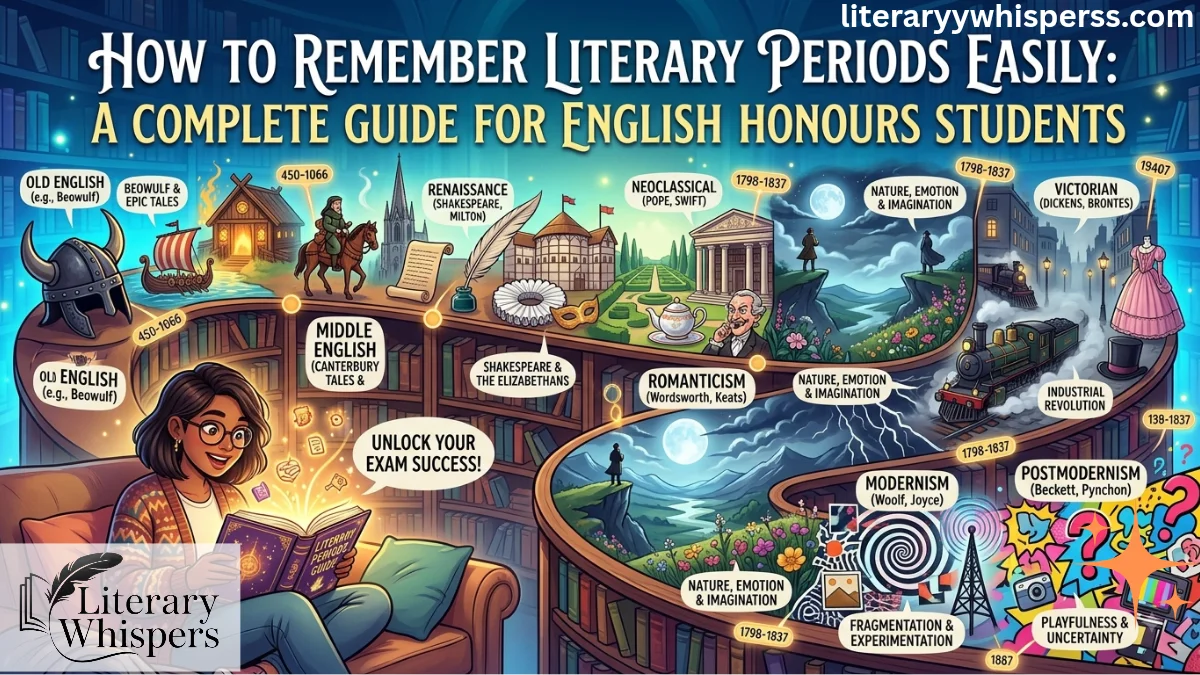
Every English Honours student faces the same wall.
Somewhere in the first semester, a list appears. The literary periods of English literature — Old English, Middle English, Renaissance, Restoration, Augustan, Romantic, Victorian, Modern, Postmodern, Contemporary — stretching across fourteen centuries, with dozens of authors attached to each, and a set of dates that seem to refuse to stay in your memory no matter how many times you write them down.
The wall is real. But the method most students use to get past it — staring at a timeline until the dates blur, or trying to memorise the periods in order through sheer repetition — is the least effective method available.
This post gives you a completely different approach.
Not dates-first. Not lists-first. Story-first.
Because the literary periods of English are not an arbitrary list. They are a story — a connected, logical, often dramatic narrative of a culture encountering new ideas, new historical forces, new ways of understanding the world, and finding new literary forms to express what those encounters produced.
When you understand the story, the periods make sense. They follow from each other with a kind of inevitability. The Romantics had to come after the Enlightenment, because the Enlightenment produced exactly the kind of excessive rationalism that the Romantics were reacting against. The Modernists had to come after the Victorians, because the Victorian certainties — about progress, about empire, about God — were shattered by the First World War into exactly the kind of fragmentation that Modernism embodies.
The story tells itself, once you know how to hear it.
This post (How to Remember Literary Periods Easily: A Complete Guide for English Honours Students) teaches you to hear it.
Before the Periods: The One Thing You Need to Understand
Literary periods are not natural phenomena. They are categories — created by scholars looking back at literary history and deciding that certain eras of writing share enough in common to be grouped together.
This means two things that are important to remember:
First: The dates of literary periods are approximate, not precise. Literature does not change on January 1st of a new century. The Romantic period does not begin on the precise date that a committee decided it should. Writers overlap, precursors appear early, late holdouts continue old styles into new eras. The dates are guideposts, not walls.
Second: Understanding why a period begins and ends is more important than memorising when. The period begins because something changed — a historical event, a new idea, a shift in what literature was for. The period ends because something else changed. The story of the change is what makes the dates memorable.
With that in mind: the story of English literary periods, from beginning to now.
Deep Insight:
The term “period” in literary studies comes from the Greek periodos — meaning a cycle or circuit. Literary periods were originally conceived as cycles — one style of writing giving way to another, which eventually gives way to the first’s renewal. The Romantic period, for example, revives concerns and forms (ballads, the sublime, oral tradition) that were present in Old English and Medieval literature and suppressed during the Augustan age. Understanding literary periods as cycles rather than a linear march through time makes the pattern more memorable and more accurate.
The Story of English Literary Periods
Period 1: Old English Literature (c. 450–1066 CE)
The mood: Dark, heroic, elegiac. Beauty and doom simultaneously.
The story:
Anglo-Saxon tribes from what is now Germany and Denmark arrive in Britain after the Roman withdrawal. They bring a Germanic language — Old English — and a warrior culture with its own set of values: loyalty to the lord, courage in battle, the acceptance of fate (wyrd).
They also encounter Christianity — and the collision between pagan warrior values and Christian faith produces one of the most fascinating tensions in early English literature.
The literature of this period is oral before it is written — poems composed to be performed, to be heard, not read. The poetry is alliterative (each line built on repeated consonant sounds rather than rhyme), formal, and saturated with a particular quality of sadness about the passing of time and the loss of what was good.
The defining text: Beowulf — the monster-fighting, mead-hall-defending, dragon-slaying epic that is simultaneously a celebration of warrior heroism and an elegy for a world passing away.
How to remember it: Think: Dark Ages, warrior poets, everything will be lost but we’ll sing about it anyway.
Key words: Wyrd (fate). Kenning (compound poetic description: “whale-road” for sea). Alliteration. Elegy. Mead-hall.
It ends when: The Norman Conquest of 1066 — William the Conqueror’s invasion completely transforms English language and culture, importing French vocabulary and court culture that make Old English effectively a foreign language within a generation.
Period 2: Middle English Literature (c. 1066–1485)
The mood: Colourful, varied, human. The emergence of personality in literature.
The story:
After the Norman Conquest, English is in a state of crisis — the aristocracy speaks French, the church writes in Latin, and the ordinary English language is developing underground, absorbing French vocabulary, changing its grammar, becoming something new.
Middle English — the language of Chaucer — is the result. It is recognisably English, though modern readers find it challenging. It is also the language of an extraordinarily diverse literary period: courtly romance, religious allegory, bawdy fabliaux, mystery plays, the rise of a reading public.
The key development: literature begins to be about people in a recognisable sense. Where Old English poetry is formal, impersonal, focused on the heroic type, Middle English literature begins to produce individuals — characters with distinctive voices, personalities, flaws, and humour.
The defining text: Chaucer’s Canterbury Tales — thirty pilgrims on a road to Canterbury, each telling stories, each fully individualised. The Wife of Bath, the Knight, the Miller, the Pardoner — these are not types but people, created with a specificity and a psychological depth that is completely new in English literature.
Also: Sir Gawain and the Green Knight (the most formally perfect poem of the period). William Langland’s Piers Plowman (religious allegory). Julian of Norwich’s Revelations (the first book in English known to have been written by a woman).
How to remember it: Think: After the French invasion, English finds itself — and discovers that people are interesting.
Key words: Middle English. Courtly love. Allegory. Fabliaux. Mystery plays. Pilgrimage.
It ends when: The invention of the printing press (1476, Caxton’s press in England) and the beginning of the Tudor dynasty after the Wars of the Roses. The Renaissance is beginning.
Period 3: The Renaissance / Early Modern Period (c. 1485–1660)
The mood: Ambitious, exploratory, contradictory. The world is expanding and so is the self.
The story:
Three forces converge to produce the most creatively explosive period in English literary history:
The Renaissance (meaning “rebirth”) — the rediscovery of classical Greek and Roman learning, which provides models of intellectual ambition and artistic achievement that English writers aspire to equal.
The Reformation — the break with the Catholic Church, producing decades of religious conflict and the extraordinary cultural event of the King James Bible (1611), which shapes English prose style for centuries.
The expansion of print — more books, more readers, more demand for literature in all forms.
The result: Shakespeare. Marlowe. Spenser. Sidney. Donne. Jonson. And Milton — writing at the very end of the period, producing Paradise Lost (1667) as a monument to what English literature had achieved.
The Renaissance is the period in which English literature decides it can compete with the classics. The ambition is enormous. The output is extraordinary.
The defining text: The complete works of Shakespeare — thirty-seven plays and 154 sonnets, written between approximately 1590 and 1613. Nothing before or since has equalled this concentration of literary achievement in a single career.
How to remember it: Think: The world gets bigger (exploration, printing, the Reformation) and literature gets more ambitious to match it. Shakespeare happens.
Key words: Humanism. Blank verse. Iambic pentameter. The sonnet. Metaphysical poetry. The English Bible. Theatre.
It ends when: The English Civil War and the Interregnum — the period when the monarchy is abolished and the Puritans close the theatres. When Charles II is restored in 1660, a new cultural moment begins.
Period 4: The Restoration and 18th Century (c. 1660–1785)
The mood: Elegant, rational, satirical. Wit as a weapon and a social performance.
The story:
Charles II returns from exile in France, and with him comes a court culture shaped by French sophistication — witty, cynical, pleasure-loving, concerned with social performance and the conventions of polite behaviour.
The literature of the Restoration (1660–1700) reflects this: Restoration comedy, with its witty couples negotiating marriage and desire; John Dryden’s heroic plays and satirical poems; the emergence of the essay as a literary form.
Then, in the early 18th century, something new: the Augustan Age — a deliberate identification with the classical period of Rome under Augustus, characterised by order, reason, formal perfection, and the use of literature to instruct and correct.
Pope perfects the heroic couplet. Swift invents modern satirical prose. Addison and Steele create the literary periodical. Johnson compiles the first great English dictionary and writes the most authoritative literary criticism of the century.
And — crucially — the novel is invented. Defoe, Richardson, Fielding: three different answers to the question of what a long prose narrative can do, establishing the foundations that every subsequent novelist builds on.
The defining texts: Pope’s The Rape of the Lock (mock epic as social satire). Swift’s Gulliver’s Travels (the most devastating satire in English prose). Richardson’s Clarissa (the first great psychological novel). Fielding’s Tom Jones (the great comic novel).
How to remember it: Think: After the chaos of civil war, England wants order and reason. Literature becomes elegant, satirical, and controlled — and the novel is born.
Key words: Augustan. Heroic couplet. Satire. Wit. The novel. Periodical essay. Dictionary.
It ends when: The French Revolution (1789) and the Industrial Revolution combine to produce a crisis of the values of order and reason — and the Romantic poets emerge as the response.
Period 5: The Romantic Period (c. 1785–1830)
The mood: Passionate, visionary, melancholy. The individual imagination against the world.
The story:
The Romantic period is a reaction — the most dramatic and coherent literary reaction in English history.
What it is reacting against: the Enlightenment’s privileging of reason over feeling, the Industrial Revolution’s dehumanisation of labour and destruction of nature, the social conventions that suppress the individual’s authentic self.
What it proposes instead: imagination as the highest human faculty. Nature as teacher and healer. The child’s direct, uncorrupted perception as a model for adult consciousness. The sublime — vast natural experiences that overwhelm ordinary categories of beauty and pleasure. The outsider, the rebel, the visionary as heroic figure.
The First Generation (Blake, Wordsworth, Coleridge) are older, more philosophically serious, more directly engaged with the political implications of the French Revolution.
The Second Generation (Byron, Shelley, Keats) are younger, more personally flamboyant, more concerned with beauty, mortality, and the cost of genius. All three died young — Byron at 36, Shelley at 29, Keats at 25.
The defining texts: Wordsworth’s The Prelude. Coleridge’s The Rime of the Ancient Mariner. Keats’s odes. Shelley’s Ode to the West Wind and Ozymandias. Blake’s Songs of Innocence and Experience.
And — essential to add — Jane Austen’s novels (written during this period though often studied separately): a cooler, more ironic counterpoint to Romantic excess, examining the same social world the Romantics were escaping from, without the escape.
How to remember it: Think: The world industrialises and the Romantics run to nature, imagination, and feeling. Everything is intense. Everyone dies young.
Key words: Imagination. Nature. The sublime. The Byronic hero. Lyric poetry. Negative Capability. Revolution.
It ends when: The Romantic generation dies or falls silent in the 1820s-30s, and Queen Victoria’s accession in 1837 begins a new cultural era.
Period 6: The Victorian Period (c. 1830–1901)
The mood: Complex, morally earnest, socially conscious. The novel becomes the dominant form.
The story:
Victoria reigns for sixty-three years — and the literature of her reign is as various and contradictory as the empire it describes.
The dominant values: moral seriousness, social responsibility, industrial progress, Christian faith — and the literature is increasingly in tension with all of these, examining them, questioning them, sometimes celebrating them and sometimes systematically dismantling them.
The great development: the Victorian novel. Dickens, George Eliot, the Brontës, Hardy, Gaskell, Trollope, Collins — a concentration of novel-writing talent that is arguably the richest period of prose fiction in any literary tradition.
These novels are socially engaged: they write about poverty, about class, about the position of women, about the hypocrisies of respectable society, about what the Industrial Revolution is doing to human beings. They are also formally sophisticated: the omniscient narrator, the multiple-plot structure, the use of setting as symbolic landscape.
The Victorian period also sees the crisis of faith — Darwin’s On the Origin of Species (1859) shaking the religious certainties that had been central to English culture. Tennyson’s In Memoriam (1850) is the great poetic response to this crisis: seventeen years of writing through grief and doubt toward a fragile renewal of faith.
The defining texts: Dickens’s Great Expectations and Bleak House. George Eliot’s Middlemarch. Charlotte Brontë’s Jane Eyre. Emily Brontë’s Wuthering Heights. Hardy’s Tess of the d’Urbervilles. Tennyson’s In Memoriam. Browning’s dramatic monologues. Wilde’s The Importance of Being Earnest.
How to remember it: Think: The empire is at its height, the novel is the form, and the confidence is cracking. Dickens exposes poverty, Eliot exposes consciousness, Hardy exposes fate, Darwin exposes doubt.
Key words: Realism. The social novel. Industrial Revolution. Empire. Evolution. Dramatic monologue. The Woman Question. Serialisation.
It ends when: Victoria dies in 1901, and the world that produced Victorian confidence is about to be destroyed by the First World War.
Period 7: The Modern Period (c. 1901–1945)
The mood: Fragmented, experimental, searching. The certainties are gone and the form has to change.
The story:
The First World War (1914–1918) is the defining event. Everything the Victorians believed in — progress, empire, the dignity of civilisation, the authority of tradition — is destroyed in the trenches of France and Belgium. Ten million dead. The world that produced Victorian confidence no longer exists.
Literature responds with formal experimentation: if the old forms expressed the old certainties, then the destruction of those certainties requires new forms.
Stream of consciousness — the attempt to represent the actual flow of human thought, unmediated by conventional narrative — is the signature technique of High Modernism. Woolf, Joyce, and later Faulkner use it to give unprecedented access to the inner life of characters.
T.S. Eliot’s The Waste Land (1922) is the defining poem — fragmented, allusive, speaking in multiple voices, collecting the ruins of Western culture and refusing to rebuild them into a coherent whole.
Yeats in Ireland, Lawrence in England, Conrad on the sea and in empire — each responding differently to the collapse of Victorian certainty, finding different formal solutions to the problem of representing a world that no longer has a stable centre.
The defining texts: Woolf’s Mrs Dalloway and To the Lighthouse. Joyce’s Ulysses and Dubliners. Eliot’s The Waste Landand Four Quartets. Yeats’s The Second Coming and Sailing to Byzantium. Conrad’s Heart of Darkness. Lawrence’s Sons and Lovers.
How to remember it: Think: The First World War breaks the Victorian world. Literature fragments to match. Stream of consciousness. Allusion. The centre cannot hold.
Key words: Modernism. Stream of consciousness. Fragmentation. The interior monologue. Free verse. The expatriate. The Lost Generation.
It ends when: The Second World War (1939–1945) ends, and the literary landscape shifts again — though the end of Modernism is gradual rather than sudden.
Period 8: Postmodernism and Contemporary Literature (c. 1945–present)
The mood: Self-aware, playful, politically engaged. The text knows it is a text.
The story:
After the devastation of the Second World War and the Holocaust — events so extreme that they seem to defy representation — literature develops two broad responses.
Postmodernism: Literature that is aware of itself as literature — that plays with narrative convention, that uses metafiction (fiction that reflects on its own fictional status), that questions whether meaning is possible or stable. Beckett’s Waiting for Godot — in which nothing happens, twice — is the founding text of postmodern drama. Nabokov’s Lolita, Pynchon’s Gravity’s Rainbow, Salman Rushdie’s Midnight’s Children: literature that draws attention to its own artifice, that refuses the Victorian realist convention that fiction is a transparent window onto reality.
Postcolonial literature: The literature that emerges from the dismantling of European empires — the voices of the colonised, finally heard on their own terms. Chinua Achebe’s Things Fall Apart (1958) rewrites the colonial narrative from inside the colonised perspective. Ngugi wa Thiong’o. Wole Soyinka. Derek Walcott. Arundhati Roy. Salman Rushdie. These writers transform what “English literature” means — expanding it from a British national tradition into a genuinely global literary practice.
Contemporary literature (c. 1980–present): Too recent and too various to summarise easily — but characterised by the increasing plurality of voices, the continued expansion of what counts as “English literature,” and the renewed engagement with questions of race, gender, class, and identity.
The defining texts: Beckett’s Waiting for Godot. Achebe’s Things Fall Apart. Rushdie’s Midnight’s Children. Morrison’s Beloved. Atwood’s The Handmaid’s Tale. Roy’s The God of Small Things. Ishiguro’s The Remains of the Day.
How to remember it: Think: After the Holocaust, literature questions whether it can represent reality. The colonised find their voice. English literature becomes world literature.
Key words: Postmodernism. Metafiction. Magic realism. Postcolonialism. The unreliable narrator. Intertextuality. Global English.
The Memory Techniques That Actually Work
Now that you have the story, here are the specific techniques for retaining the periods, their dates, and their key features under examination pressure.
Technique 1: The Character for Each Period
Give each period a single character — not a historical figure, but a type — that embodies its spirit.
Old English: The warrior-poet. Sitting in the mead-hall, singing about battles, knowing it will all end badly, singing anyway.
Middle English: The pilgrim. On the road. Meeting people from every walk of life. Telling stories.
Renaissance: The ambitious playwright. Standing in the Globe, writing the greatest plays in the language, knowing it. Slightly insufferable. Completely right.
Restoration/Augustan: The wit. Perfectly dressed, perfectly composed, making a remark so precise and so damning that everyone laughs — and everyone checks whether it’s about them.
Romantic: The young poet. Feverish. Beautiful. Writing about nature and death and beauty and dying of tuberculosis at twenty-five. Devastatingly right about everything.
Victorian: The moral novelist. Writing a thousand-page novel about poverty because something must be done. Moved to tears by their own characters. Serialising it in monthly instalments to maximum suspense.
Modern: The experimental writer. At a desk in Paris or London, convinced that the old forms are broken and the only honest response is to break the new ones too. Producing something unreadable on first encounter and essential on the third.
Postmodern/Contemporary: The self-aware narrator. Winking at the camera. Reminding you that this is a constructed text. Also: the colonised writer, finally speaking in their own voice.
These characters are not accurate as historical portraits. They are memory devices — vivid, slightly exaggerated, designed to make each period feel distinct and recognisable.
Technique 2: The Reaction Chain
Each period can be understood as a reaction to the previous one. Learning the chain of reactions makes the sequence logical rather than arbitrary.
Old English establishes the tradition → Middle English inherits and humanises it (the French add social sophistication) → Renaissance explodes it with classical ambition and individual genius → Restoration/Augustan reacts against Renaissance excess with reason and order → Romantic reacts against Augustan coldness with passion and imagination → Victorian inherits Romantic sensibility but applies it to social problems, requiring moral seriousness → Modernreacts against Victorian confidence with fragmentation after the First World War → Postmodern reacts against Modernism’s elitism with self-awareness and plurality
When you understand each period as a reaction — as a “yes, but—” or “no, because—” to what came before — the sequence becomes a conversation, and conversations are much more memorable than lists.
Technique 3: One Author, One Text, One Line Per Period
The most efficient memory anchor for each period: one author who defines it, one text that exemplifies it, one line that captures its spirit.
| Period | Author | Text | Line |
|---|---|---|---|
| Old English | Anonymous | Beowulf | “What! We have heard of the glory of the Spear-Danes’ kings” |
| Middle English | Chaucer | Canterbury Tales | “Whan that Aprill with his shoures soote” |
| Renaissance | Shakespeare | Hamlet | “To be, or not to be: that is the question” |
| Restoration/Augustan | Pope | The Rape of the Lock | “To err is human, to forgive, divine” |
| Romantic | Keats | Ode to a Nightingale | “Beauty is truth, truth beauty — that is all / Ye know on earth, and all ye need to know” |
| Victorian | George Eliot | Middlemarch | “The growing good of the world is partly dependent on unhistoric acts” |
| Modern | T.S. Eliot | The Waste Land | “April is the cruellest month” |
| Postmodern/Contemporary | Roy | The God of Small Things | “Things can change in a day” |
One author. One text. One line. Eight anchors in your memory, each attached to a period’s spirit.
Technique 4: The Three-Word Period Summary
For quick recall — particularly useful in examinations where you need to establish a period’s context in a sentence — develop a three-word summary for each period.
Old English: Dark, heroic, elegiac. Middle English: Varied, human, social. Renaissance: Ambitious, theatrical, explosive. Restoration/Augustan: Elegant, rational, satirical. Romantic: Passionate, natural, visionary. Victorian:Earnest, social, morally complex. Modern: Fragmented, experimental, interior. Postmodern/Contemporary: Self-aware, global, plural.
These three-word summaries are not definitions. They are memory triggers — the three qualities that distinguish this period from the others, available to you in the first paragraph of an essay when you need to establish context quickly.
Technique 5: The Historical Event Bridge
Every period change is associated with a historical event. Learning the event is more memorable than learning the year — because events have stories attached, and stories are more memorable than numbers.
Old English ends: The Norman Conquest (1066) — William the Conqueror defeats Harold at Hastings. French becomes the language of power. Old English survives underground.
Middle English ends: Caxton’s printing press (1476) + Tudor dynasty begins (1485). The world changes technologically and politically simultaneously.
Renaissance ends: Civil War and Interregnum (1642–1660) — the king is executed, the theatres close, the Puritans govern. When the theatres reopen in 1660, a new era begins.
Restoration/Augustan ends: The French Revolution (1789) + Industrial Revolution — the twin revolutions that make Enlightenment rationalism seem inadequate to the new world.
Romantic ends: The deaths of the major poets (Byron 1824, Blake 1827, Shelley 1822, Keats 1821) + Victoria’s accession (1837). The Romantic generation is gone.
Victorian ends: Victoria’s death (1901) + the Boer War revealing the moral cost of empire. The confidence is cracking.
Modern ends: The Second World War (1939–1945). The world that produced High Modernism is replaced by something more complicated and more global.
Historical events are stories. Stories are memorable. The dates that mark the end of a period are the endings of those stories.
Technique 6: The Visual Timeline
For students who learn visually, create a physical timeline on a long piece of paper or across the top of a whiteboard.
Mark the eight periods. Colour-code them — a different colour for each. Above the line: historical events that define the period transitions. Below the line: key authors and texts in their approximate positions.
The visual timeline does something that a list cannot: it gives you the proportions of the periods. Old English covers roughly 600 years. The Romantic period covers roughly 45 years. Seeing these proportions visually makes them more memorable than knowing the dates abstractly.
It also makes relationships between authors visible. Keats and Austen overlap chronologically. Chaucer and the Pearl Poet are contemporaries. T.S. Eliot and Virginia Woolf are writing at the same moment. These contemporaneities become interesting when you can see them on a timeline.
The Most Confused Pairs — And How to Distinguish Them
Certain periods are consistently confused. Here are the most common confusions and the most efficient distinctions.
Restoration vs Augustan:
These are often treated as one continuous period — and they overlap — but they have distinct characters.
Restoration (1660–1700): The court returns from France. The mood is cynical, pleasure-loving, relieved. Comedy of manners. Dryden. Congreve. The theatre reopens.
Augustan (1700–1785): More serious, more systematic, more explicitly classical. Pope. Swift. Johnson. The essay. The novel. Less cynicism, more satire with genuine moral purpose.
How to remember: Restoration = the party after the war. Augustan = the serious work after the party.
Romantic vs Victorian:
These feel very different but are sometimes confused by students who associate both with the 19th century.
Romantic (1785–1830): Individual consciousness. Nature. Emotion over reason. Poetry dominant. The imagination as supreme faculty. Rejection of social convention.
Victorian (1830–1901): Social responsibility. The novel dominant. Moral earnestness. Engagement with social problems. The individual in society, not against it.
How to remember: Romantics run away from society. Victorians run toward it (to fix it, or at least to describe it accurately).
Modern vs Postmodern:
The most frequently confused pair, particularly because they overlap in time and share some features.
Modern (1901–1945): Fragmented because the world has fragmented (the war). Still searching for meaning. Stream of consciousness. The interior life. Deeply serious about the loss of certainty.
Postmodern (1945–present): Aware that meaning is constructed and plays with that awareness. Metafiction. Magic realism. Irony about irony. Not mourning the loss of certainty so much as playing with its absence.
How to remember: Modernism grieves the loss of stable meaning. Postmodernism makes art from the absence of it.
How the Periods Connect to Your Examination
Understanding literary periods is not merely background knowledge. It is the frame that makes every examination answer more sophisticated.
When you are asked to analyse a passage from Hamlet, knowing that the Renaissance valued individual genius, philosophical complexity, and the capacity of language to hold contradiction makes your analysis richer. You are not just analysing a passage — you are identifying what this passage is doing that belongs specifically to this moment in literary history.
When you are asked to compare a Victorian novel and a Modernist one, understanding the reaction relationship — Modernism’s fragmentation as a response to Victorian confidence — gives you the structural principle for the comparison before you have written a word.
Every essay question is set in the context of a literary period. Every primary text you study belongs to a period. Every critical debate you engage with has a historical dimension. The literary periods are the architecture within which everything else is organised.
Learn them as a story. Use them as a context. Let them make everything else make sense.
A Complete Quick-Reference Summary
| Period | Dates | Mood | Key Form | Key Author | Ends Because |
|---|---|---|---|---|---|
| Old English | 450–1066 | Dark, heroic, elegiac | Alliterative verse, oral epic | Anonymous (Beowulf) | Norman Conquest |
| Middle English | 1066–1485 | Varied, human, social | Romance, fabliaux, allegory | Chaucer | Printing press + Tudor dynasty |
| Renaissance | 1485–1660 | Ambitious, theatrical | Drama, sonnet, epic | Shakespeare | Civil War + Interregnum |
| Restoration/Augustan | 1660–1785 | Elegant, rational, satirical | Heroic couplet, novel, essay | Pope, Swift, Johnson | French Revolution + Industrial Revolution |
| Romantic | 1785–1830 | Passionate, natural, visionary | Lyric ode, ballad, narrative poem | Keats, Wordsworth, Blake | Romantic generation dies; Victorian era begins |
| Victorian | 1830–1901 | Earnest, social, complex | The realist novel | Dickens, Eliot, the Brontës | Victoria dies; WWI approaching |
| Modern | 1901–1945 | Fragmented, experimental | Stream of consciousness, free verse | Woolf, Eliot, Joyce | Second World War |
| Postmodern/Contemporary | 1945–present | Self-aware, global, plural | Metafiction, magic realism | Achebe, Rushdie, Morrison, Roy | Ongoing |
A Personal Reflection: The Period That Changed Everything
For a long time, I thought of the Victorian period as the safe one — the comfortable one, the period where the novels were reassuring and the world made sense and literature had its proper social function.
Then I read Thomas Hardy’s Tess of the d’Urbervilles.
Hardy is Victorian. He is writing at the very end of the period, and he is writing about a woman destroyed — destroyed by the same forces the Victorian moral consensus was supposedly designed to protect against. The novel’s subtitle — “A Pure Woman” — is a deliberate challenge to everything Victorian respectability claimed to believe.
Understanding that Hardy is writing at the end of a period — that he is one of the writers who is dismantling the confidence of the era rather than celebrating it — changes how you read him. The period context isn’t background. It’s part of the meaning.
That realisation changed how I read all literary history. The period is not the context for the text. The text is partly an argument about the period — about its values, its contradictions, its limitations.
Learn the periods. Then use them not as boxes to sort texts into but as arguments the texts are participating in.
That is what literary history is for.
A Warm Closing from Literary Whispers
The literary periods of English are fourteen centuries of human beings finding new forms for what they needed to say.
Old English poets finding beauty in darkness. Chaucer finding comedy in humanity. Shakespeare finding everything in language. Pope finding precision in the couplet. Wordsworth finding truth in nature. Dickens finding injustice in the city. Woolf finding consciousness in prose. Roy finding history in the lives of the small.
Each period is a chapter in a story. Each transition is a moment when the world changed and literature changed with it. And each text you study is a specific human response to a specific historical moment — carrying within it the questions, the forms, the anxieties, and the ambitions of its time.
When you understand the story, the dates follow. When you understand why each period began and ended, the sequence makes sense. When you know what each period was reacting against and reaching toward, the individual texts you study take their place in a larger conversation that makes them richer, more interesting, and more fully comprehensible.
Learn the story. The dates will take care of themselves.
Which literary period do you find most confusing? Tell me in the comments — I’ll point you to exactly what will help.
Share this post with every English Honours student struggling with their timeline — this is the guide they needed.
✦ Everything at Literary Whispers deepens your understanding of these periods:
- [Semester-Wise Book List for English Honours Students] — every period’s key texts explained
- [Difference Between British, American, and World Literature] — where each period sits globally
- [100 Most Important Literary Terms Every English Honours Student Must Know] — the vocabulary of each period
- [How to Read a Novel Like a Literature Student] — apply this period knowledge to specific texts
- [How to Analyze a Poem Step by Step] — poetry across all periods
- [How to Study for English Literature Without Memorising Everything] — the understanding approach
- [Can You Score 80%+ in English Honours?] — how period knowledge feeds examination performance
- [How to Write Better Literature Answers in University Exams] — contextualising your arguments
- [Books That Were Once Banned but Are Classics Today] — banned books across periods
- [English Honours 1st Year Students’ Complete Survival Guide (2026)] — your complete orientation
- [How to Read Shakespeare Without Feeling Lost] — the Renaissance period in depth
- [Dark Academia Starter Pack: Books Every Introvert Should Read] — reading across multiple periods
With love and ink, Literary Whispers.
Where literature feels like home.

